AQA · A-Level · History
Course version: 7042 · Version from Sept 2017
The preaching of the Second Crusade; its course and outcome
Full specification wording
1A The Age of the Crusades, c1071–1204 – The foundation of new states and the Second Crusade, c1099–1149: The preaching of the Second Crusade; its course and outcome
Triggered by the fall of Edessa in 1144, the Second Crusade was formally launched by Pope Eugenius III's bull Quantum praedecessores.
Checked against the AQA 7042 specification (opens in a new tab) on .
- Point 5 of 6
- 4 key terms
Study notes
From the checked teaching notes for this specification point.
The idea
Triggered by the fall of Edessa in 1144, the Second Crusade was formally launched by Pope Eugenius III's bull Quantum praedecessores. Bernard of Clairvaux’s charismatic preaching galvanised mass participation, recruiting King Louis VII at Vézelay in 1146 and King Conrad III later at Speyer. The crusade's course was disastrous; both armies suffered heavy losses traversing Anatolia due to Seljuk attacks and logistical failures. Reaching the Levant, the leaders held the Council of Acre in 1148 and disastrously decided to attack Damascus, a former ally. The siege failed within days due to poor positioning and lack of water. The outcome was a humiliating retreat, damaging the prestige of the crusading movement and leaving Outremer highly vulnerable.
What earns the marks
- Assess the role of Bernard of Clairvaux and the papal bull Quantum praedecessores in mobilising European monarchs and popular support.
- Evaluate the logistical and military failures of the French and German armies during their march across Asia Minor.
- Analyse the strategic decision-making at the Council of Acre and the subsequent failed siege of Damascus in 1148.
- Explain the immediate outcomes of the crusade, including the collapse of the expedition and the return of the monarchs in disgrace.
Common mistakes and how to put them right
Claiming the crusade was launched to recapture Jerusalem.
Put it right: It was actually triggered by Zengi's capture of Edessa in 1144.
Confusing the routes of the French and German armies.
Put it right: Conrad III marched ahead and was defeated at Dorylaeum before Louis VII arrived.
Stating that Damascus was a hostile Muslim stronghold prior to the crusade.
Put it right: It was actually allied with Jerusalem against Nur ad-Din before the crusaders attacked it.
Assuming Bernard of Clairvaux recruited both kings at Vézelay.
Put it right: Conrad III actually took the cross later at Speyer.
Exam tips
- Link the failure of the crusade directly to the divided leadership and poor strategic choices, such as the attack on Damascus.
- Use Bernard of Clairvaux as a primary example of how crusading ideology was communicated and popularised in the Latin West.
- Contrast the high expectations set by the involvement of European monarchs with the reality of their military defeats in Anatolia.
Try the lesson
The start of the 1A The Age of the Crusades, c1071–1204 – The foundation of new states and the Second Crusade, c1099–1149: The preaching of the Second Crusade; its course and outcome lesson, made from checked teaching notes for this specification point.
Have a go first
Which prominent Cistercian abbot was primarily responsible for preaching the Second Crusade across France and Germany in 1146?
Listen
Triggered by the fall of Edessa in 1144, the Second Crusade was formally launched by Pope Eugenius III's bull Quantum praedecessores. Bernard of Clairvaux’s charismatic preaching galvanised mass participation, recruiting King Louis VII at Vézelay in 1146 and King Conrad III later at Speyer. The crusade's course was disastrous; both armies suffered heavy losses traversing Anatolia due to Seljuk attacks and logistical failures. Reaching the Levant, the leaders held the Council of Acre in 1148 and disastrously decided to attack Damascus, a former ally. The siege failed within days due to poor positioning and lack of water. The outcome was a humiliating retreat, damaging the prestige of the crusading movement and leaving Outremer highly vulnerable. A strong answer earns marks for these points. Assess the role of Bernard of Clairvaux and the papal bull Quantum praedecessores in mobilising European monarchs and popular support. Evaluate the logistical and military failures of the French and German armies during their march across Asia Minor. Analyse the strategic decision-making at the Council of Acre and the subsequent failed siege of Damascus in 1148. Explain the immediate outcomes of the crusade, including the collapse of the expedition and the return of the monarchs in disgrace. Exam tip: Link the failure of the crusade directly to the divided leadership and poor strategic choices, such as the attack on Damascus.
See it
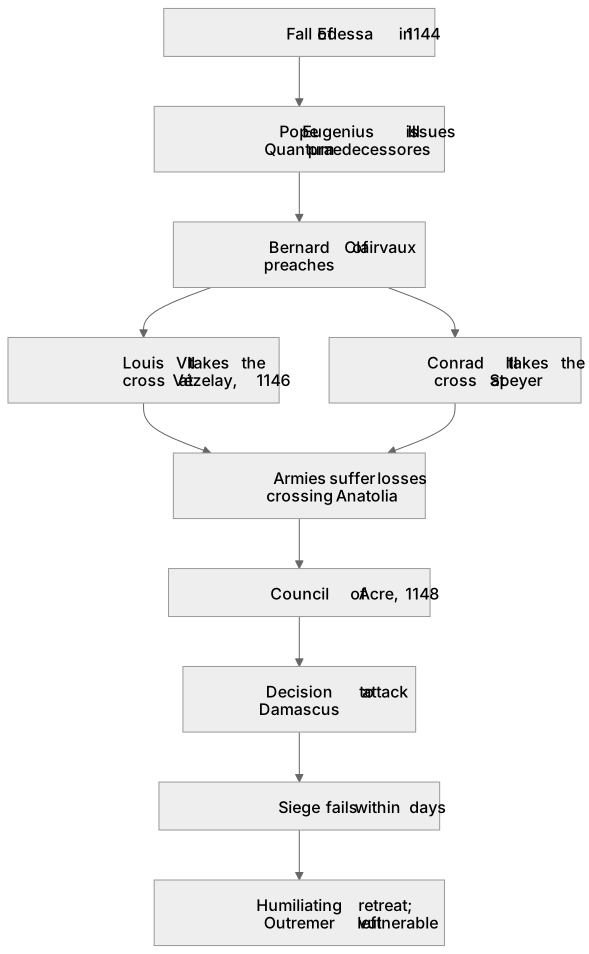
Put the events in order
Put these events in the order they happened, earliest first.
- 1. Fall of Edessa triggers the Second Crusade
- 2. Council of Acre decides to attack Damascus
- 3. Bernard of Clairvaux recruits King Louis VII at Vézelay
Key words
Say what each word means before you turn the card.
Quantum praedecessores
Try answering aloud or in your head before turning the card.
Bernard of Clairvaux
Try answering aloud or in your head before turning the card.
Council of Acre
Try answering aloud or in your head before turning the card.
Siege of Damascus
Try answering aloud or in your head before turning the card.
See every definition
- Quantum praedecessores
- The bull by which Pope Eugenius III formally launched the Second Crusade.
- Bernard of Clairvaux
- Preacher whose charismatic preaching galvanised mass participation, recruiting King Louis VII at Vézelay and King Conrad III later at Speyer.
- Council of Acre
- Meeting held by the leaders in the Levant in 1148 where they disastrously decided to attack Damascus, a former ally.
- Siege of Damascus
- Attack that failed within days due to poor positioning and lack of water, leading to a humiliating retreat.
Label the diagram
Some boxes have lost their names. Pick the right name for each number.
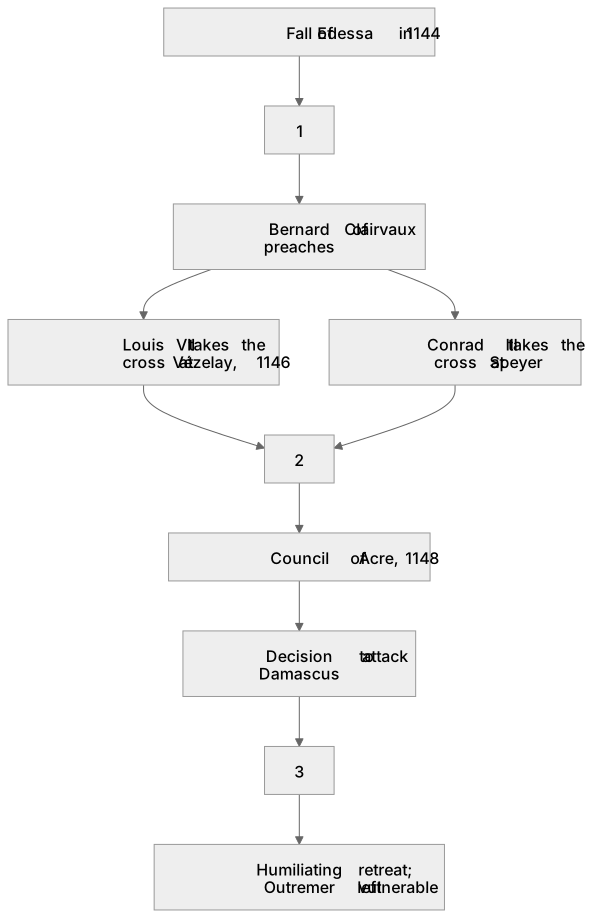
1Box 1
2Box 2
3Box 3
There is more to this lesson
The full lesson goes on to check your understanding and help you earn the marks. Create a free account to carry on, with your progress saved.
A week of Premium from your first lesson · Then the free plan continues · No card, no charge
Test your understanding of 1A The Age of the Crusades, c1071–1204 – The foundation of new states and the Second Crusade, c1099–1149: The preaching of the Second Crusade; its course and outcome
Active recall beats re-reading. Take an instant quiz now to test what you’ve learned and lock it into long-term memory.
A week of Premium from your first lesson · Then the free plan continues · No card, no charge