AQA · A-Level · History
Course version: 7042 · Version from Sept 2017
Relations between Outremer and wider Christendom, the Latin West and the…
Full specification wording
1A The Age of the Crusades, c1071–1204 – The Muslim Counter-Crusade and Crusader states, 1149–1187 (A-level only): Relations between Outremer and wider Christendom, the Latin West and the Byzantine Empire
Between 1149 and 1187, Outremer’s survival increasingly depended on external support, yet relations with wider Christendom were often strained.
Checked against the AQA 7042 specification (opens in a new tab) on .
- Point 3 of 6
Study notes
From the checked teaching notes for this specification point.
The idea
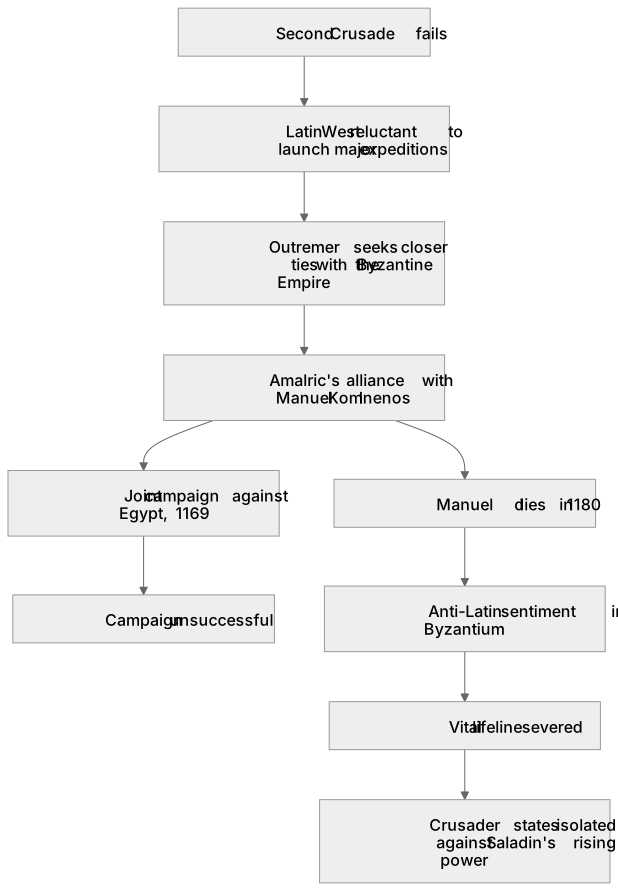
Between 1149 and 1187, Outremer’s survival increasingly depended on external support, yet relations with wider Christendom were often strained. Following the Second Crusade's failure, the Latin West grew reluctant to launch major expeditions, despite frequent embassies from Jerusalem pleading for financial and military aid from monarchs like Henry II of England and Louis VII of France. Consequently, Outremer sought closer ties with the Byzantine Empire. King Amalric forged a crucial alliance with Emperor Manuel I Komnenos, culminating in a joint, albeit unsuccessful, campaign against Egypt in 1169. However, Manuel's death in 1180 and subsequent anti-Latin sentiment in Byzantium severed this vital lifeline, leaving the Crusader states isolated against Saladin's rising power.
What earns the marks
- Assess the impact of the Second Crusade's failure on the Latin West's willingness to provide military support to Outremer.
- Evaluate the diplomatic efforts of Outremer, such as the 1184 embassy led by Patriarch Heraclius to secure aid from European monarchs.
- Analyse the strategic alliance between King Amalric of Jerusalem and Byzantine Emperor Manuel I Komnenos, including their joint Egyptian campaign.
- Explain how the death of Manuel I in 1180 and the subsequent decline of Byzantine power left Outremer strategically isolated.
Common mistakes and how to put them right
Assuming the Latin West provided continuous military support.
Put it right: In reality, major crusading efforts stalled between 1149 and 1187 due to European political conflicts.
Confusing the Byzantine Empire's stance; students often claim Byzantium was always hostile, ignoring the strong alliance and financial support during Manuel I's reign.
Treating 'wider Christendom' as a unified entity.
Put it right by distinguishing between the Papacy's spiritual appeals and the pragmatic, often reluctant, responses of secular Western monarchs.
Exam tips
- Use the 1169 joint campaign against Egypt as a concrete example of Byzantine-Outremer cooperation.
- Contrast the diplomatic successes of Amalric with the isolation faced by his successors to demonstrate change over time.
- When evaluating Outremer's vulnerability, explicitly link the lack of Western reinforcements to the growing unified threat posed by Nur ad-Din and Saladin.
Try the lesson
The start of the 1A The Age of the Crusades, c1071–1204 – The Muslim Counter-Crusade and Crusader states, 1149–1187 (A-level only): Relations between Outremer and wider Christendom, the Latin West and the Byzantine Empire lesson, made from checked teaching notes for this specification point.
Have a go first
How did the Byzantine Empire primarily attempt to assert its influence over the Crusader Principality of Antioch in the twelfth century?
Listen
Between 1149 and 1187, Outremer’s survival increasingly depended on external support, yet relations with wider Christendom were often strained. Following the Second Crusade's failure, the Latin West grew reluctant to launch major expeditions, despite frequent embassies from Jerusalem pleading for financial and military aid from monarchs like Henry II of England and Louis VII of France. Consequently, Outremer sought closer ties with the Byzantine Empire. King Amalric forged a crucial alliance with Emperor Manuel I Komnenos, culminating in a joint, albeit unsuccessful, campaign against Egypt in 1169. However, Manuel's death in 1180 and subsequent anti-Latin sentiment in Byzantium severed this vital lifeline, leaving the Crusader states isolated against Saladin's rising power. A strong answer earns marks for these points. Assess the impact of the Second Crusade's failure on the Latin West's willingness to provide military support to Outremer. Evaluate the diplomatic efforts of Outremer, such as the 1184 embassy led by Patriarch Heraclius to secure aid from European monarchs. Analyse the strategic alliance between King Amalric of Jerusalem and Byzantine Emperor Manuel I Komnenos, including their joint Egyptian campaign. Explain how the death of Manuel I in 1180 and the subsequent decline of Byzantine power left Outremer strategically isolated. A common slip: Treating 'wider Christendom' as a unified entity. Instead, distinguishing between the Papacy's spiritual appeals and the pragmatic, often reluctant, responses of secular Western monarchs. Exam tip: Use the 1169 joint campaign against Egypt as a concrete example of Byzantine-Outremer cooperation.
See it
Put the events in order
Put these events in the order they happened, earliest first.
- 1. Joint Byzantine-Outremer campaign against Egypt
- 2. Embassy led by Patriarch Heraclius to secure aid
- 3. Death of Manuel I
Label the diagram
Some boxes have lost their names. Pick the right name for each number.
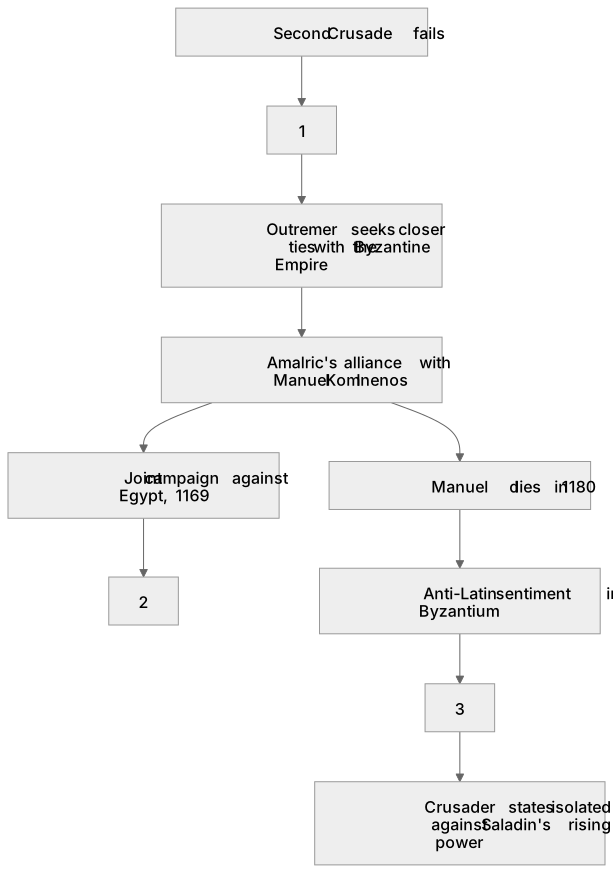
1Box 1
2Box 2
3Box 3
There is more to this lesson
The full lesson goes on to check your understanding and help you earn the marks. Create a free account to carry on, with your progress saved.
A week of Premium from your first lesson · Then the free plan continues · No card, no charge
Test your understanding of 1A The Age of the Crusades, c1071–1204 – The Muslim Counter-Crusade and Crusader states, 1149–1187 (A-level only): Relations between Outremer and wider Christendom, the Latin West and the Byzantine Empire
Active recall beats re-reading. Take an instant quiz now to test what you’ve learned and lock it into long-term memory.
A week of Premium from your first lesson · Then the free plan continues · No card, no charge