AQA · A-Level · History
Course version: 7042 · Version from Sept 2017
Internal divisions within Outremer, including the reign of Baldwin IV and…
Full specification wording
1A The Age of the Crusades, c1071–1204 – The Muslim Counter-Crusade and Crusader states, 1149–1187 (A-level only): Internal divisions within Outremer, including the reign of Baldwin IV and his successors
Internal divisions severely weakened Outremer between 1149 and 1187, leaving it vulnerable to Muslim reconquest.
Checked against the AQA 7042 specification (opens in a new tab) on .
- Point 4 of 6
- 3 key terms
Study notes
From the checked teaching notes for this specification point.
The idea
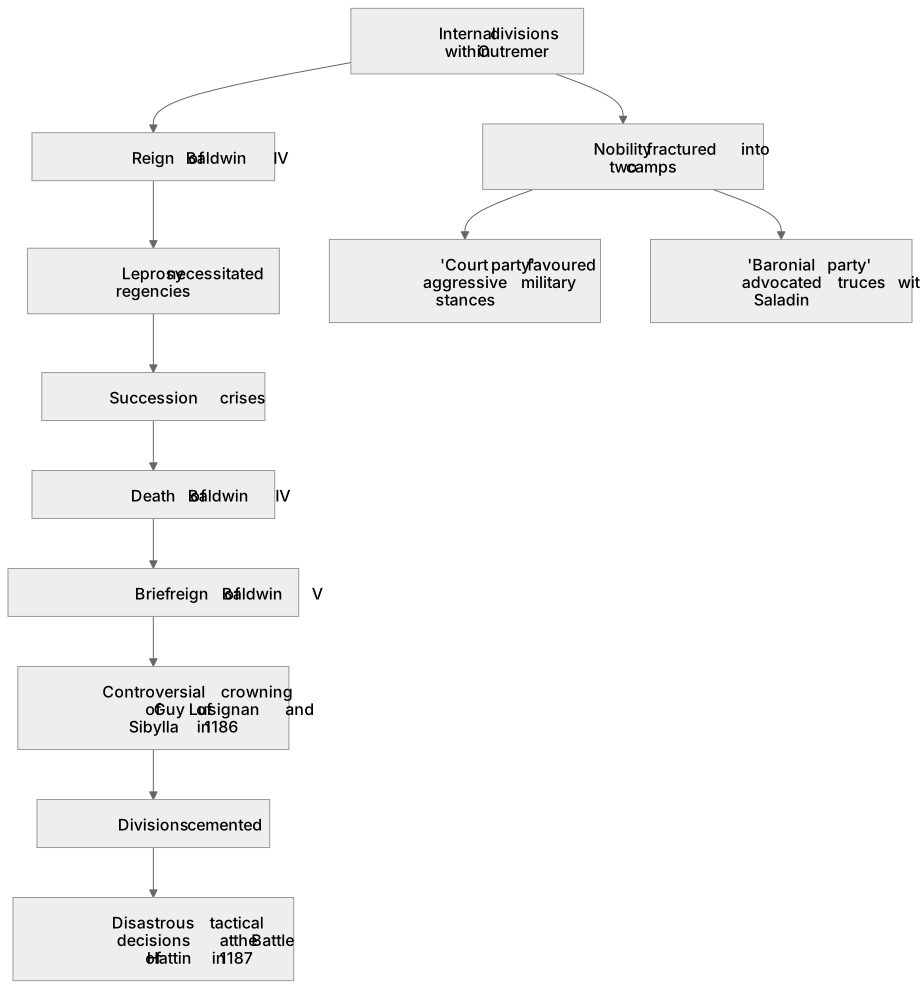
Internal divisions severely weakened Outremer between 1149 and 1187, leaving it vulnerable to Muslim reconquest. Factionalism peaked during the reign of Baldwin IV (1174–1185), whose leprosy necessitated regencies and sparked succession crises. The nobility fractured into two main camps: the 'court party', including Agnes of Courtenay and Guy of Lusignan, who favoured aggressive military stances, and the 'baronial party', led by Raymond III of Tripoli, who advocated for truces with Saladin. Following Baldwin IV's death and the brief reign of his nephew Baldwin V, the controversial crowning of Guy of Lusignan and Sibylla in 1186 cemented these divisions. This catastrophic disunity directly contributed to the disastrous tactical decisions made at the Battle of Hattin in 1187.
What earns the marks
- Analyse the impact of Baldwin IV's leprosy on the political stability of Jerusalem, focusing on the necessity of regencies.
- Evaluate the ideological and personal conflicts between the 'court party' (e.g., Guy of Lusignan, Reynald of Châtillon) and the 'baronial party' (e.g., Raymond III of Tripoli).
- Assess the succession crisis following the deaths of Baldwin IV and Baldwin V, culminating in the disputed coronation of Guy and Sibylla.
- Explain how internal factionalism dictated military strategy, specifically leading to the fatal decisions at the Battle of Hattin.
Common mistakes and how to put them right
Describing the factions purely as 'hawks' and 'doves'.
Put it right by explaining that both sides engaged in warfare and truces depending on pragmatic strategic needs rather than strict ideology.
Blaming the fall of Jerusalem solely on Saladin's strength.
Put it right by balancing external threats with the internal paralysis caused by the succession crises of Baldwin IV and his successors.
Confusing the timeline of successors.
Put it right: Ensure the correct sequence is maintained: Baldwin IV, followed by the child-king Baldwin V, and then Guy of Lusignan with Sibylla.
Exam tips
- Use the coronation crisis of 1186 as a primary example of how internal divisions crippled Outremer's ability to present a united front.
- Link the actions of specific individuals, such as Reynald of Châtillon's breaking of truces, to the wider factional disputes within the kingdom.
- When discussing Baldwin IV, acknowledge his military successes, such as Montgisard, to provide a balanced assessment of his reign despite his illness.
Try the lesson
The start of the 1A The Age of the Crusades, c1071–1204 – The Muslim Counter-Crusade and Crusader states, 1149–1187 (A-level only): Internal divisions within Outremer, including the reign of Baldwin IV and his successors lesson, made from checked teaching notes for this specification point.
Have a go first
Which disease is generally accepted to have afflicted Baldwin IV, shaping both his rule and the political factions at the Jerusalem court?
Listen
Internal divisions severely weakened Outremer between 1149 and 1187, leaving it vulnerable to Muslim reconquest. Factionalism peaked during the reign of Baldwin IV (1174–1185), whose leprosy necessitated regencies and sparked succession crises. The nobility fractured into two main camps: the 'court party', including Agnes of Courtenay and Guy of Lusignan, who favoured aggressive military stances, and the 'baronial party', led by Raymond III of Tripoli, who advocated for truces with Saladin. Following Baldwin IV's death and the brief reign of his nephew Baldwin V, the controversial crowning of Guy of Lusignan and Sibylla in 1186 cemented these divisions. This catastrophic disunity directly contributed to the disastrous tactical decisions made at the Battle of Hattin in 1187. A strong answer earns marks for these points. Analyse the impact of Baldwin IV's leprosy on the political stability of Jerusalem, focusing on the necessity of regencies. Evaluate the ideological and personal conflicts between the 'court party' (e.g., Guy of Lusignan, Reynald of Châtillon) and the 'baronial party' (e.g., Raymond III of Tripoli). Assess the succession crisis following the deaths of Baldwin IV and Baldwin V, culminating in the disputed coronation of Guy and Sibylla. Explain how internal factionalism dictated military strategy, specifically leading to the fatal decisions at the Battle of Hattin. A common slip: Describing the factions purely as 'hawks' and 'doves'. Instead, explaining that both sides engaged in warfare and truces depending on pragmatic strategic needs rather than strict ideology. Exam tip: Use the coronation crisis of 1186 as a primary example of how internal divisions crippled Outremer's ability to present a united front.
See it
Put the events in order
Put these events in the order they happened, earliest first.
- 1. Battle of Hattin
- 2. Reign of Baldwin IV begins
- 3. Coronation of Guy of Lusignan and Sibylla
- 4. Death of Baldwin IV
Key words
Say what each word means before you turn the card.
Factionalism
Try answering aloud or in your head before turning the card.
Succession crises
Try answering aloud or in your head before turning the card.
Political instability
Try answering aloud or in your head before turning the card.
See every definition
- Factionalism
- Internal divisions that severely weakened Outremer between 1149 and 1187, leaving it vulnerable to Muslim reconquest.
- Succession crises
- Disputes sparked during the reign of Baldwin IV, whose leprosy necessitated regencies, and following the deaths of Baldwin IV and Baldwin V.
- Political instability
- A condition caused by Baldwin IV's leprosy, which necessitated regencies and sparked succession crises.
Label the diagram
Some boxes have lost their names. Pick the right name for each number.
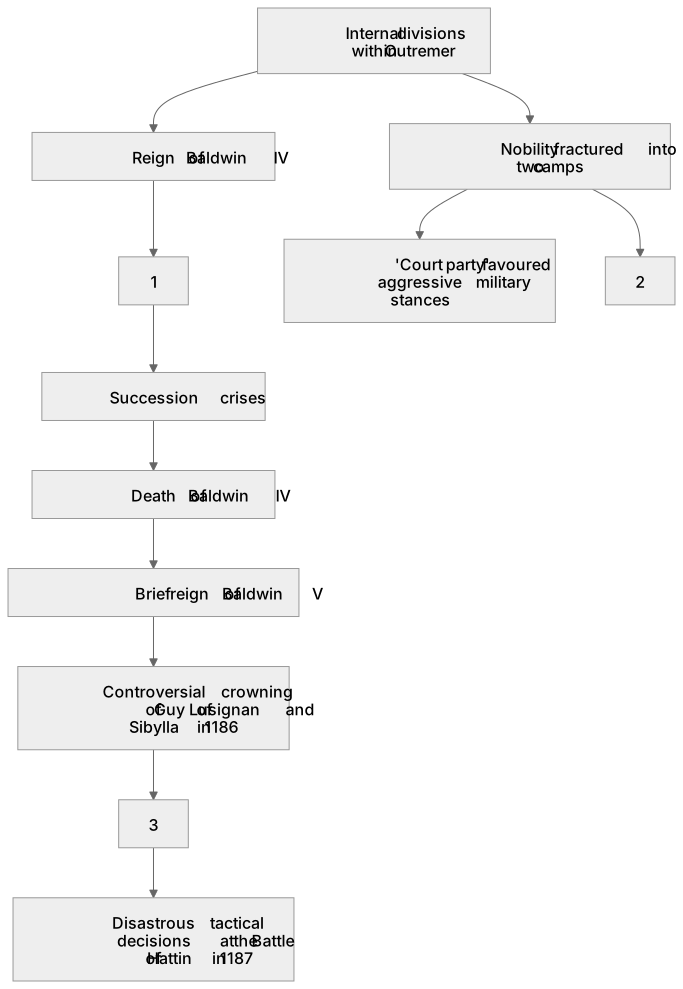
1Box 1
2Box 2
3Box 3
There is more to this lesson
The full lesson goes on to check your understanding and help you earn the marks. Create a free account to carry on, with your progress saved.
A week of Premium from your first lesson · Then the free plan continues · No card, no charge
Test your understanding of 1A The Age of the Crusades, c1071–1204 – The Muslim Counter-Crusade and Crusader states, 1149–1187 (A-level only): Internal divisions within Outremer, including the reign of Baldwin IV and his successors
Active recall beats re-reading. Take an instant quiz now to test what you’ve learned and lock it into long-term memory.
A week of Premium from your first lesson · Then the free plan continues · No card, no charge