AQA · A-Level · History
Course version: 7042 · Version from Sept 2017
The rise of Saladin: religion, politics and military expansion; victory at…
Full specification wording
1A The Age of the Crusades, c1071–1204 – The Muslim Counter-Crusade and Crusader states, 1149–1187 (A-level only): The rise of Saladin: religion, politics and military expansion; victory at Hattin
Saladin’s ascent blended religious ideology, political manoeuvring, and military expansion.
Checked against the AQA 7042 specification (opens in a new tab) on .
- Point 5 of 6
- 4 key terms
Study notes
From the checked teaching notes for this specification point.
The idea
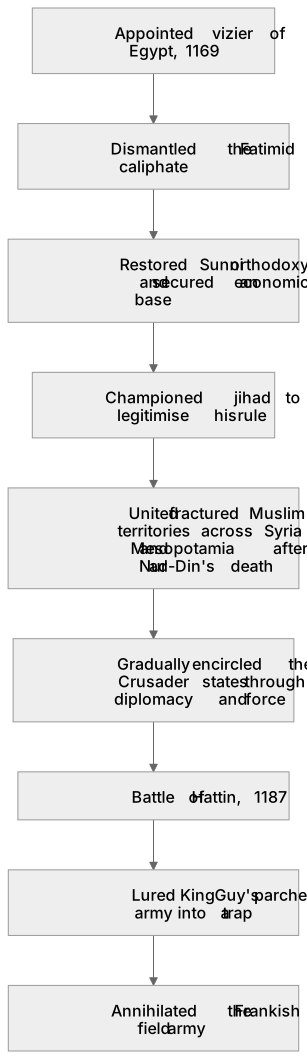
Saladin’s ascent blended religious ideology, political manoeuvring, and military expansion. Appointed vizier of Egypt in 1169, he dismantled the Fatimid caliphate, restoring Sunni orthodoxy and securing a vast economic base. Politically, he legitimised his rule by championing jihad, uniting fractured Muslim territories across Syria and Mesopotamia after Nur ad-Din’s death. His military expansion involved both diplomacy and force, gradually encircling the Crusader states. This strategic encirclement culminated in the decisive Battle of Hattin in 1187. By luring King Guy’s parched army into a trap, Saladin annihilated the Frankish field army. This victory demonstrated his tactical brilliance and the effectiveness of a unified Muslim front.
What earns the marks
- Evaluate Saladin's use of jihad as a political tool to unify disparate Muslim factions.
- Assess the significance of Saladin's conquest of Egypt in providing the financial and military resources for his campaigns.
- Analyse the strategic encirclement of the Crusader states through Saladin's campaigns in Syria and Mesopotamia.
- Explain the tactical errors of the Franks and Saladin's military acumen that led to the decisive Muslim victory at Hattin.
Common mistakes and how to put them right
Claiming Saladin immediately fought the Crusaders upon taking power.
Put it right: Emphasise that he spent years fighting and unifying other Muslims before focusing on the Franks.
Confusing the Fatimid and Abbasid caliphates.
Put it right: Specify that Saladin overthrew the Shi'a Fatimid caliphate in Egypt to restore allegiance to the Sunni Abbasid caliphate.
Attributing the victory at Hattin solely to Frankish incompetence.
Put it right: Acknowledge Saladin's active role in forcing the engagement and exploiting the terrain and water supply.
Exam tips
- When discussing Saladin's rise, balance his genuine religious devotion with his pragmatic political calculations.
- Use the Battle of Hattin as a turning point to evaluate the success of Saladin's long-term strategy of encirclement.
- Contrast Saladin's unified leadership with the factionalism plaguing the Crusader states during the 1180s.
Try the lesson
The start of the 1A The Age of the Crusades, c1071–1204 – The Muslim Counter-Crusade and Crusader states, 1149–1187 (A-level only): The rise of Saladin: religion, politics and military expansion; victory at Hattin lesson, made from checked teaching notes for this specification point.
Have a go first
Which significant battle in 1187 resulted in the destruction of the Crusader field army and paved the way for Saladin's capture of Jerusalem?
Listen
Saladin’s ascent blended religious ideology, political manoeuvring, and military expansion. Appointed vizier of Egypt in 1169, he dismantled the Fatimid caliphate, restoring Sunni orthodoxy and securing a vast economic base. Politically, he legitimised his rule by championing jihad, uniting fractured Muslim territories across Syria and Mesopotamia after Nur ad-Din’s death. His military expansion involved both diplomacy and force, gradually encircling the Crusader states. This strategic encirclement culminated in the decisive Battle of Hattin in 1187. By luring King Guy’s parched army into a trap, Saladin annihilated the Frankish field army. This victory demonstrated his tactical brilliance and the effectiveness of a unified Muslim front. A strong answer earns marks for these points. Evaluate Saladin's use of jihad as a political tool to unify disparate Muslim factions. Assess the significance of Saladin's conquest of Egypt in providing the financial and military resources for his campaigns. Analyse the strategic encirclement of the Crusader states through Saladin's campaigns in Syria and Mesopotamia. Explain the tactical errors of the Franks and Saladin's military acumen that led to the decisive Muslim victory at Hattin. A common slip: Claiming Saladin immediately fought the Crusaders upon taking power. Instead, emphasise that he spent years fighting and unifying other Muslims before focusing on the Franks. Exam tip: When discussing Saladin's rise, balance his genuine religious devotion with his pragmatic political calculations.
See it
Key words
Say what each word means before you turn the card.
Religious ideology and jihad
Try answering aloud or in your head before turning the card.
Political consolidation
Try answering aloud or in your head before turning the card.
Military strategy and tactics
Try answering aloud or in your head before turning the card.
Leadership and authority
Try answering aloud or in your head before turning the card.
See every definition
- Religious ideology and jihad
- Championing jihad legitimised Saladin's rule and helped unite fractured Muslim territories.
- Political consolidation
- He legitimised his rule by championing jihad, uniting fractured Muslim territories across Syria and Mesopotamia after Nur ad-Din's death.
- Military strategy and tactics
- His military expansion involved both diplomacy and force, gradually encircling the Crusader states and culminating in the decisive Battle of Hattin.
- Leadership and authority
- His victory demonstrated his tactical brilliance and the effectiveness of a unified Muslim front.
Label the diagram
Some boxes have lost their names. Pick the right name for each number.
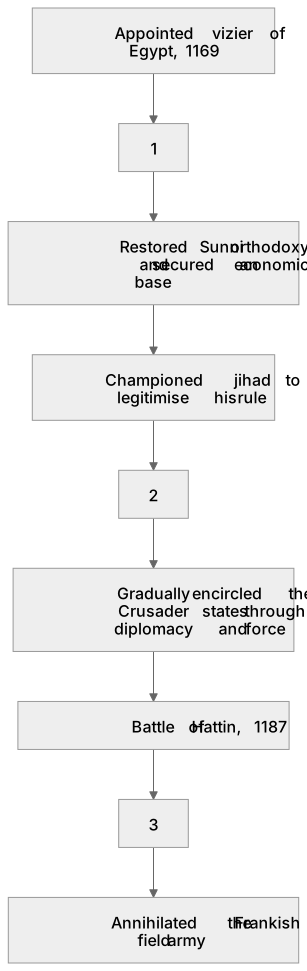
1Box 1
2Box 2
3Box 3
There is more to this lesson
The full lesson goes on to check your understanding and help you earn the marks. Create a free account to carry on, with your progress saved.
A week of Premium from your first lesson · Then the free plan continues · No card, no charge
Test your understanding of 1A The Age of the Crusades, c1071–1204 – The Muslim Counter-Crusade and Crusader states, 1149–1187 (A-level only): The rise of Saladin: religion, politics and military expansion; victory at Hattin
Active recall beats re-reading. Take an instant quiz now to test what you’ve learned and lock it into long-term memory.
A week of Premium from your first lesson · Then the free plan continues · No card, no charge