AQA · A-Level · History
Course version: 7042 · Version from Sept 2017
Preaching and preparing for the Third Crusade: motives of Pope Gregory…
Full specification wording
1A The Age of the Crusades, c1071–1204 – The Third and Fourth Crusades, 1187–1204 (A-level only): Preaching and preparing for the Third Crusade: motives of Pope Gregory VIII; Henry II and Richard I of England; Philip II of France; Frederick Barbarossa
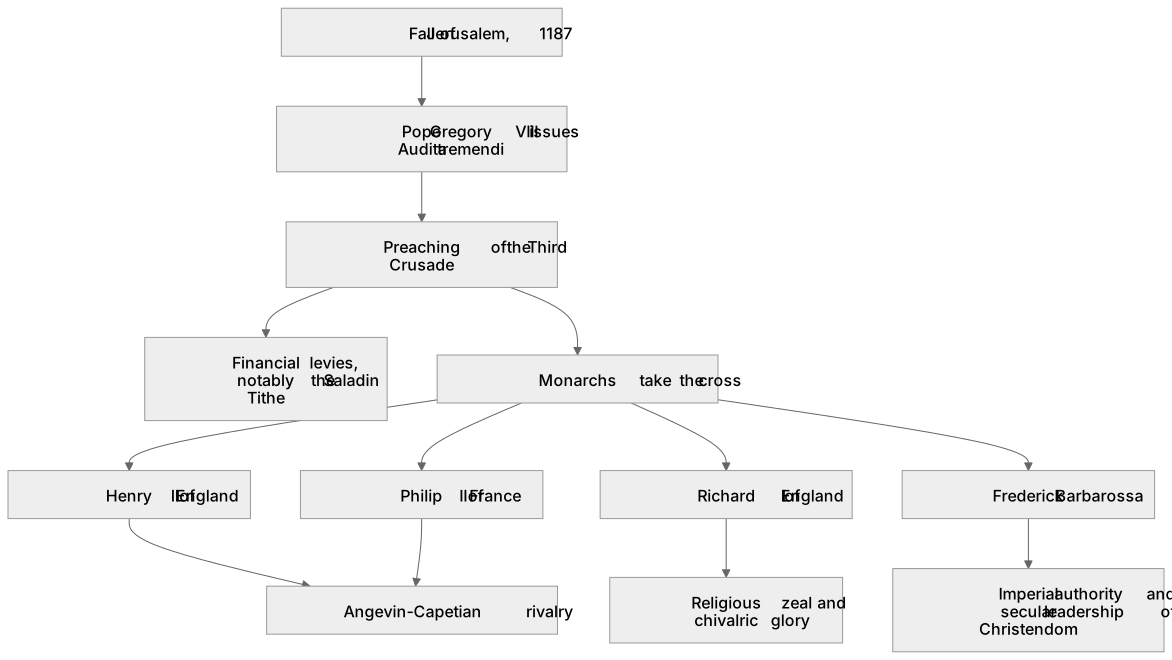
The 1187 fall of Jerusalem prompted Pope Gregory VIII to issue Audita tremendi, preaching the Third Crusade by framing the loss as divine punishment.
Checked against the AQA 7042 specification (opens in a new tab) on .
- Point 1 of 6
- 4 key terms
Study notes
From the checked teaching notes for this specification point.
The idea
The 1187 fall of Jerusalem prompted Pope Gregory VIII to issue Audita tremendi, preaching the Third Crusade by framing the loss as divine punishment. Preparation involved unprecedented financial levies, notably the Saladin Tithe. Motives varied among the monarchs. Henry II of England and Philip II of France were initially reluctant, driven more by their Angevin-Capetian territorial rivalry than piety, taking the cross to avoid losing face. Following Henry's death, Richard I's motives combined genuine religious zeal with a desire for chivalric glory. Holy Roman Emperor Frederick Barbarossa, a veteran of the Second Crusade, sought to assert his imperial authority and demonstrate his role as the secular leader of Christendom by raising a massive German army.
What earns the marks
- Explain the significance of the papal bull Audita tremendi in shaping the spiritual and penitential motives for the crusade.
- Analyse the impact of the Saladin Tithe as a logistical preparation method and its effect on royal revenues.
- Evaluate how the ongoing Angevin-Capetian conflict delayed the preparations of Henry II and Philip II.
- Assess Richard I's dual motivations of religious devotion and the pursuit of military prestige.
- Examine Frederick Barbarossa's desire to consolidate his imperial legacy and lead a unified Christian response.
Common mistakes and how to put them right
Claiming Henry II led the English contingent on the crusade.
Put it right: Henry II took the cross but died in 1189 before departing; his son Richard I actually led the English forces.
Assuming Philip II and Richard I shared identical, purely religious motives.
Put it right: Philip was highly pragmatic and focused on French territorial gains, whereas Richard was heavily motivated by chivalric glory and genuine piety.
Stating that preaching the crusade was universally successful without resistance.
Put it right: Acknowledge that the heavy taxation of the Saladin Tithe caused significant resentment and resistance among the laity and clergy.
Exam tips
- Contrast the pragmatic, politically driven motives of Philip II with the chivalric and pious motivations of Richard I to build a strong comparative argument.
- Use the Saladin Tithe as specific evidence when discussing the scale and sophistication of preparations compared to earlier crusades.
- Link Pope Gregory VIII's theological arguments in Audita tremendi directly to the recruitment of the secular monarchs.
Try the lesson
The start of the 1A The Age of the Crusades, c1071–1204 – The Third and Fourth Crusades, 1187–1204 (A-level only): Preaching and preparing for the Third Crusade: motives of Pope Gregory VIII; Henry II and Richard I of England; Philip II of France; Frederick Barbarossa lesson, made from checked teaching notes for this specification point.
Have a go first
What was the primary motive of Pope Gregory VIII in issuing the papal bull *Audita tremendi* to launch the Third Crusade?
Listen
The 1187 fall of Jerusalem prompted Pope Gregory VIII to issue Audita tremendi, preaching the Third Crusade by framing the loss as divine punishment. Preparation involved unprecedented financial levies, notably the Saladin Tithe. Motives varied among the monarchs. Henry II of England and Philip II of France were initially reluctant, driven more by their Angevin-Capetian territorial rivalry than piety, taking the cross to avoid losing face. Following Henry's death, Richard I's motives combined genuine religious zeal with a desire for chivalric glory. Holy Roman Emperor Frederick Barbarossa, a veteran of the Second Crusade, sought to assert his imperial authority and demonstrate his role as the secular leader of Christendom by raising a massive German army. A strong answer earns marks for these points. Explain the significance of the papal bull Audita tremendi in shaping the spiritual and penitential motives for the crusade. Analyse the impact of the Saladin Tithe as a logistical preparation method and its effect on royal revenues. Evaluate how the ongoing Angevin-Capetian conflict delayed the preparations of Henry II and Philip II. Assess Richard I's dual motivations of religious devotion and the pursuit of military prestige. A common slip: Claiming Henry II led the English contingent on the crusade. Instead, Henry II took the cross but died in 1189 before departing; his son Richard I actually led the English forces. Exam tip: Contrast the pragmatic, politically driven motives of Philip II with the chivalric and pious motivations of Richard I to build a strong comparative argument.
See it
Key words
Say what each word means before you turn the card.
Audita tremendi
Try answering aloud or in your head before turning the card.
Saladin Tithe
Try answering aloud or in your head before turning the card.
Angevin-Capetian territorial rivalry
Try answering aloud or in your head before turning the card.
Chivalric glory
Try answering aloud or in your head before turning the card.
See every definition
- Audita tremendi
- The papal bull issued by Pope Gregory VIII after the 1187 fall of Jerusalem, framing the loss as divine punishment.
- Saladin Tithe
- An unprecedented financial levy used as a logistical preparation method, whose heavy taxation caused resentment and resistance among the laity and clergy.
- Angevin-Capetian territorial rivalry
- The rivalry that drove Henry II of England and Philip II of France more than piety, leading them to take the cross to avoid losing face.
- Chivalric glory
- A desire that, combined with genuine religious zeal, motivated Richard I of England.
Label the diagram
Some boxes have lost their names. Pick the right name for each number.
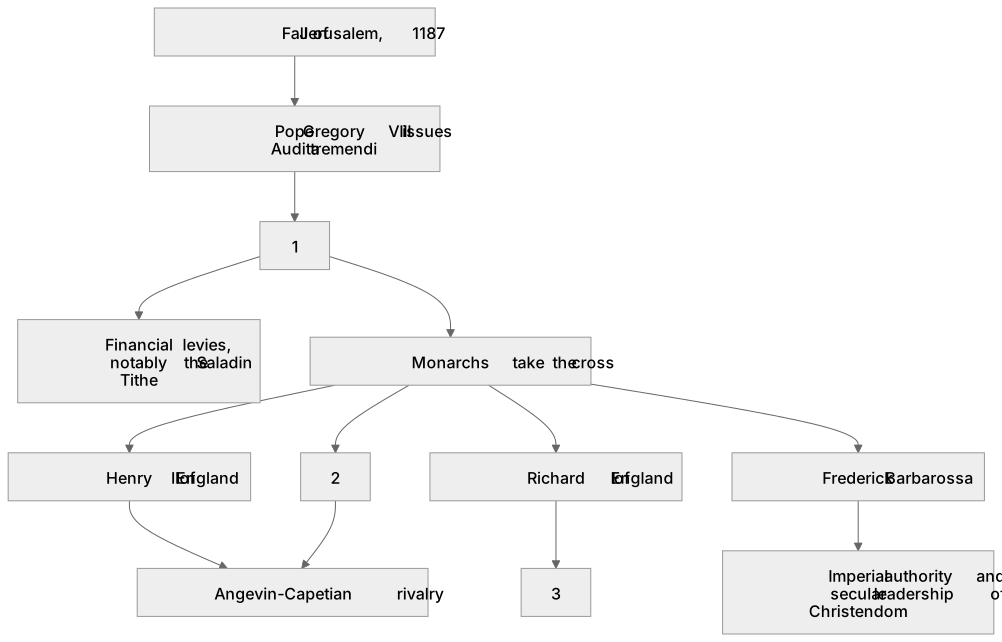
1Box 1
2Box 2
3Box 3
There is more to this lesson
The full lesson goes on to check your understanding and help you earn the marks. Create a free account to carry on, with your progress saved.
A week of Premium from your first lesson · Then the free plan continues · No card, no charge
Test your understanding of 1A The Age of the Crusades, c1071–1204 – The Third and Fourth Crusades, 1187–1204 (A-level only): Preaching and preparing for the Third Crusade: motives of Pope Gregory VIII; Henry II and Richard I of England; Philip II of France; Frederick Barbarossa
Active recall beats re-reading. Take an instant quiz now to test what you’ve learned and lock it into long-term memory.
A week of Premium from your first lesson · Then the free plan continues · No card, no charge