AQA · A-Level · History
Course version: 7042 · Version from Sept 2017
The course of the Third Crusade: leadership and internal rivalries of the…
Full specification wording
1A The Age of the Crusades, c1071–1204 – The Third and Fourth Crusades, 1187–1204 (A-level only): The course of the Third Crusade: leadership and internal rivalries of the Crusaders; the reasons for the military outcome
The Third Crusade's course was heavily dictated by the fractured leadership and intense internal rivalries among the crusaders.
Checked against the AQA 7042 specification (opens in a new tab) on .
- Point 2 of 6
- 4 key terms
Study notes
From the checked teaching notes for this specification point.
The idea
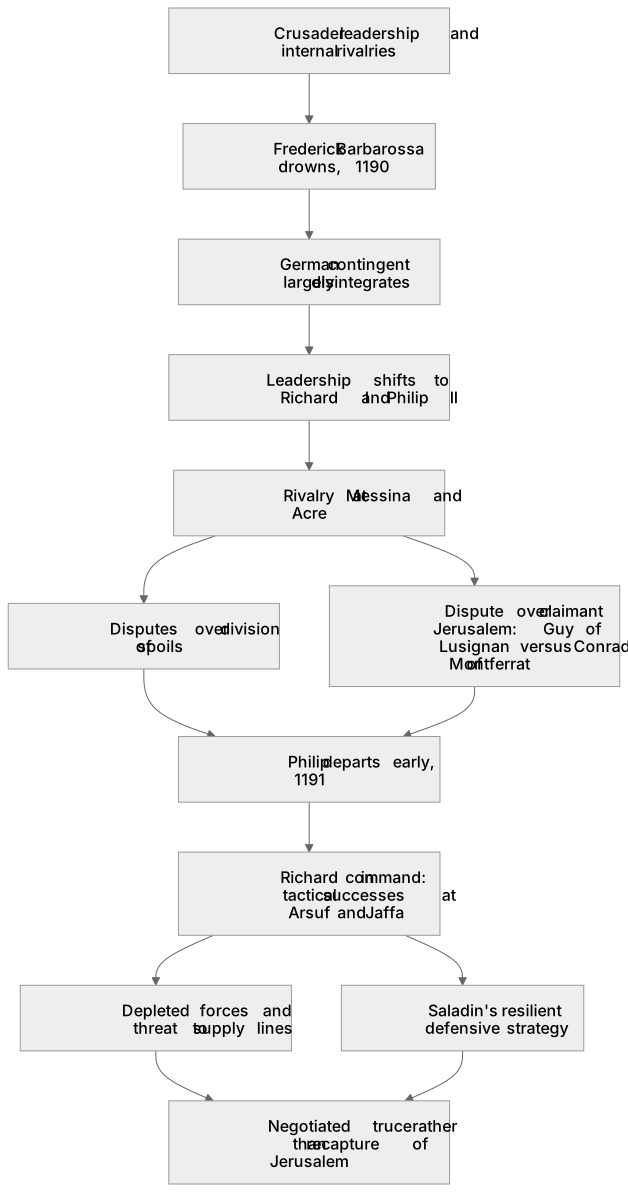
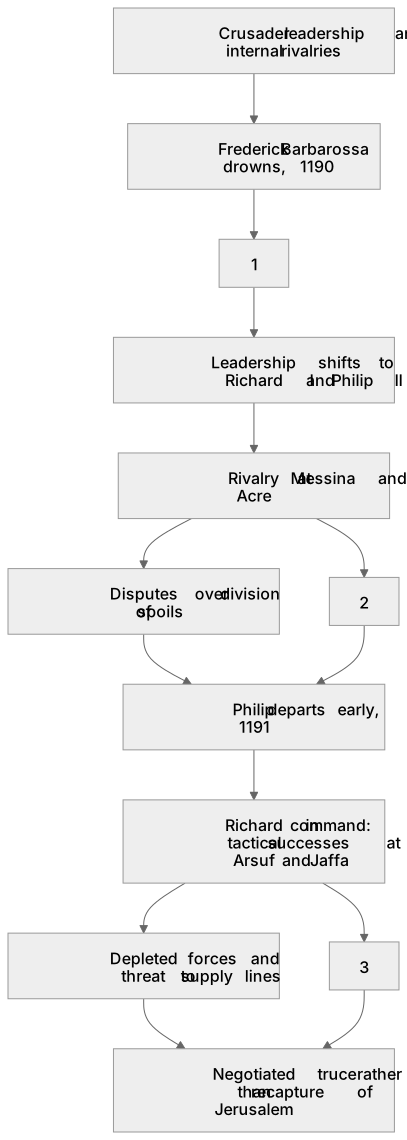
The Third Crusade's course was heavily dictated by the fractured leadership and intense internal rivalries among the crusaders. Following Frederick Barbarossa's accidental drowning in 1190, the German contingent largely disintegrated, shifting the leadership burden to Richard I and Philip II. Their relationship rapidly deteriorated during the siege of Acre over disputes regarding the division of spoils and the claimant to the throne of Jerusalem (Guy of Lusignan versus Conrad of Montferrat). Philip's early departure in 1191 left Richard in command. Despite Richard's tactical brilliance at Arsuf and Jaffa, the military outcome—a negotiated truce rather than the recapture of Jerusalem—was caused by his depleted forces, the constant threat to his supply lines, and Saladin's resilient defensive strategy.
What earns the marks
- Analyse how the death of Frederick Barbarossa fundamentally altered the balance of power and leadership structure of the crusade.
- Evaluate the impact of the rivalry between Richard I and Philip II, particularly their disputes at Messina and Acre.
- Examine the factional conflict over the Kingdom of Jerusalem between supporters of Guy of Lusignan and Conrad of Montferrat.
- Assess Richard I's military leadership, noting his tactical successes at the battles of Arsuf and Jaffa.
- Explain the strategic and logistical reasons why Richard I chose to negotiate the Treaty of Jaffa rather than besiege Jerusalem.
Common mistakes and how to put them right
Stating that the Third Crusade was a complete failure because Jerusalem was not captured.
Put it right: Recognise that the crusade was a partial success, as it secured the coastal cities, captured Cyprus, and guaranteed unarmed Christian access to Jerusalem.
Attributing the failure to take Jerusalem solely to Richard I's lack of commitment.
Put it right: Explain that Richard's decision to turn back was based on sound military logistics, as he lacked the manpower to hold the city even if he captured it.
Ignoring the role of Saladin's tactics in the military outcome.
Put it right: Include Saladin's scorched-earth policy, poisoning of wells, and preservation of his army as key factors in preventing a crusader victory.
Exam tips
- When discussing leadership, explicitly link the personal animosity between Richard and Philip to specific military and political delays during the campaign.
- Use the Battle of Arsuf as a concrete example of Richard I's effective military discipline and tactical command.
- Argue whether internal crusader divisions or Saladin's military resilience was the primary reason for the crusade's ultimate military outcome.
Try the lesson
The start of the 1A The Age of the Crusades, c1071–1204 – The Third and Fourth Crusades, 1187–1204 (A-level only): The course of the Third Crusade: leadership and internal rivalries of the Crusaders; the reasons for the military outcome lesson, made from checked teaching notes for this specification point.
Have a go first
During the siege of Acre in 1191, which significant internal rivalry severely undermined the unity of the Crusader leadership?
Listen
The Third Crusade's course was heavily dictated by the fractured leadership and intense internal rivalries among the crusaders. Following Frederick Barbarossa's accidental drowning in 1190, the German contingent largely disintegrated, shifting the leadership burden to Richard I and Philip II. Their relationship rapidly deteriorated during the siege of Acre over disputes regarding the division of spoils and the claimant to the throne of Jerusalem (Guy of Lusignan versus Conrad of Montferrat). Philip's early departure in 1191 left Richard in command. Despite Richard's tactical brilliance at Arsuf and Jaffa, the military outcome—a negotiated truce rather than the recapture of Jerusalem—was caused by his depleted forces, the constant threat to his supply lines, and Saladin's resilient defensive strategy. A strong answer earns marks for these points. Analyse how the death of Frederick Barbarossa fundamentally altered the balance of power and leadership structure of the crusade. Evaluate the impact of the rivalry between Richard I and Philip II, particularly their disputes at Messina and Acre. Examine the factional conflict over the Kingdom of Jerusalem between supporters of Guy of Lusignan and Conrad of Montferrat. Assess Richard I's military leadership, noting his tactical successes at the battles of Arsuf and Jaffa. A common slip: Stating that the Third Crusade was a complete failure because Jerusalem was not captured. Instead, Recognise that the crusade was a partial success, as it secured the coastal cities, captured Cyprus, and guaranteed unarmed Christian access to Jerusalem. Exam tip: When discussing leadership, explicitly link the personal animosity between Richard and Philip to specific military and political delays during the campaign.
See it
Key words
Say what each word means before you turn the card.
Leadership and command
Try answering aloud or in your head before turning the card.
Factionalism and political rivalry
Try answering aloud or in your head before turning the card.
Military strategy and logistics
Try answering aloud or in your head before turning the card.
Diplomacy and negotiation
Try answering aloud or in your head before turning the card.
See every definition
- Leadership and command
- The burden of leading the crusade shifted to Richard I and Philip II after Frederick Barbarossa's accidental drowning in 1190, and Philip's early departure in 1191 left Richard in command.
- Factionalism and political rivalry
- Intense internal rivalries among the crusaders included disputes between Richard I and Philip II over the division of spoils and the claimant to the throne of Jerusalem, Guy of Lusignan versus Conrad of Montferrat.
- Military strategy and logistics
- The negotiated truce rather than the recapture of Jerusalem was caused by depleted forces, the constant threat to supply lines, and Saladin's resilient defensive strategy.
- Diplomacy and negotiation
- The military outcome of the Third Crusade was a negotiated truce rather than the recapture of Jerusalem.
Label the diagram
Some boxes have lost their names. Pick the right name for each number.
1Box 1
2Box 2
3Box 3
There is more to this lesson
The full lesson goes on to check your understanding and help you earn the marks. Create a free account to carry on, with your progress saved.
A week of Premium from your first lesson · Then the free plan continues · No card, no charge
Test your understanding of 1A The Age of the Crusades, c1071–1204 – The Third and Fourth Crusades, 1187–1204 (A-level only): The course of the Third Crusade: leadership and internal rivalries of the Crusaders; the reasons for the military outcome
Active recall beats re-reading. Take an instant quiz now to test what you’ve learned and lock it into long-term memory.
A week of Premium from your first lesson · Then the free plan continues · No card, no charge