AQA · A-Level · History
Course version: 7042 · Version from Sept 2017
The impact of the Third Crusade; Saladin’s power and prestige in the…
Full specification wording
1A The Age of the Crusades, c1071–1204 – The Third and Fourth Crusades, 1187–1204 (A-level only): The impact of the Third Crusade; Saladin’s power and prestige in the Muslim Near East
The Third Crusade (1189–1192) significantly impacted the Crusader States by securing their survival for another century, despite failing to recapture Jerusalem.
Checked against the AQA 7042 specification (opens in a new tab) on .
- Point 3 of 6
- 3 key terms
Study notes
From the checked teaching notes for this specification point.
The idea
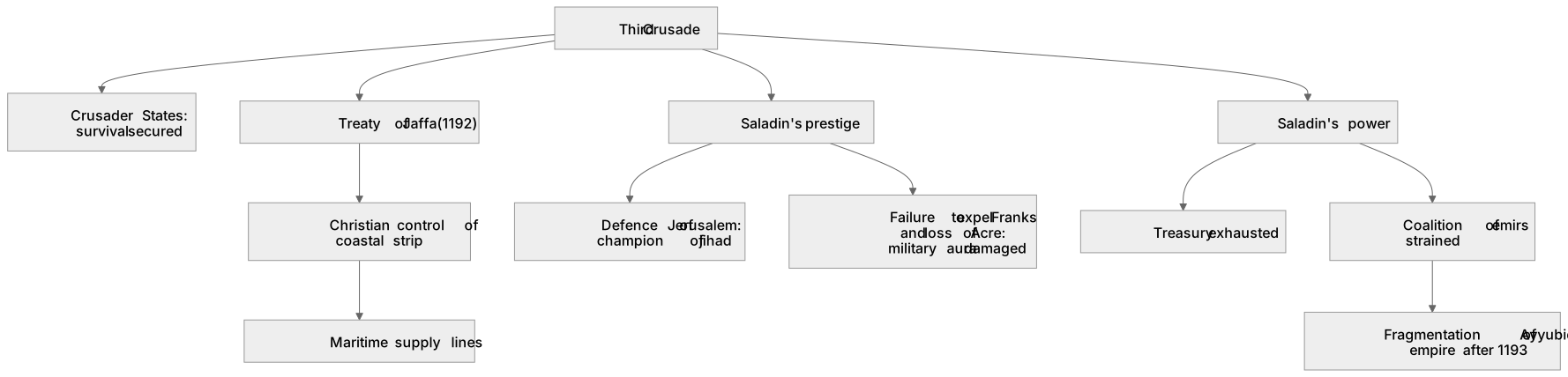
The Third Crusade (1189–1192) significantly impacted the Crusader States by securing their survival for another century, despite failing to recapture Jerusalem. The Treaty of Jaffa (1192) consolidated Christian control of the Levantine coast from Jaffa to Tyre, ensuring vital maritime supply lines. For Saladin, the crusade had a complex effect on his power and prestige in the Muslim Near East. While he successfully defended Jerusalem, enhancing his reputation as the champion of jihad, his failure to expel the Franks entirely and the loss of Acre damaged his military aura. Furthermore, the prolonged conflict exhausted his treasury and strained his fragile coalition of emirs, leading to immediate fragmentation of his Ayyubid empire upon his death in 1193.
What earns the marks
- Assess the territorial impact of the Third Crusade, specifically the retention of the coastal strip and Cyprus, which ensured the survival of Outremer.
- Evaluate the terms of the Treaty of Jaffa (1192) and its role in establishing a truce that allowed unarmed Christian pilgrims access to Jerusalem.
- Analyse how Saladin's successful defence of Jerusalem cemented his ideological prestige as the leader of the Islamic jihad against the Franks.
- Examine the limitations of Saladin's power post-crusade, including the financial exhaustion of his empire and the growing discontent among his emirs.
Common mistakes and how to put them right
Claiming the Third Crusade was a complete failure.
Put it right: Acknowledge that while Jerusalem was not taken, the crusade successfully secured the coastal cities and ensured the survival of the Crusader States.
Assuming Saladin emerged from the crusade with absolute, unchallenged power.
Put it right: Recognise that the prolonged war drained his resources and strained his alliances, leaving his empire vulnerable to fragmentation.
Stating that Saladin lost Jerusalem during the Third Crusade.
Put it right: Saladin successfully defended Jerusalem, which remained in Muslim hands, though he conceded coastal territories like Acre.
Exam tips
- Use the Treaty of Jaffa as a key piece of evidence when evaluating the extent of the Third Crusade's success.
- Contrast Saladin's ideological prestige with his practical military and financial weaknesses in the early 1190s to build a nuanced argument.
- Link the survival of the coastal strip directly to the long-term viability of the Crusader States, highlighting the strategic importance of maritime supply routes.
Try the lesson
The start of the 1A The Age of the Crusades, c1071–1204 – The Third and Fourth Crusades, 1187–1204 (A-level only): The impact of the Third Crusade; Saladin’s power and prestige in the Muslim Near East lesson, made from checked teaching notes for this specification point.
Have a go first
Why did Saladin face criticism from some Muslim contemporaries following the conclusion of the Third Crusade in 1192?
Listen
The Third Crusade (1189–1192) significantly impacted the Crusader States by securing their survival for another century, despite failing to recapture Jerusalem. The Treaty of Jaffa (1192) consolidated Christian control of the Levantine coast from Jaffa to Tyre, ensuring vital maritime supply lines. For Saladin, the crusade had a complex effect on his power and prestige in the Muslim Near East. While he successfully defended Jerusalem, enhancing his reputation as the champion of jihad, his failure to expel the Franks entirely and the loss of Acre damaged his military aura. Furthermore, the prolonged conflict exhausted his treasury and strained his fragile coalition of emirs, leading to immediate fragmentation of his Ayyubid empire upon his death in 1193. A strong answer earns marks for these points. Assess the territorial impact of the Third Crusade, specifically the retention of the coastal strip and Cyprus, which ensured the survival of Outremer. Evaluate the terms of the Treaty of Jaffa (1192) and its role in establishing a truce that allowed unarmed Christian pilgrims access to Jerusalem. Analyse how Saladin's successful defence of Jerusalem cemented his ideological prestige as the leader of the Islamic jihad against the Franks. Examine the limitations of Saladin's power post-crusade, including the financial exhaustion of his empire and the growing discontent among his emirs. A common slip: Claiming the Third Crusade was a complete failure. Instead, acknowledge that while Jerusalem was not taken, the crusade successfully secured the coastal cities and ensured the survival of the Crusader States. Exam tip: Use the Treaty of Jaffa as a key piece of evidence when evaluating the extent of the Third Crusade's success.
See it
Put the events in order
Put these events in the order they happened, earliest first.
- 1. The Third Crusade began its impact on the Crusader States
- 2. Saladin died and his Ayyubid empire fragmented
- 3. The Treaty of Jaffa consolidated Christian control of the Levantine coast
Key words
Say what each word means before you turn the card.
Treaty of Jaffa
Try answering aloud or in your head before turning the card.
jihad
Try answering aloud or in your head before turning the card.
Crusader States
Try answering aloud or in your head before turning the card.
See every definition
- Treaty of Jaffa
- The 1192 agreement that consolidated Christian control of the Levantine coast from Jaffa to Tyre, ensuring vital maritime supply lines and allowing unarmed Christian pilgrims access to Jerusalem.
- jihad
- The Islamic struggle against the Franks, of which Saladin's successful defence of Jerusalem cemented his reputation as champion and leader.
- Crusader States
- The states whose survival for another century was secured by the Third Crusade, despite its failure to recapture Jerusalem.
Label the diagram
Some boxes have lost their names. Pick the right name for each number.
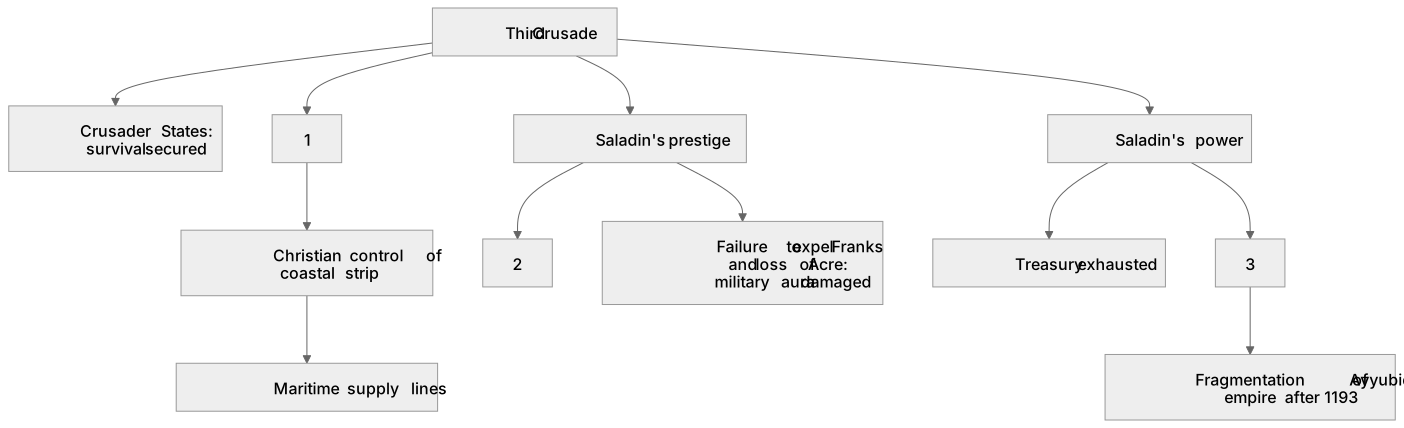
1Box 1
2Box 2
3Box 3
There is more to this lesson
The full lesson goes on to check your understanding and help you earn the marks. Create a free account to carry on, with your progress saved.
A week of Premium from your first lesson · Then the free plan continues · No card, no charge
Test your understanding of 1A The Age of the Crusades, c1071–1204 – The Third and Fourth Crusades, 1187–1204 (A-level only): The impact of the Third Crusade; Saladin’s power and prestige in the Muslim Near East
Active recall beats re-reading. Take an instant quiz now to test what you’ve learned and lock it into long-term memory.
A week of Premium from your first lesson · Then the free plan continues · No card, no charge