AQA · A-Level · History
Course version: 7042 · Version from Sept 2017
How important was the role of key individuals and groups and how were they…
Full specification wording
1B Spain in the Age of Discovery, 1469–1598 (A-level only) – consequence in this period through the following key questions:: How important was the role of key individuals and groups and how were they affected by developments?
This topic demands an evaluation of how monarchs, ministers, and social groups shaped, and were shaped by, Spain's evolution from 1469 to 1598.
Checked against the AQA 7042 specification (opens in a new tab) on .
- Point 6 of 6
Study notes
From the checked teaching notes for this specification point.
The idea
This topic demands an evaluation of how monarchs, ministers, and social groups shaped, and were shaped by, Spain's evolution from 1469 to 1598. For example, how the nobility's political power was curtailed by the Crown while retaining social prestige, or how the peasantry and conversos bore the brunt of economic inflation and the Inquisition. A strong analysis links individual decisions to broader socio-economic shifts, demonstrating the reciprocal relationship between people and state developments.
What earns the marks
- Assess the leadership and decision-making of key monarchs (Ferdinand, Isabella, Charles V, Philip II) in shaping domestic and foreign policy.
- Evaluate the influence of key ministers and advisors in administering the vast Spanish Empire.
- Analyse how the nobility, clergy, and peasantry were affected by economic developments, such as the price revolution and taxation.
- Examine the impact of religious policies, particularly the Inquisition, on minority groups like conversos and moriscos.
Common mistakes and how to put them right
Focusing solely on monarchs while ignoring the role of broader social groups.
Put it right: Ensure your analysis includes the nobility, peasantry, and religious minorities alongside royal figures.
Describing what individuals did without evaluating their importance.
Put it right: Explicitly weigh the significance of an individual's actions against underlying economic or structural factors.
Neglecting the second part of the question regarding how groups were affected.
Put it right: Actively discuss the consequences of state policies and economic shifts on the lived experience of different social classes.
Exam tips
- Structure your essay to explicitly address both the 'role' of individuals/groups and 'how they were affected' to ensure full coverage of the prompt.
- Use specific examples of ministers or regional rebellions (like the Comuneros) to illustrate the tension between central authority and local groups.
- Contrast the experiences of different social classes to demonstrate a nuanced understanding of Spain's socio-economic developments.
Try the lesson
The start of the 1B Spain in the Age of Discovery, 1469–1598 (A-level only) – consequence in this period through the following key questions:: How important was the role of key individuals and groups and how were they affected by developments? lesson, made from checked teaching notes for this specification point.
Have a go first
During the reigns of Ferdinand and Isabella, what was the primary role of the 'letrados' in the development of the Spanish state?
Listen
This topic demands an evaluation of how monarchs, ministers, and social groups shaped, and were shaped by, Spain's evolution from 1469 to 1598. For example, how the nobility's political power was curtailed by the Crown while retaining social prestige, or how the peasantry and conversos bore the brunt of economic inflation and the Inquisition. A strong analysis links individual decisions to broader socio-economic shifts, demonstrating the reciprocal relationship between people and state developments. A strong answer earns marks for these points. Assess the leadership and decision-making of key monarchs (Ferdinand, Isabella, Charles V, Philip II) in shaping domestic and foreign policy. Evaluate the influence of key ministers and advisors in administering the vast Spanish Empire. Analyse how the nobility, clergy, and peasantry were affected by economic developments, such as the price revolution and taxation. Examine the impact of religious policies, particularly the Inquisition, on minority groups like conversos and moriscos. A common slip: Focusing solely on monarchs while ignoring the role of broader social groups. Instead, Ensure your analysis includes the nobility, peasantry, and religious minorities alongside royal figures. Exam tip: Structure your essay to explicitly address both the 'role' of individuals/groups and 'how they were affected' to ensure full coverage of the prompt.
See it
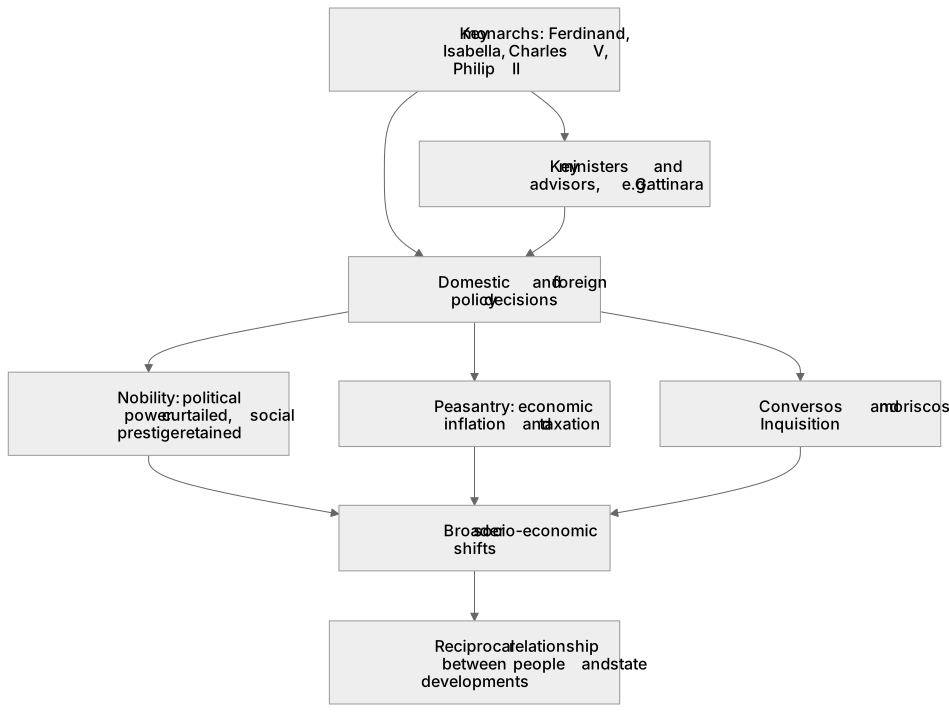
Label the diagram
Some boxes have lost their names. Pick the right name for each number.
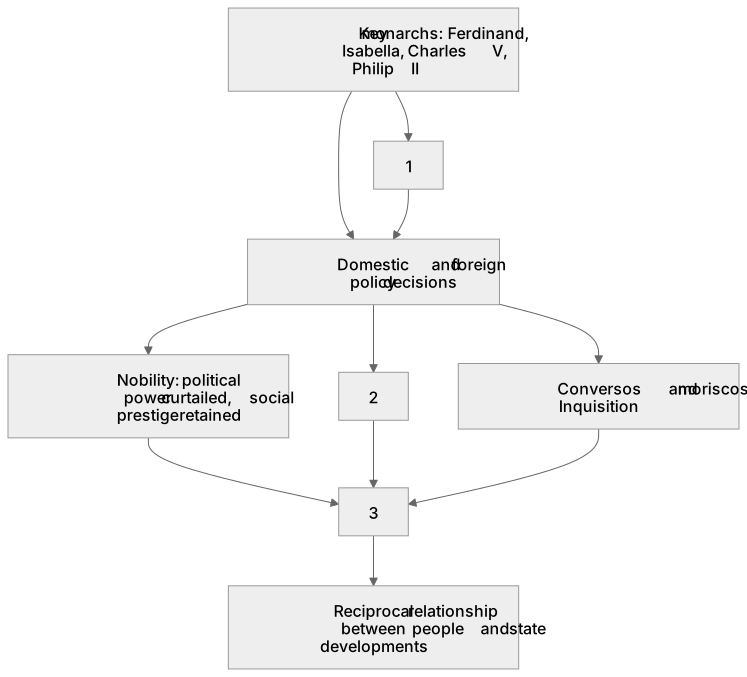
1Box 1
2Box 2
3Box 3
There is more to this lesson
The full lesson goes on to check your understanding and help you earn the marks. Create a free account to carry on, with your progress saved.
A week of Premium from your first lesson · Then the free plan continues · No card, no charge
Test your understanding of 1B Spain in the Age of Discovery, 1469–1598 (A-level only) – consequence in this period through the following key questions:: How important was the role of key individuals and groups and how were they affected by developments?
Active recall beats re-reading. Take an instant quiz now to test what you’ve learned and lock it into long-term memory.
A week of Premium from your first lesson · Then the free plan continues · No card, no charge