AQA · A-Level · History
Course version: 7042 · Version from Sept 2017
How important were religious and other new ideas in Spain's development?
Full specification wording
1B Spain in the Age of Discovery, 1469–1598 (A-level only) – consequence in this period through the following key questions:: How important were religious and other new ideas in Spain's development?
This topic explores the profound impact of religious and intellectual currents on Spain's evolution from 1469 to 1598.
Checked against the AQA 7042 specification (opens in a new tab) on .
- Point 4 of 6
- 2 key terms
Study notes
From the checked teaching notes for this specification point.
The idea
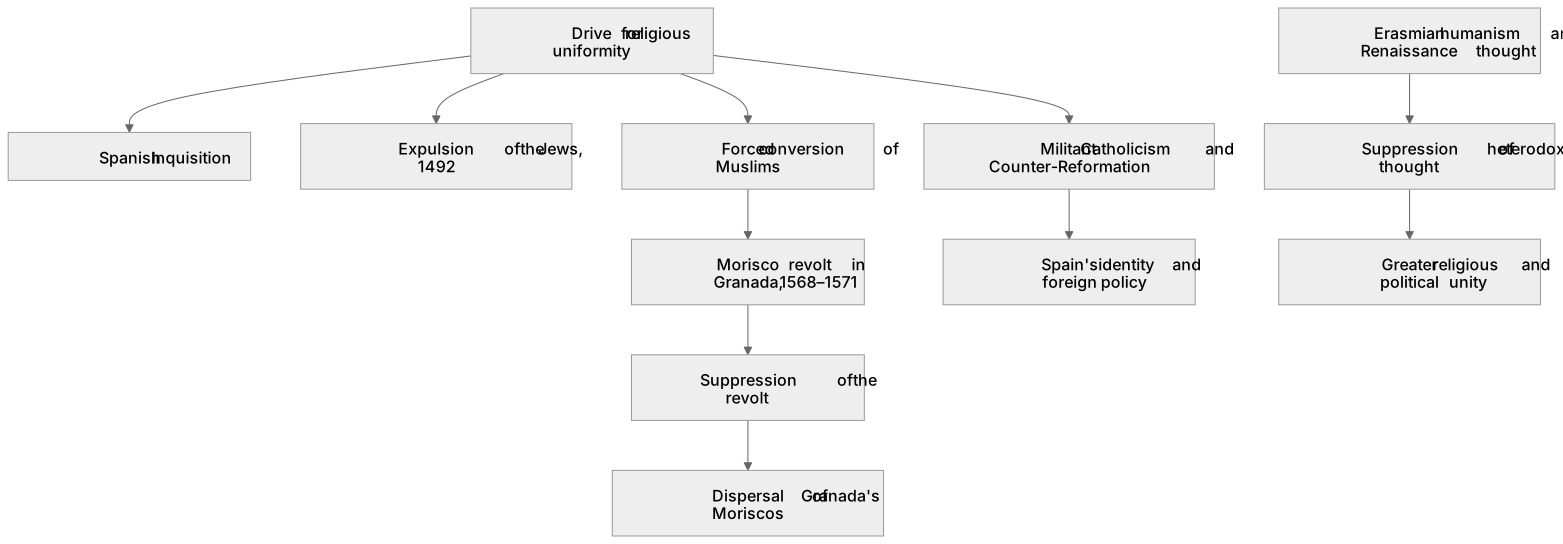
This topic explores the profound impact of religious and intellectual currents on Spain's evolution from 1469 to 1598. You must evaluate the drive for religious uniformity through the Spanish Inquisition, the expulsion of the Jews in 1492, the forced conversion of Muslims and the suppression of the Morisco revolt in Granada from 1568 to 1571. Assess how militant Catholicism and the Counter-Reformation shaped Spain's identity and foreign policy. Furthermore, examine the influence of other new ideas, including Erasmian humanism and Renaissance cultural shifts, particularly during Charles V's reign. Determine whether suppressing heterodox thought stifled development or helped the monarchy impose greater religious and political unity.
What earns the marks
- Evaluate the role of the Spanish Inquisition in enforcing religious orthodoxy, suppressing dissent and shaping a unified national identity.
- Assess the political, cultural and economic consequences of the expulsion of the Jews in 1492, forced conversion policies and the dispersal of Granada's Moriscos after the revolt of 1568–1571.
- Analyse the initial spread and subsequent suppression of Erasmian humanism, Renaissance thought and Protestant ideas within Spain.
- Examine how militant Catholicism and Counter-Reformation ideology influenced Spain's foreign policy and imperial expansion under Charles V and Philip II.
Common mistakes and how to put them right
Equating the Spanish Inquisition solely with religious persecution.
Put it right: Acknowledge its crucial role as a political tool used by the monarchy to centralise power across different kingdoms.
Ignoring intellectual movements outside of strict Catholicism.
Put it right: Discuss the significant, albeit temporary, influence of Renaissance humanism and Erasmian thought before the conservative backlash.
Confusing the post-1609 expulsion of the Moriscos with events before 1598.
Put it right: Use the forced conversions, the revolt of 1568–1571 and the subsequent dispersal of Granada's Moriscos for this period.
Exam tips
- Contrast the relatively open intellectual climate of the early sixteenth century with the closed, Counter-Reformation environment established under Philip II.
- Use the concept of 'limpieza de sangre' (purity of blood) to link religious ideas directly to social development, hierarchy and exclusion.
- When assessing 'importance', weigh the unifying political effects of religious orthodoxy against the long-term intellectual and economic costs of intolerance.
Try the lesson
The start of the 1B Spain in the Age of Discovery, 1469–1598 (A-level only) – consequence in this period through the following key questions:: How important were religious and other new ideas in Spain's development? lesson, made from checked teaching notes for this specification point.
Have a go first
Which institution was established in 1478 by Ferdinand and Isabella primarily to enforce religious uniformity and investigate the sincerity of conversos?
Listen
This topic explores the profound impact of religious and intellectual currents on Spain's evolution from 1469 to 1598. You must evaluate the drive for religious uniformity through the Spanish Inquisition, the expulsion of the Jews in 1492, the forced conversion of Muslims and the suppression of the Morisco revolt in Granada from 1568 to 1571. Assess how militant Catholicism and the Counter-Reformation shaped Spain's identity and foreign policy. Furthermore, examine the influence of other new ideas, including Erasmian humanism and Renaissance cultural shifts, particularly during Charles V's reign. Determine whether suppressing heterodox thought stifled development or helped the monarchy impose greater religious and political unity. A strong answer earns marks for these points. Evaluate the role of the Spanish Inquisition in enforcing religious orthodoxy, suppressing dissent and shaping a unified national identity. Assess the political, cultural and economic consequences of the expulsion of the Jews in 1492, forced conversion policies and the dispersal of Granada's Moriscos after the revolt of 1568–1571. Analyse the initial spread and subsequent suppression of Erasmian humanism, Renaissance thought and Protestant ideas within Spain. Examine how militant Catholicism and Counter-Reformation ideology influenced Spain's foreign policy and imperial expansion under Charles V and Philip II. A common slip: Equating the Spanish Inquisition solely with religious persecution. Instead, acknowledge its crucial role as a political tool used by the monarchy to centralise power across different kingdoms. Exam tip: Contrast the relatively open intellectual climate of the early sixteenth century with the closed, Counter-Reformation environment established under Philip II.
See it
Key words
Say what each word means before you turn the card.
Religious uniformity
Try answering aloud or in your head before turning the card.
Spanish Inquisition
Try answering aloud or in your head before turning the card.
See every definition
- Religious uniformity
- The drive to impose a single accepted faith, pursued through the Spanish Inquisition, the expulsion of the Jews in 1492, forced conversion of Muslims and suppression of the Morisco revolt.
- Spanish Inquisition
- An instrument used by the monarchy to enforce religious orthodoxy, suppress dissent and shape a unified national identity, and also a political tool to centralise power across different kingdoms.
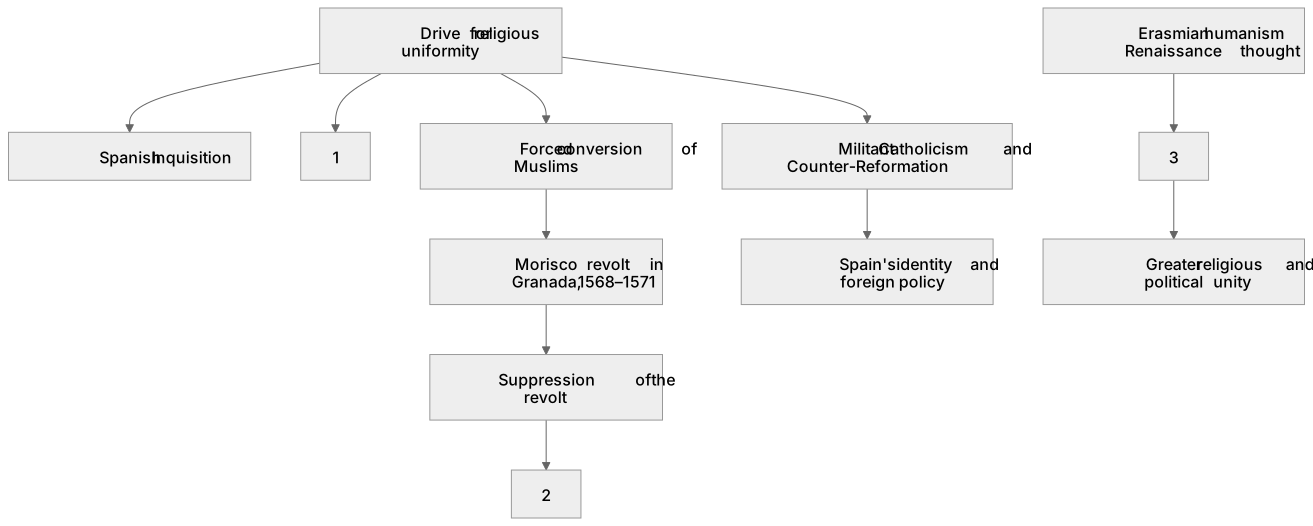
Label the diagram
Some boxes have lost their names. Pick the right name for each number.
1Box 1
2Box 2
3Box 3
There is more to this lesson
The full lesson goes on to check your understanding and help you earn the marks. Create a free account to carry on, with your progress saved.
A week of Premium from your first lesson · Then the free plan continues · No card, no charge
Test your understanding of 1B Spain in the Age of Discovery, 1469–1598 (A-level only) – consequence in this period through the following key questions:: How important were religious and other new ideas in Spain's development?
Active recall beats re-reading. Take an instant quiz now to test what you’ve learned and lock it into long-term memory.
A week of Premium from your first lesson · Then the free plan continues · No card, no charge