AQA · A-Level · History
Course version: 7042 · Version from Sept 2017
Charles' inheritance; opposition and consolidation; revolts of the…
Full specification wording
1B Spain in the Age of Discovery, 1469–1598 (A-level only) – The drive to 'Great Power' status, 1516–1556: Charles' inheritance; opposition and consolidation; revolts of the Communeros and Germania
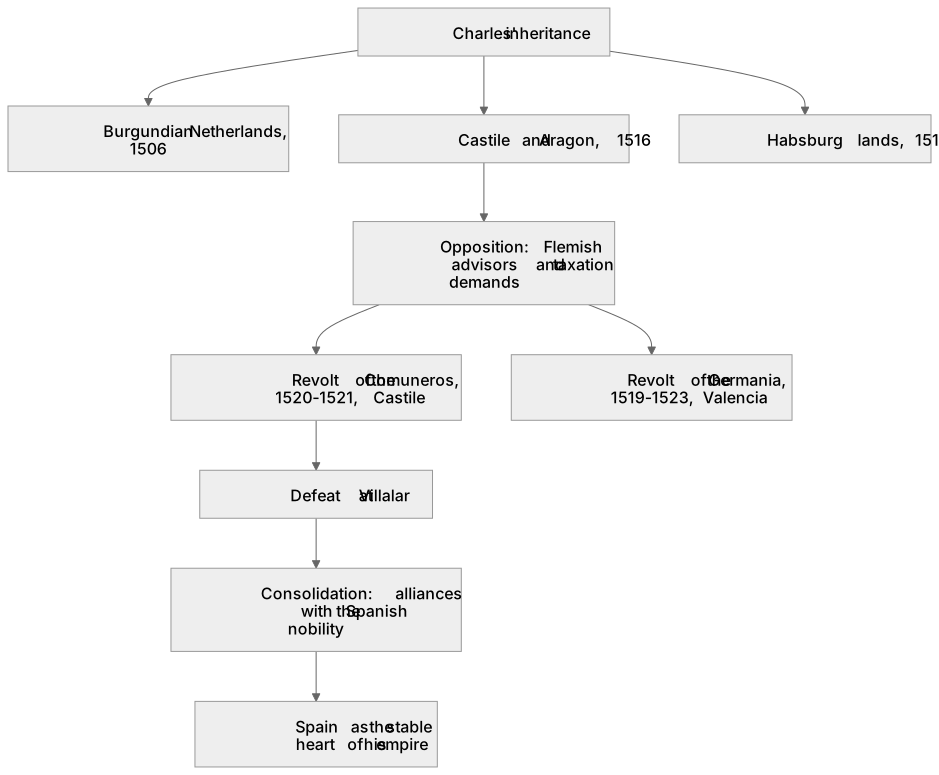
Charles I inherited a fragmented empire, acquiring the Burgundian Netherlands in 1506, Castile and Aragon in 1516, and the Habsburg lands in 1519.
Checked against the AQA 7042 specification (opens in a new tab) on .
- Point 1 of 6
- 4 key terms
Study notes
From the checked teaching notes for this specification point.
The idea
Charles I inherited a fragmented empire, acquiring the Burgundian Netherlands in 1506, Castile and Aragon in 1516, and the Habsburg lands in 1519. His arrival sparked opposition due to his reliance on Flemish advisors and demands for taxation to fund imperial ambitions. This discontent fuelled two major uprisings. The Revolt of the Comuneros (1520–1521) in Castile saw urban elites rebel against foreign influence, ending with their defeat at Villalar. Concurrently, the Revolt of the Germania (1519–1523) in Valencia involved artisan guilds rising against local nobility. Charles consolidated his power by forging alliances with the Spanish nobility and learning Castilian, transforming Spain into the stable heart of his empire.
What earns the marks
- Identify the diverse nature of Charles's inheritance, distinguishing between the Burgundian territories acquired in 1506, the Spanish crowns in 1516, and the Habsburg lands in 1519.
- Explain the causes of early opposition, including Charles's absenteeism, foreign entourage, and financial demands for his Holy Roman Emperor election.
- Analyse the Revolt of the Comuneros as a political rebellion by Castilian towns seeking to protect their traditional liberties and influence.
- Evaluate the Revolt of the Germania as a social conflict driven by artisan guilds against the aristocracy and their Mudéjar vassals.
- Assess the methods of consolidation, particularly Charles's strategic alignment with the grandees who helped suppress the rebellions.
Common mistakes and how to put them right
Confusing the causes of the two revolts.
Put it right: The Comuneros was primarily a political revolt against royal policy in Castile, whereas the Germania was a social conflict against the nobility in Valencia.
Assuming Charles was immediately accepted as a Spanish king.
Put it right: Charles was initially viewed as a foreign interloper who did not speak Castilian and exploited Spanish wealth.
Overstating the unity of Spain in 1516.
Put it right: Recognise that Charles inherited separate crowns with distinct laws, cortes, and administrative systems, not a unified nation-state.
Exam tips
- Compare the differing motivations and social compositions of the Comuneros and Germania rebels to demonstrate analytical depth.
- Use the Battle of Villalar (1521) as a key turning point in Charles's relationship with the Castilian nobility.
- Link Charles's early difficulties in Spain to his wider European commitments, such as his election as Holy Roman Emperor in 1519.
Try the lesson
The start of the 1B Spain in the Age of Discovery, 1469–1598 (A-level only) – The drive to 'Great Power' status, 1516–1556: Charles' inheritance; opposition and consolidation; revolts of the Communeros and Germania lesson, made from checked teaching notes for this specification point.
Have a go first
Which combination of territories did Charles I of Spain inherit directly from his maternal grandparents, Ferdinand and Isabella?
Listen
Charles I inherited a fragmented empire, acquiring the Burgundian Netherlands in 1506, Castile and Aragon in 1516, and the Habsburg lands in 1519. His arrival sparked opposition due to his reliance on Flemish advisors and demands for taxation to fund imperial ambitions. This discontent fuelled two major uprisings. The Revolt of the Comuneros (1520–1521) in Castile saw urban elites rebel against foreign influence, ending with their defeat at Villalar. Concurrently, the Revolt of the Germania (1519–1523) in Valencia involved artisan guilds rising against local nobility. Charles consolidated his power by forging alliances with the Spanish nobility and learning Castilian, transforming Spain into the stable heart of his empire. A strong answer earns marks for these points. Identify the diverse nature of Charles's inheritance, distinguishing between the Burgundian territories acquired in 1506, the Spanish crowns in 1516, and the Habsburg lands in 1519. Explain the causes of early opposition, including Charles's absenteeism, foreign entourage, and financial demands for his Holy Roman Emperor election. Analyse the Revolt of the Comuneros as a political rebellion by Castilian towns seeking to protect their traditional liberties and influence. Evaluate the Revolt of the Germania as a social conflict driven by artisan guilds against the aristocracy and their Mudéjar vassals. A common slip: Confusing the causes of the two revolts. Instead, The Comuneros was primarily a political revolt against royal policy in Castile, whereas the Germania was a social conflict against the nobility in Valencia. Exam tip: Compare the differing motivations and social compositions of the Comuneros and Germania rebels to demonstrate analytical depth.
See it
Put the events in order
Put these events in the order they happened, earliest first.
- 1. Charles inherited Castile and Aragon
- 2. Charles acquired the Burgundian Netherlands
- 3. Comuneros defeated at the Battle of Villalar
- 4. Charles inherited the Habsburg lands
- 5. Revolt of the Comuneros began in Castile
Key words
Say what each word means before you turn the card.
Revolt of the Comuneros
Try answering aloud or in your head before turning the card.
Revolt of the Germania
Try answering aloud or in your head before turning the card.
Consolidation
Try answering aloud or in your head before turning the card.
Grandees
Try answering aloud or in your head before turning the card.
See every definition
- Revolt of the Comuneros
- A rebellion in Castile in which urban elites rose against foreign influence and were defeated at Villalar.
- Revolt of the Germania
- An uprising in Valencia in which artisan guilds rose against the local nobility.
- Consolidation
- Charles's forging of alliances with the Spanish nobility and learning Castilian, transforming Spain into the stable heart of his empire.
- Grandees
- The Spanish nobility with whom Charles aligned and who helped suppress the rebellions.
Label the diagram
Some boxes have lost their names. Pick the right name for each number.
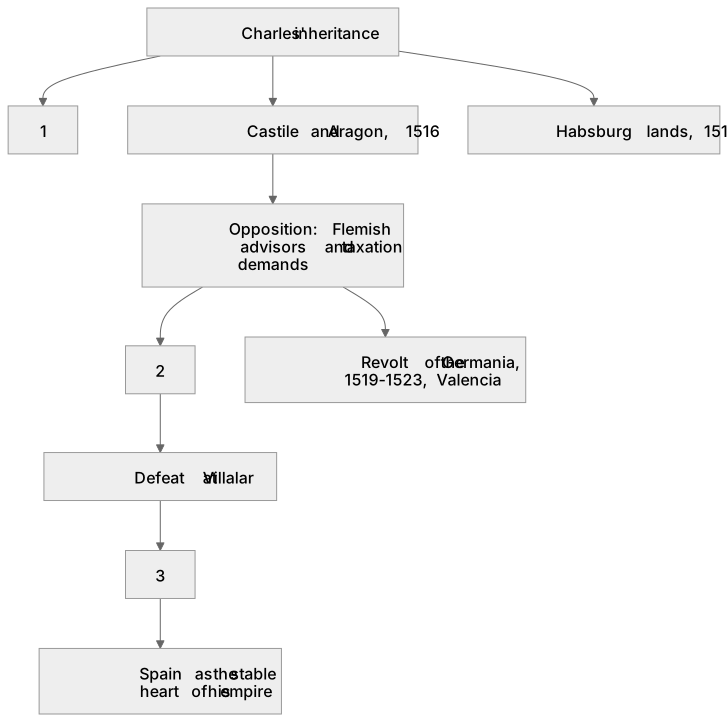
1Box 1
2Box 2
3Box 3
There is more to this lesson
The full lesson goes on to check your understanding and help you earn the marks. Create a free account to carry on, with your progress saved.
A week of Premium from your first lesson · Then the free plan continues · No card, no charge
Test your understanding of 1B Spain in the Age of Discovery, 1469–1598 (A-level only) – The drive to 'Great Power' status, 1516–1556: Charles' inheritance; opposition and consolidation; revolts of the Communeros and Germania
Active recall beats re-reading. Take an instant quiz now to test what you’ve learned and lock it into long-term memory.
A week of Premium from your first lesson · Then the free plan continues · No card, no charge