AQA · A-Level · History
Course version: 7042 · Version from Sept 2017
The restoration of royal authority; royal government; unity and…
Full specification wording
1B Spain in the Age of Discovery, 1469–1598 (A-level only) – The forging of a new state, 1469–1516: The restoration of royal authority; royal government; unity and confederation; relations with other European powers
Ferdinand and Isabella restored royal authority by subduing rebellious nobles through the use of the Santa Hermandad (a crown-controlled police force) and reclaiming alienated crown lands at the…
Checked against the AQA 7042 specification (opens in a new tab) on .
- Point 2 of 6
- 4 key terms
Study notes
From the checked teaching notes for this specification point.
The idea
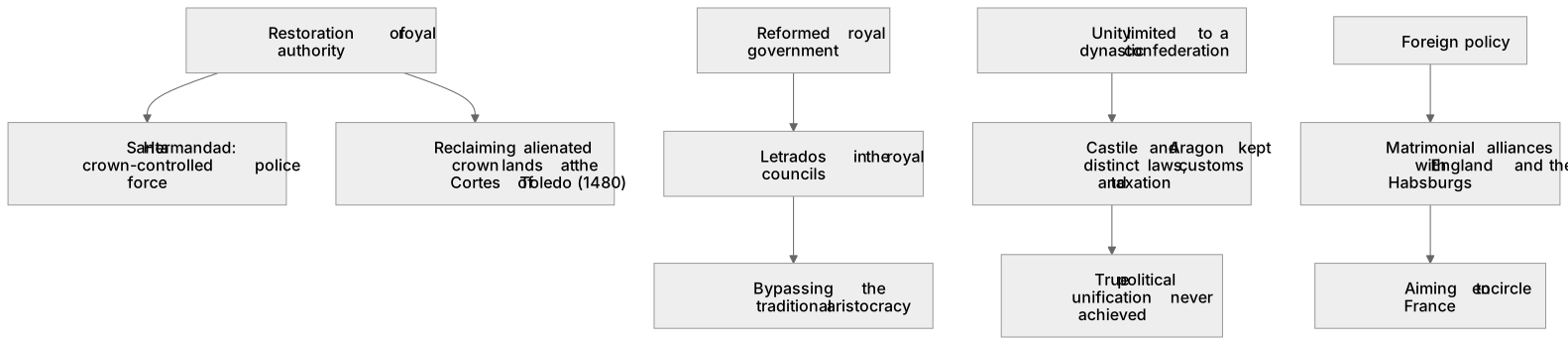
Ferdinand and Isabella restored royal authority by subduing rebellious nobles through the use of the Santa Hermandad (a crown-controlled police force) and reclaiming alienated crown lands at the Cortes of Toledo (1480). Royal government was reformed by relying on letrados (university-educated lawyers) in the royal councils, bypassing the traditional aristocracy. Despite their marriage, unity was limited to a dynastic confederation; Castile and Aragon retained their distinct laws, customs, and taxation systems, meaning true political unification was never achieved. In foreign policy, they expanded their influence through strategic matrimonial alliances with England and the Habsburgs, aiming to encircle their primary rival, France, while securing their borders and Mediterranean interests.
What earns the marks
- Explain the mechanisms used to restore royal authority, such as the Santa Hermandad and the Act of Resumption (1480).
- Analyze the restructuring of royal government, particularly the professionalisation of the Royal Council using letrados.
- Evaluate the nature of the union between Castile and Aragon as a dynastic confederation rather than a unified, centralized state.
- Assess the strategic goals of their foreign policy, focusing on anti-French alliances and the use of dynastic marriages.
Common mistakes and how to put them right
Claiming Ferdinand and Isabella created a fully unified Spanish nation.
Put it right by explaining they operated a dual monarchy where each kingdom kept its own laws and institutions.
Stating that the nobility lost all their power.
Put it right by noting that while their political power in government was reduced, their social and economic dominance remained intact.
Viewing foreign policy as solely focused on the New World.
Put it right by emphasizing that European relations, particularly containing France and securing Italy, were their primary diplomatic concerns.
Exam tips
- Use specific examples of government machinery, such as the corregidores and the letrados, to demonstrate knowledge of royal government.
- When discussing unity, explicitly contrast the theoretical concept of a united Spain with the practical reality of a confederation of distinct realms.
- Link foreign policy directly to dynastic security, showing how the marriages of their children were used as diplomatic weapons against France.
Try the lesson
The start of the 1B Spain in the Age of Discovery, 1469–1598 (A-level only) – The forging of a new state, 1469–1516: The restoration of royal authority; royal government; unity and confederation; relations with other European powers lesson, made from checked teaching notes for this specification point.
Have a go first
Which institution was established by Isabella and Ferdinand in 1476 to restore royal authority and maintain law and order in Castile?
Listen
Ferdinand and Isabella restored royal authority by subduing rebellious nobles through the use of the Santa Hermandad (a crown-controlled police force) and reclaiming alienated crown lands at the Cortes of Toledo (1480). Royal government was reformed by relying on letrados (university-educated lawyers) in the royal councils, bypassing the traditional aristocracy. Despite their marriage, unity was limited to a dynastic confederation; Castile and Aragon retained their distinct laws, customs, and taxation systems, meaning true political unification was never achieved. In foreign policy, they expanded their influence through strategic matrimonial alliances with England and the Habsburgs, aiming to encircle their primary rival, France, while securing their borders and Mediterranean interests. A strong answer earns marks for these points. Explain the mechanisms used to restore royal authority, such as the Santa Hermandad and the Act of Resumption (1480). Analyze the restructuring of royal government, particularly the professionalisation of the Royal Council using letrados. Evaluate the nature of the union between Castile and Aragon as a dynastic confederation rather than a unified, centralized state. Assess the strategic goals of their foreign policy, focusing on anti-French alliances and the use of dynastic marriages. A common slip: Claiming Ferdinand and Isabella created a fully unified Spanish nation. Instead, explaining they operated a dual monarchy where each kingdom kept its own laws and institutions. Exam tip: Use specific examples of government machinery, such as the corregidores and the letrados, to demonstrate knowledge of royal government.
See it
Key words
Say what each word means before you turn the card.
Centralisation of power
Try answering aloud or in your head before turning the card.
Bureaucratic reform
Try answering aloud or in your head before turning the card.
Dynastic confederation vs. national unity
Try answering aloud or in your head before turning the card.
Diplomatic alliances and European rivalry
Try answering aloud or in your head before turning the card.
See every definition
- Centralisation of power
- Royal authority was restored by subduing rebellious nobles through the Santa Hermandad and reclaiming alienated crown lands at the Cortes of Toledo.
- Bureaucratic reform
- Royal government was reformed by relying on letrados, university-educated lawyers, in the royal councils, bypassing the traditional aristocracy.
- Dynastic confederation vs. national unity
- Unity was limited to a dynastic confederation, as Castile and Aragon retained their distinct laws, customs, and taxation systems, so true political unification was never achieved.
- Diplomatic alliances and European rivalry
- Influence was expanded through strategic matrimonial alliances with England and the Habsburgs, aiming to encircle their primary rival, France, while securing borders and Mediterranean interests.
Label the diagram
Some boxes have lost their names. Pick the right name for each number.
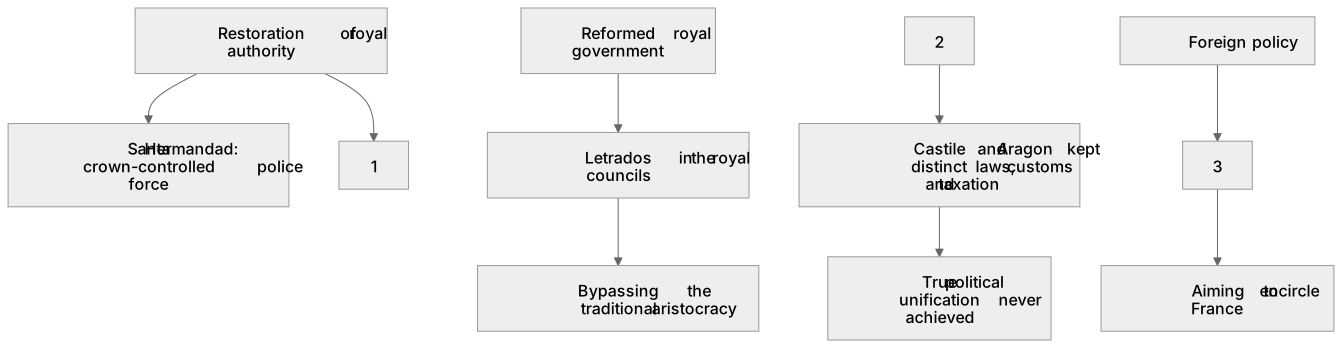
1Box 1
2Box 2
3Box 3
There is more to this lesson
The full lesson goes on to check your understanding and help you earn the marks. Create a free account to carry on, with your progress saved.
A week of Premium from your first lesson · Then the free plan continues · No card, no charge
Test your understanding of 1B Spain in the Age of Discovery, 1469–1598 (A-level only) – The forging of a new state, 1469–1516: The restoration of royal authority; royal government; unity and confederation; relations with other European powers
Active recall beats re-reading. Take an instant quiz now to test what you’ve learned and lock it into long-term memory.
A week of Premium from your first lesson · Then the free plan continues · No card, no charge