AQA · A-Level · History
Course version: 7042 · Version from Sept 2017
England, 1485–1603 – Henry VII, 1485–1509: Religion; humanism; arts and…
Full specification wording
1C The Tudors: England, 1485–1603 – Henry VII, 1485–1509: Religion; humanism; arts and learning
During Henry VII's reign, religion remained firmly rooted in traditional Catholicism, with the Church playing a central role in community life and social control, while Lollardy survived only as a…
Checked against the AQA 7042 specification (opens in a new tab) on .
- Point 6 of 6
Study notes
From the checked teaching notes for this specification point.
The idea
During Henry VII's reign, religion remained firmly rooted in traditional Catholicism, with the Church playing a central role in community life and social control, while Lollardy survived only as a marginal underground movement. The period witnessed the early emergence of Renaissance humanism in England, championed by scholars like John Colet and Thomas More, who sought to reform education and religious practice. Learning expanded through the foundation of new grammar schools and university colleges, aided by the growing influence of the printing press. The arts flourished under royal patronage, most notably in the perpendicular Gothic architecture of Henry VII's Lady Chapel at Westminster Abbey, reflecting both piety and dynastic pride.
What earns the marks
- Describe the pervasive influence of the Catholic Church in daily life, including the importance of the sacraments, guilds, and chantries.
- Evaluate the limited threat posed by Lollardy and the general absence of widespread anti-clericalism before 1509.
- Analyse the introduction of humanism into England, noting the contributions of figures like John Colet, Thomas More, and Thomas Linacre.
- Assess the development of learning, highlighting the foundation of new grammar schools and the impact of William Caxton's printing press.
- Explain the significance of royal patronage in the arts, particularly the architectural achievements like Henry VII's Lady Chapel at Westminster Abbey.
Common mistakes and how to put them right
Assuming the English Church was deeply unpopular or corrupt under Henry VII.
Put it right: Emphasise that the Church was generally well-supported and central to community life, with anti-clericalism being rare.
Exaggerating the immediate impact of humanism on the general population.
Put it right: Clarify that humanism was restricted to a small, educated elite during Henry VII's reign and did not cause widespread religious change.
Confusing the religious changes of Henry VIII with those of Henry VII.
Put it right: Maintain strict focus on the pre-Reformation, orthodox Catholic context of Henry VII's reign.
Exam tips
- Use Henry VII's Lady Chapel at Westminster Abbey as a concrete example of how the arts were used to project dynastic legitimacy and religious piety.
- When discussing learning, mention the printing press to explain how humanist ideas and standardized texts began to circulate among the elite.
- Contrast the orthodox religious devotion of the majority with the isolated, underground survival of Lollardy to evaluate the stability of the Church.
Try the lesson
The start of the 1C The Tudors: England, 1485–1603 – Henry VII, 1485–1509: Religion; humanism; arts and learning lesson, made from checked teaching notes for this specification point.
Have a go first
Which statement most accurately describes the position and role of the Church in England during the reign of Henry VII?
Listen
During Henry VII's reign, religion remained firmly rooted in traditional Catholicism, with the Church playing a central role in community life and social control, while Lollardy survived only as a marginal underground movement. The period witnessed the early emergence of Renaissance humanism in England, championed by scholars like John Colet and Thomas More, who sought to reform education and religious practice. Learning expanded through the foundation of new grammar schools and university colleges, aided by the growing influence of the printing press. The arts flourished under royal patronage, most notably in the perpendicular Gothic architecture of Henry VII's Lady Chapel at Westminster Abbey, reflecting both piety and dynastic pride. A strong answer earns marks for these points. Describe the pervasive influence of the Catholic Church in daily life, including the importance of the sacraments, guilds, and chantries. Evaluate the limited threat posed by Lollardy and the general absence of widespread anti-clericalism before 1509. Analyse the introduction of humanism into England, noting the contributions of figures like John Colet, Thomas More, and Thomas Linacre. Assess the development of learning, highlighting the foundation of new grammar schools and the impact of William Caxton's printing press. A common slip: Assuming the English Church was deeply unpopular or corrupt under Henry VII. Instead, Emphasise that the Church was generally well-supported and central to community life, with anti-clericalism being rare. Exam tip: Use Henry VII's Lady Chapel at Westminster Abbey as a concrete example of how the arts were used to project dynastic legitimacy and religious piety.
See it
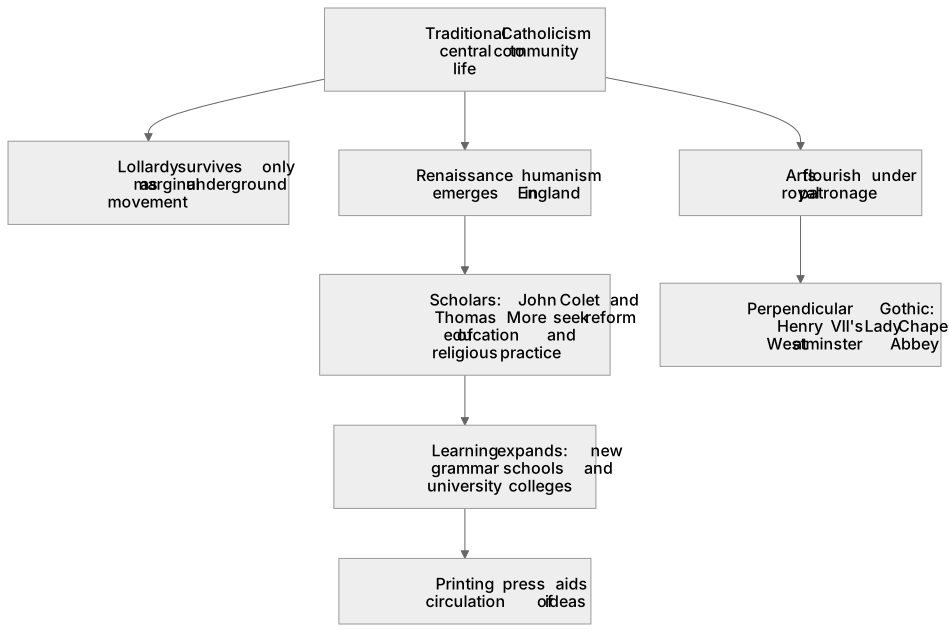
Label the diagram
Some boxes have lost their names. Pick the right name for each number.
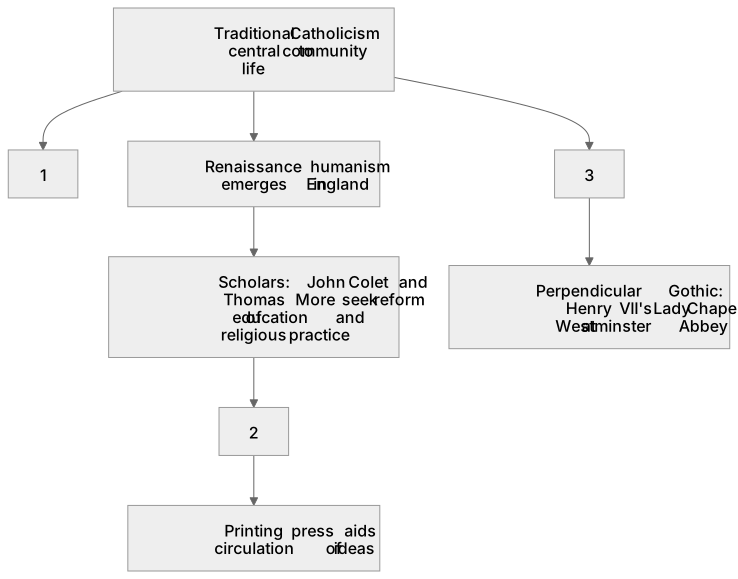
1Box 1
2Box 2
3Box 3
There is more to this lesson
The full lesson goes on to check your understanding and help you earn the marks. Create a free account to carry on, with your progress saved.
A week of Premium from your first lesson · Then the free plan continues · No card, no charge
Test your understanding of 1C The Tudors: England, 1485–1603 – Henry VII, 1485–1509: Religion; humanism; arts and learning
Active recall beats re-reading. Take an instant quiz now to test what you’ve learned and lock it into long-term memory.
A week of Premium from your first lesson · Then the free plan continues · No card, no charge