AQA · A-Level · History
Course version: 7042 · Version from Sept 2017
England, 1485–1603 – The triumph of Elizabeth, 1563–1603 (A-level only):…
Full specification wording
1C The Tudors: England, 1485–1603 – The triumph of Elizabeth, 1563–1603 (A-level only): Religious developments, change and continuity; the English renaissance and ‘the Golden Age’ of art, literature and music
Elizabethan England balanced religious change and continuity.
Checked against the AQA 7042 specification (opens in a new tab) on .
- Point 5 of 6
- 4 key terms
Study notes
From the checked teaching notes for this specification point.
The idea
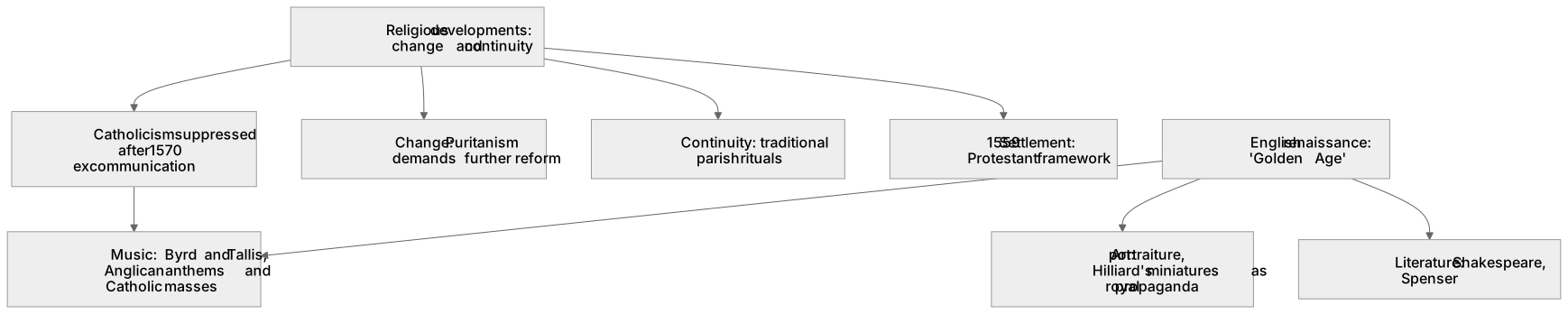
Elizabethan England balanced religious change and continuity. The 1559 Settlement created a Protestant framework, yet continuity persisted through traditional parish rituals. Change accelerated as Puritanism demanded further reform and Catholicism faced suppression after the 1570 excommunication. Concurrently, England experienced a cultural renaissance, dubbed a 'Golden Age'. Literature flourished through Shakespeare's plays and Spenser's poetry. Art saw the rise of portraiture, notably Hilliard's miniatures, serving as royal propaganda. Music thrived with composers like Byrd and Tallis, who navigated the religious divide by producing both Anglican anthems and Catholic masses, reflecting the era's complex cultural synthesis.
What earns the marks
- Evaluate the extent to which the 1559 Religious Settlement represented a compromise between Protestant change and Catholic continuity.
- Analyse the impact of the English Renaissance on the development of a distinct national identity and royal propaganda.
- Assess the contributions of key figures in literature, art, and music to the concept of an Elizabethan 'Golden Age'.
- Examine how cultural developments, particularly in music and theatre, reflected the underlying religious and political tensions of the period.
Common mistakes and how to put them right
Assuming the 'Golden Age' was universally experienced.
Put it right: Acknowledge that this cultural flourishing was largely confined to the elite and urban centres like London.
Treating religious change as an immediate transformation.
Put it right: Emphasise that the transition to a Protestant nation was gradual, with significant continuity of traditional beliefs at the parish level.
Viewing Elizabethan culture as entirely secular.
Put it right: Recognise that religion heavily influenced art, literature, and music, with composers like Tallis writing for both Protestant and Catholic services.
Exam tips
- Use specific examples of cultural output, such as Hilliard's 'Pelican Portrait', to demonstrate how art was used to cultivate the cult of Gloriana.
- When discussing religious continuity, reference the survival of Church Papists and the slow decline of traditional Catholic practices in the North.
- Link cultural developments to political stability, arguing whether the 'Golden Age' was a product of peace or a deliberate tool for state control.
Try the lesson
The start of the 1C The Tudors: England, 1485–1603 – The triumph of Elizabeth, 1563–1603 (A-level only): Religious developments, change and continuity; the English renaissance and ‘the Golden Age’ of art, literature and music lesson, made from checked teaching notes for this specification point.
Have a go first
Which of the following best describes the primary focus of the 'Golden Age' of Elizabethan literature?
Listen
Elizabethan England balanced religious change and continuity. The 1559 Settlement created a Protestant framework, yet continuity persisted through traditional parish rituals. Change accelerated as Puritanism demanded further reform and Catholicism faced suppression after the 1570 excommunication. Concurrently, England experienced a cultural renaissance, dubbed a 'Golden Age'. Literature flourished through Shakespeare's plays and Spenser's poetry. Art saw the rise of portraiture, notably Hilliard's miniatures, serving as royal propaganda. Music thrived with composers like Byrd and Tallis, who navigated the religious divide by producing both Anglican anthems and Catholic masses, reflecting the era's complex cultural synthesis. A strong answer earns marks for these points. Evaluate the extent to which the 1559 Religious Settlement represented a compromise between Protestant change and Catholic continuity. Analyse the impact of the English Renaissance on the development of a distinct national identity and royal propaganda. Assess the contributions of key figures in literature, art, and music to the concept of an Elizabethan 'Golden Age'. Examine how cultural developments, particularly in music and theatre, reflected the underlying religious and political tensions of the period. A common slip: Assuming the 'Golden Age' was universally experienced. Instead, acknowledge that this cultural flourishing was largely confined to the elite and urban centres like London. Exam tip: Use specific examples of cultural output, such as Hilliard's 'Pelican Portrait', to demonstrate how art was used to cultivate the cult of Gloriana.
See it
Key words
Say what each word means before you turn the card.
Cultural flourishing and the Renaissance
Try answering aloud or in your head before turning the card.
Religious compromise and conflict
Try answering aloud or in your head before turning the card.
Propaganda and the image of the monarchy
Try answering aloud or in your head before turning the card.
Continuity versus change in society
Try answering aloud or in your head before turning the card.
See every definition
- Cultural flourishing and the Renaissance
- England experienced a cultural renaissance, dubbed a 'Golden Age', in which literature, art and music flourished.
- Religious compromise and conflict
- The 1559 Settlement created a Protestant framework, yet continuity persisted through traditional parish rituals, while Puritanism demanded further reform and Catholicism faced suppression after the 1570 excommunication.
- Propaganda and the image of the monarchy
- Art saw the rise of portraiture, notably Hilliard's miniatures, serving as royal propaganda.
- Continuity versus change in society
- Change accelerated as Puritanism demanded further reform and Catholicism faced suppression, while continuity persisted through traditional parish rituals.
Label the diagram
Some boxes have lost their names. Pick the right name for each number.
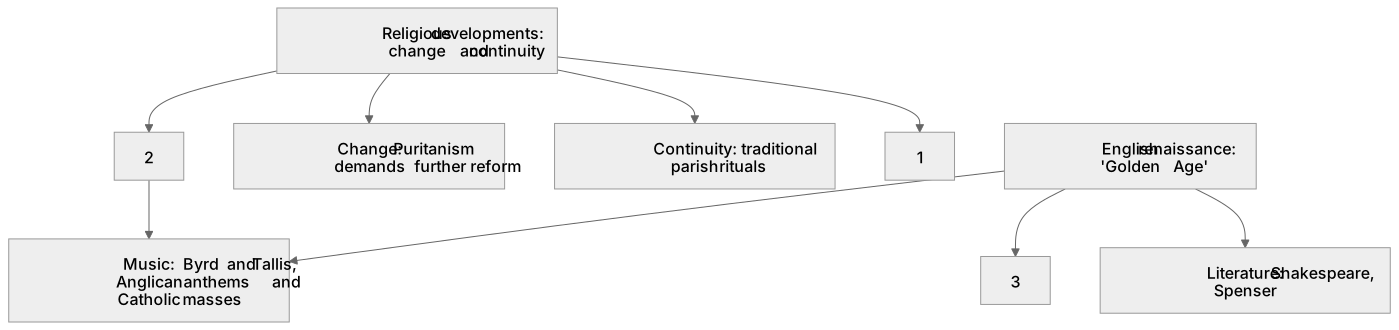
1Box 1
2Box 2
3Box 3
There is more to this lesson
The full lesson goes on to check your understanding and help you earn the marks. Create a free account to carry on, with your progress saved.
A week of Premium from your first lesson · Then the free plan continues · No card, no charge
Test your understanding of 1C The Tudors: England, 1485–1603 – The triumph of Elizabeth, 1563–1603 (A-level only): Religious developments, change and continuity; the English renaissance and ‘the Golden Age’ of art, literature and music
Active recall beats re-reading. Take an instant quiz now to test what you’ve learned and lock it into long-term memory.
A week of Premium from your first lesson · Then the free plan continues · No card, no charge