AQA · A-Level · History
Course version: 7042 · Version from Sept 2017
How far did the monarchy change?
Full specification wording
1D Stuart Britain and the Crisis of Monarchy, 1603–1702 – consequence in this period through the following key questions:: How far did the monarchy change?
This topic evaluates the transformation of the English monarchy between 1603 and 1702.
Checked against the AQA 7042 specification (opens in a new tab) on .
- Point 1 of 6
- 3 key terms
Study notes
From the checked teaching notes for this specification point.
The idea
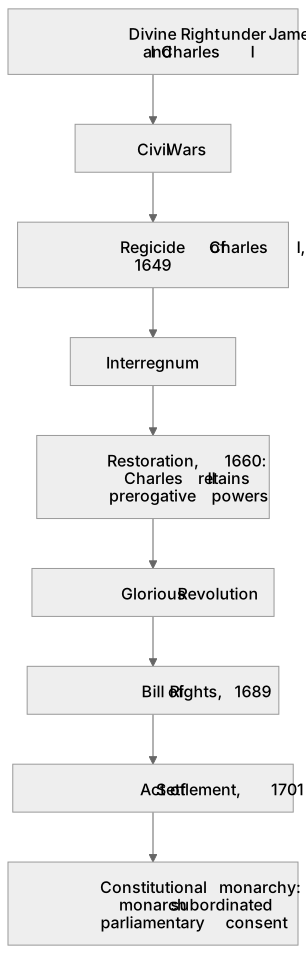
This topic evaluates the transformation of the English monarchy between 1603 and 1702. The period encompasses radical disruption, notably the regicide of Charles I in 1649 and the Interregnum. Although the monarchy was restored in 1660 with Charles II retaining significant prerogative powers, the Glorious Revolution fundamentally altered the institution. By analysing the 1689 Bill of Rights and the 1701 Act of Settlement, students can demonstrate how the monarch's ability to suspend laws or raise taxes was permanently subordinated to parliamentary consent, marking a profound constitutional shift.
What earns the marks
- Assess the ideological shift from the Divine Right of Kings under James I to a monarchy constrained by parliamentary statute after 1689.
- Evaluate the impact of the Civil Wars and the 1649 regicide in temporarily dismantling the monarchical structure.
- Analyse the limitations of the 1660 Restoration Settlement in defining the exact boundaries of royal prerogative versus parliamentary privilege.
- Examine the significance of the Bill of Rights (1689) and Act of Settlement (1701) in establishing a constitutional monarchy and securing Protestant succession.
Common mistakes and how to put them right
Claiming the monarchy was completely powerless after 1689.
Put it right: Acknowledge that William III and Mary II still retained significant executive powers, including directing foreign policy and choosing ministers.
Assuming the Restoration in 1660 returned the monarchy to its exact pre-1640 state.
Put it right: Note that while prerogative was restored, key prerogative courts like the Star Chamber remained permanently abolished.
Treating the entire Stuart period as a linear decline in royal power.
Put it right: Recognise the fluctuations, such as Charles II's period of personal rule in the early 1680s following the Exclusion Crisis.
Exam tips
- Use specific constitutional documents, such as the Triennial Acts or the Bill of Rights, to provide concrete evidence of changing royal power.
- When evaluating 'how far', explicitly contrast the beginning of the period (1603) with the end (1702) to establish the overall trajectory of change.
- Distinguish between theoretical claims of royal power, such as Divine Right, and the practical limitations monarchs faced in enforcing their will.
Try the lesson
The start of the 1D Stuart Britain and the Crisis of Monarchy, 1603–1702 – consequence in this period through the following key questions:: How far did the monarchy change? lesson, made from checked teaching notes for this specification point.
Have a go first
Which event most significantly altered the theoretical basis of the English monarchy by establishing that the monarch ruled by consent of Parliament rather than divine right?
Listen
This topic evaluates the transformation of the English monarchy between 1603 and 1702. The period encompasses radical disruption, notably the regicide of Charles I in 1649 and the Interregnum. Although the monarchy was restored in 1660 with Charles II retaining significant prerogative powers, the Glorious Revolution fundamentally altered the institution. By analysing the 1689 Bill of Rights and the 1701 Act of Settlement, students can demonstrate how the monarch's ability to suspend laws or raise taxes was permanently subordinated to parliamentary consent, marking a profound constitutional shift. A strong answer earns marks for these points. Assess the ideological shift from the Divine Right of Kings under James I to a monarchy constrained by parliamentary statute after 1689. Evaluate the impact of the Civil Wars and the 1649 regicide in temporarily dismantling the monarchical structure. Analyse the limitations of the 1660 Restoration Settlement in defining the exact boundaries of royal prerogative versus parliamentary privilege. Examine the significance of the Bill of Rights (1689) and Act of Settlement (1701) in establishing a constitutional monarchy and securing Protestant succession. A common slip: Claiming the monarchy was completely powerless after 1689. Instead, Acknowledge that William III and Mary II still retained significant executive powers, including directing foreign policy and choosing ministers. Exam tip: Use specific constitutional documents, such as the Triennial Acts or the Bill of Rights, to provide concrete evidence of changing royal power.
See it
Put the events in order
Put these events in the order they happened, earliest first.
- 1. Act of Settlement
- 2. Regicide of Charles I
- 3. Bill of Rights
- 4. Monarchy restored with Charles II
Key words
Say what each word means before you turn the card.
Divine Right
Try answering aloud or in your head before turning the card.
Royal Prerogative
Try answering aloud or in your head before turning the card.
The Glorious Revolution
Try answering aloud or in your head before turning the card.
See every definition
- Divine Right
- The early Stuart assertion of royal authority, exemplified by James I and Charles I, which the period shifted away from.
- Royal Prerogative
- Powers retained by Charles II after 1660, whose exact boundaries against parliamentary privilege the Restoration Settlement failed to define.
- The Glorious Revolution
- A change that fundamentally altered the institution of the monarchy, marked by the 1689 Bill of Rights and the 1701 Act of Settlement.
Label the diagram
Some boxes have lost their names. Pick the right name for each number.
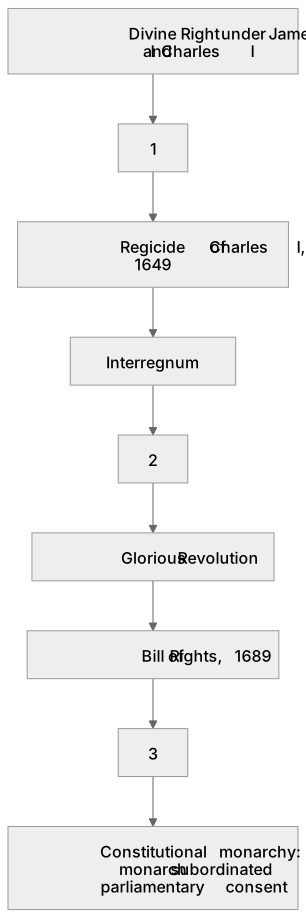
1Box 1
2Box 2
3Box 3
There is more to this lesson
The full lesson goes on to check your understanding and help you earn the marks. Create a free account to carry on, with your progress saved.
A week of Premium from your first lesson · Then the free plan continues · No card, no charge
Test your understanding of 1D Stuart Britain and the Crisis of Monarchy, 1603–1702 – consequence in this period through the following key questions:: How far did the monarchy change?
Active recall beats re-reading. Take an instant quiz now to test what you’ve learned and lock it into long-term memory.
A week of Premium from your first lesson · Then the free plan continues · No card, no charge