AQA · A-Level · History
Course version: 7042 · Version from Sept 2017
Why and with what results were there disputes over religion?
Full specification wording
1D Stuart Britain and the Crisis of Monarchy, 1603–1702 – consequence in this period through the following key questions:: Why and with what results were there disputes over religion?
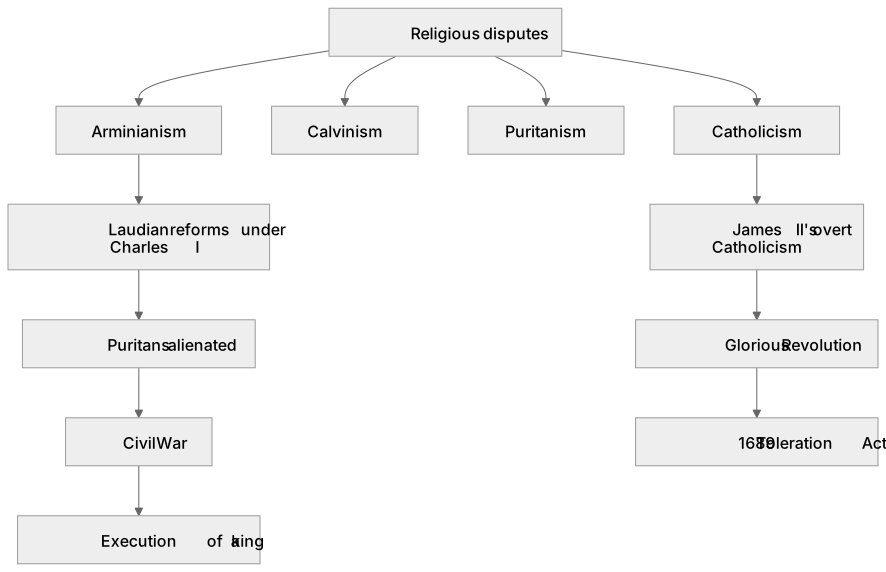
Religious disputes in Stuart Britain stemmed from deep ideological divides between Arminianism, Calvinism, Puritanism, and Catholicism.
Checked against the AQA 7042 specification (opens in a new tab) on .
- Point 3 of 6
- 4 key terms
Study notes
From the checked teaching notes for this specification point.
The idea
Religious disputes in Stuart Britain stemmed from deep ideological divides between Arminianism, Calvinism, Puritanism, and Catholicism. The 'why' involves monarchs like Charles I imposing Arminian reforms (such as the Laudian beauty of holiness) which alienated Puritans who feared a return to Rome, alongside James II's overt Catholicism. The 'results' were profound, directly contributing to the outbreak of the Civil War, the execution of a king, and the eventual Glorious Revolution. The resulting religious settlements fluctuated wildly, from the oppressive Clarendon Code targeting Dissenters under Charles II to the 1689 Toleration Act, which finally granted limited religious freedom but cemented Anglican supremacy.
What earns the marks
- Identify the theological and political causes of religious disputes, such as Laudian reforms under Charles I.
- Evaluate the role of anti-Catholic paranoia in triggering crises, including the Popish Plot and the Exclusion Crisis.
- Assess the consequences of religious conflict on the monarchy, notably the Civil War and the Glorious Revolution.
- Analyse the shifting legislative results of these disputes, from the penal laws of the Clarendon Code to the 1689 Toleration Act.
Common mistakes and how to put them right
Treating 'Protestantism' as a single unified group.
Put it right: Distinguish clearly between Anglicans, Arminians, Puritans, and later Dissenters.
Assuming the 1689 Toleration Act granted complete religious equality.
Put it right: Note that it excluded Catholics and Unitarians, and kept the Test Acts in place.
Focusing only on the causes of religious disputes.
Put it right: Ensure equal weight is given to the 'results', such as political instability and legislative changes.
Exam tips
- Link religious disputes directly to political crises, demonstrating how theology and state power were inextricably intertwined.
- Use specific examples of religious policy, such as the imposition of the Scottish Prayer Book in 1637, to illustrate the triggers for conflict.
- When discussing results, evaluate both short-term political upheaval and long-term shifts in the Church of England's authority.
Try the lesson
The start of the 1D Stuart Britain and the Crisis of Monarchy, 1603–1702 – consequence in this period through the following key questions:: Why and with what results were there disputes over religion? lesson, made from checked teaching notes for this specification point.
Have a go first
Which of the following was a direct result of Archbishop William Laud's religious reforms in the 1630s?
Listen
Religious disputes in Stuart Britain stemmed from deep ideological divides between Arminianism, Calvinism, Puritanism, and Catholicism. The 'why' involves monarchs like Charles I imposing Arminian reforms (such as the Laudian beauty of holiness) which alienated Puritans who feared a return to Rome, alongside James II's overt Catholicism. The 'results' were profound, directly contributing to the outbreak of the Civil War, the execution of a king, and the eventual Glorious Revolution. The resulting religious settlements fluctuated wildly, from the oppressive Clarendon Code targeting Dissenters under Charles II to the 1689 Toleration Act, which finally granted limited religious freedom but cemented Anglican supremacy. A strong answer earns marks for these points. Identify the theological and political causes of religious disputes, such as Laudian reforms under Charles I. Evaluate the role of anti-Catholic paranoia in triggering crises, including the Popish Plot and the Exclusion Crisis. Assess the consequences of religious conflict on the monarchy, notably the Civil War and the Glorious Revolution. Analyse the shifting legislative results of these disputes, from the penal laws of the Clarendon Code to the 1689 Toleration Act. A common slip: Treating 'Protestantism' as a single unified group. Instead, distinguish clearly between Anglicans, Arminians, Puritans, and later Dissenters. Exam tip: Link religious disputes directly to political crises, demonstrating how theology and state power were inextricably intertwined.
See it
Key words
Say what each word means before you turn the card.
Arminianism
Try answering aloud or in your head before turning the card.
Puritanism
Try answering aloud or in your head before turning the card.
Clarendon Code
Try answering aloud or in your head before turning the card.
1689 Toleration Act
Try answering aloud or in your head before turning the card.
See every definition
- Arminianism
- One side of the deep ideological divides in Stuart Britain, whose reforms under Charles I, such as the Laudian beauty of holiness, alienated Puritans who feared a return to Rome.
- Puritanism
- One side of the deep ideological divides in Stuart Britain, whose adherents were alienated by Arminian reforms and feared a return to Rome.
- Clarendon Code
- The oppressive religious settlement under Charles II that targeted Dissenters.
- 1689 Toleration Act
- The settlement that finally granted limited religious freedom but cemented Anglican supremacy, while excluding Catholics and Unitarians and keeping the Test Acts in place.
Label the diagram
Some boxes have lost their names. Pick the right name for each number.
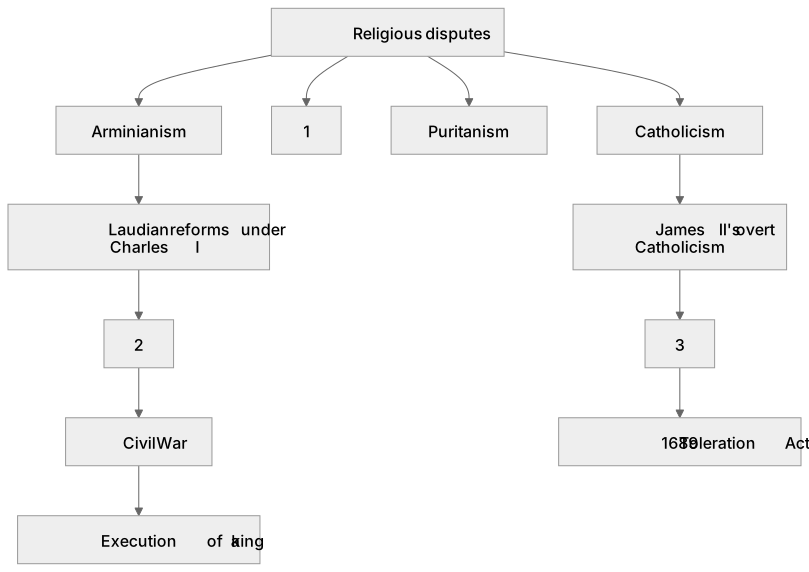
1Box 1
2Box 2
3Box 3
There is more to this lesson
The full lesson goes on to check your understanding and help you earn the marks. Create a free account to carry on, with your progress saved.
A week of Premium from your first lesson · Then the free plan continues · No card, no charge
Test your understanding of 1D Stuart Britain and the Crisis of Monarchy, 1603–1702 – consequence in this period through the following key questions:: Why and with what results were there disputes over religion?
Active recall beats re-reading. Take an instant quiz now to test what you’ve learned and lock it into long-term memory.
A week of Premium from your first lesson · Then the free plan continues · No card, no charge