AQA · A-Level · History
Course version: 7042 · Version from Sept 2017
The Political Nation and the social basis of power: the importance of land…
Full specification wording
1D Stuart Britain and the Crisis of Monarchy, 1603–1702 – Monarchs and Parliaments, 1603–1629: The Political Nation and the social basis of power: the importance of land ownership; rival forms of wealth including merchants
The 'Political Nation' comprised individuals wealthy enough to participate in governance, primarily the aristocracy and gentry.
Checked against the AQA 7042 specification (opens in a new tab) on .
- Point 1 of 6
- 3 key terms
Study notes
From the checked teaching notes for this specification point.
The idea
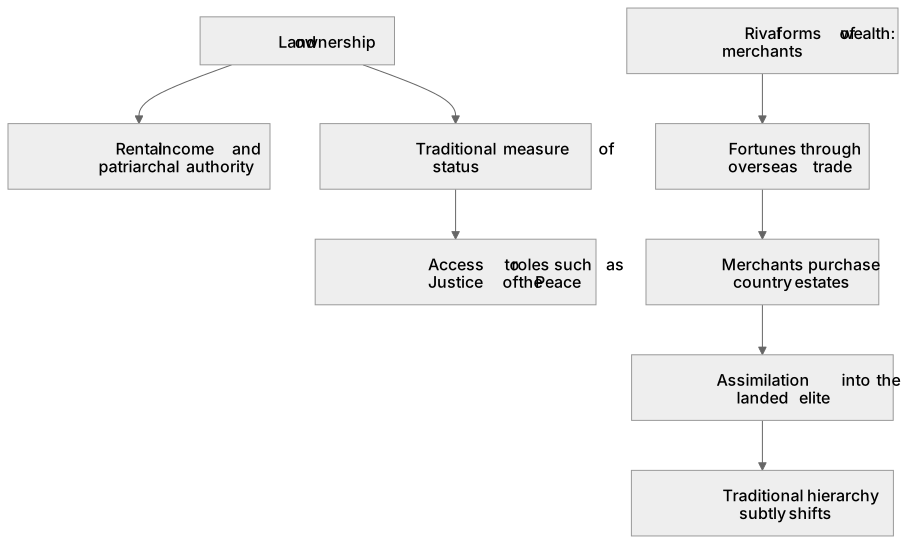
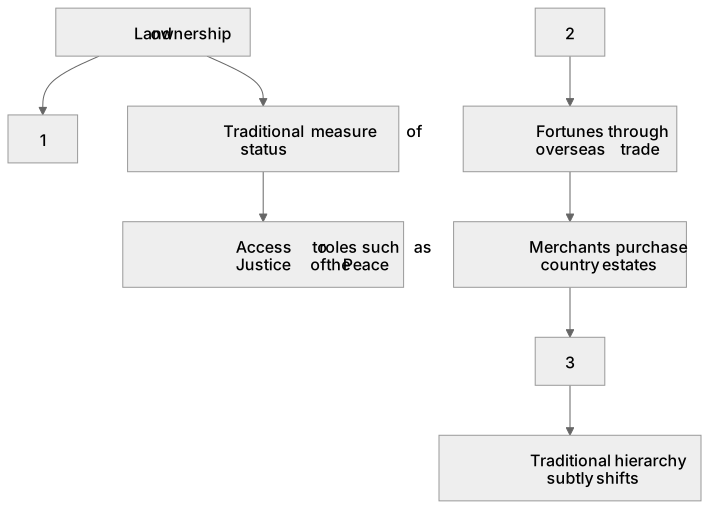
The 'Political Nation' comprised individuals wealthy enough to participate in governance, primarily the aristocracy and gentry. The social basis of power was rooted in land ownership, providing rental income and patriarchal authority over communities. Land was the traditional measure of status, granting access to vital roles like Justice of the Peace. However, rival forms of wealth began challenging this agrarian dominance. The expanding mercantile class in urban centres accumulated vast fortunes through overseas trade. These merchants increasingly sought political influence and social mobility, often purchasing country estates to assimilate into the landed elite, thereby subtly shifting the traditional hierarchy and the social basis of power.
What earns the marks
- Define the Political Nation as the group of people with economic, social, and political influence, primarily based on a minimum income threshold.
- Explain how land ownership conferred local authority, such as serving as a Justice of the Peace or Lord Lieutenant, and national influence in Parliament.
- Identify the growing economic power of merchants, particularly in London, through international trade and joint-stock companies.
- Analyse the tension and integration between traditional landed elites and new mercantile wealth, noting how merchants often bought land to secure social status.
Common mistakes and how to put them right
Assuming the Political Nation included the majority of the population.
Put it right: Specify that the Political Nation was a small minority, comprising only the aristocracy, gentry, and wealthy professionals or merchants.
Treating merchants and the landed gentry as entirely separate, hostile classes.
Put it right: Recognise the fluidity between these groups, as successful merchants frequently purchased land to enter the gentry.
Ignoring the political implications of mercantile wealth.
Put it right: Explain that the Crown's reliance on merchants for loans and customs duties gave this group significant political leverage.
Exam tips
- Use the term 'Political Nation' explicitly in your essays to demonstrate an understanding of seventeenth-century political structures.
- When discussing the causes of conflict, evaluate how the Crown's financial needs empowered rival forms of wealth like the merchant class.
- Contrast the traditional, rural power base of the gentry with the dynamic, urban wealth of the merchants to show the changing social fabric.
Try the lesson
The start of the 1D Stuart Britain and the Crisis of Monarchy, 1603–1702 – Monarchs and Parliaments, 1603–1629: The Political Nation and the social basis of power: the importance of land ownership; rival forms of wealth including merchants lesson, made from checked teaching notes for this specification point.
Have a go first
In early seventeenth-century Britain, what was the primary basis of wealth and status that determined membership of the Political Nation?
Listen
The 'Political Nation' comprised individuals wealthy enough to participate in governance, primarily the aristocracy and gentry. The social basis of power was rooted in land ownership, providing rental income and patriarchal authority over communities. Land was the traditional measure of status, granting access to vital roles like Justice of the Peace. However, rival forms of wealth began challenging this agrarian dominance. The expanding mercantile class in urban centres accumulated vast fortunes through overseas trade. These merchants increasingly sought political influence and social mobility, often purchasing country estates to assimilate into the landed elite, thereby subtly shifting the traditional hierarchy and the social basis of power. A strong answer earns marks for these points. Define the Political Nation as the group of people with economic, social, and political influence, primarily based on a minimum income threshold. Explain how land ownership conferred local authority, such as serving as a Justice of the Peace or Lord Lieutenant, and national influence in Parliament. Identify the growing economic power of merchants, particularly in London, through international trade and joint-stock companies. Analyse the tension and integration between traditional landed elites and new mercantile wealth, noting how merchants often bought land to secure social status. A common slip: Assuming the Political Nation included the majority of the population. Instead, Specify that the Political Nation was a small minority, comprising only the aristocracy, gentry, and wealthy professionals or merchants. Exam tip: Use the term 'Political Nation' explicitly in your essays to demonstrate an understanding of seventeenth-century political structures.
See it
Key words
Say what each word means before you turn the card.
Political Nation
Try answering aloud or in your head before turning the card.
Land ownership
Try answering aloud or in your head before turning the card.
Merchants
Try answering aloud or in your head before turning the card.
See every definition
- Political Nation
- The group of people with economic, social, and political influence, primarily based on a minimum income threshold.
- Land ownership
- The social basis of power, providing rental income and patriarchal authority over communities, and the traditional measure of status.
- Merchants
- An expanding mercantile class in urban centres who accumulated vast fortunes through overseas trade and increasingly sought political influence and social mobility.
Label the diagram
Some boxes have lost their names. Pick the right name for each number.
1Box 1
2Box 2
3Box 3
There is more to this lesson
The full lesson goes on to check your understanding and help you earn the marks. Create a free account to carry on, with your progress saved.
A week of Premium from your first lesson · Then the free plan continues · No card, no charge
Test your understanding of 1D Stuart Britain and the Crisis of Monarchy, 1603–1702 – Monarchs and Parliaments, 1603–1629: The Political Nation and the social basis of power: the importance of land ownership; rival forms of wealth including merchants
Active recall beats re-reading. Take an instant quiz now to test what you’ve learned and lock it into long-term memory.
A week of Premium from your first lesson · Then the free plan continues · No card, no charge