AQA · A-Level · History
Course version: 7042 · Version from Sept 2017
Post-war divisions between Army and Parliament and the failure to secure a…
Full specification wording
1D Stuart Britain and the Crisis of Monarchy, 1603–1702 – Revolution, 1629–1649: Post-war divisions between Army and Parliament and the failure to secure a post-war settlement
Following the First Civil War (1646), deep divisions emerged between the New Model Army and the Presbyterian-dominated Parliament, fundamentally undermining attempts to secure a post-war settlement.
Checked against the AQA 7042 specification (opens in a new tab) on .
- Point 5 of 6
Study notes
From the checked teaching notes for this specification point.
The idea
Following the First Civil War (1646), deep divisions emerged between the New Model Army and the Presbyterian-dominated Parliament, fundamentally undermining attempts to secure a post-war settlement. Parliament sought to disband the Army without settling massive arrears of pay and aimed to establish a strict Presbyterian church, alienating military Independents. The Army, politicised by figures like Ireton, responded with the Solemn Engagement (1647) and seized the King. Charles I exploited these divisions, engaging in duplicitous negotiations such as the Heads of the Proposals with the Army and the Engagement with the Scots. This factionalism, combined with Charles's refusal to compromise, ensured the failure of a lasting settlement.
What earns the marks
- Identify the financial and religious grievances of the New Model Army against the Presbyterian Parliament, particularly regarding arrears of pay and indemnity.
- Explain the politicisation of the Army, referencing the election of Agitators and the Solemn Engagement of 1647.
- Analyse the different settlement proposals, such as the Newcastle Propositions (Parliament) and the Heads of the Proposals (Army).
- Evaluate how Charles I's strategy of playing factions against each other, culminating in the Engagement with the Scots, prevented a successful settlement.
Common mistakes and how to put them right
Assuming Parliament and the Army were a united front after defeating the King.
Put it right: Emphasise that Parliament and the Army became bitter rivals over pay, religion, and political power immediately after the First Civil War.
Blaming the failure of the settlement solely on Charles I.
Put it right: Acknowledge Charles's duplicity, but also evaluate how the radicalisation of the Army and the inflexibility of Political Presbyterians contributed to the deadlock.
Confusing the Newcastle Propositions with the Heads of the Proposals.
Put it right: The Newcastle Propositions were Parliament's harsher terms (1646), while the Heads of the Proposals were the Army's more moderate, independent terms (1647).
Exam tips
- Use the Putney Debates (1647) as concrete evidence of the ideological divisions not just between Army and Parliament, but within the Army itself.
- When evaluating the failure of the settlement, weigh the relative importance of Parliament's provocation, the Army's radicalisation, and the King's intransigence.
- Link the failure of these negotiations directly to the outbreak of the Second Civil War to demonstrate a strong understanding of cause and consequence.
Try the lesson
The start of the 1D Stuart Britain and the Crisis of Monarchy, 1603–1702 – Revolution, 1629–1649: Post-war divisions between Army and Parliament and the failure to secure a post-war settlement lesson, made from checked teaching notes for this specification point.
Have a go first
What was the primary cause of the initial breakdown in relations between the New Model Army and Parliament in the spring of 1647?
Listen
Following the First Civil War (1646), deep divisions emerged between the New Model Army and the Presbyterian-dominated Parliament, fundamentally undermining attempts to secure a post-war settlement. Parliament sought to disband the Army without settling massive arrears of pay and aimed to establish a strict Presbyterian church, alienating military Independents. The Army, politicised by figures like Ireton, responded with the Solemn Engagement (1647) and seized the King. Charles I exploited these divisions, engaging in duplicitous negotiations such as the Heads of the Proposals with the Army and the Engagement with the Scots. This factionalism, combined with Charles's refusal to compromise, ensured the failure of a lasting settlement. A strong answer earns marks for these points. Identify the financial and religious grievances of the New Model Army against the Presbyterian Parliament, particularly regarding arrears of pay and indemnity. Explain the politicisation of the Army, referencing the election of Agitators and the Solemn Engagement of 1647. Analyse the different settlement proposals, such as the Newcastle Propositions (Parliament) and the Heads of the Proposals (Army). Evaluate how Charles I's strategy of playing factions against each other, culminating in the Engagement with the Scots, prevented a successful settlement. A common slip: Assuming Parliament and the Army were a united front after defeating the King. Instead, Emphasise that Parliament and the Army became bitter rivals over pay, religion, and political power immediately after the First Civil War. Exam tip: Use the Putney Debates (1647) as concrete evidence of the ideological divisions not just between Army and Parliament, but within the Army itself.
See it
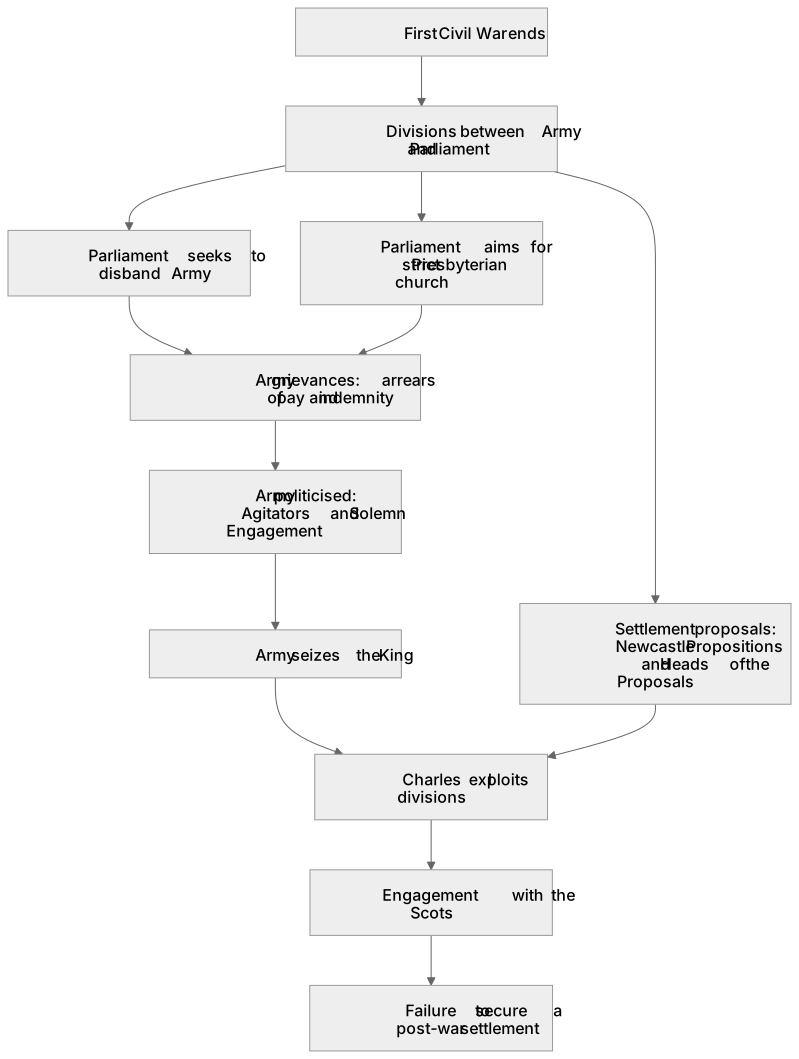
Label the diagram
Some boxes have lost their names. Pick the right name for each number.
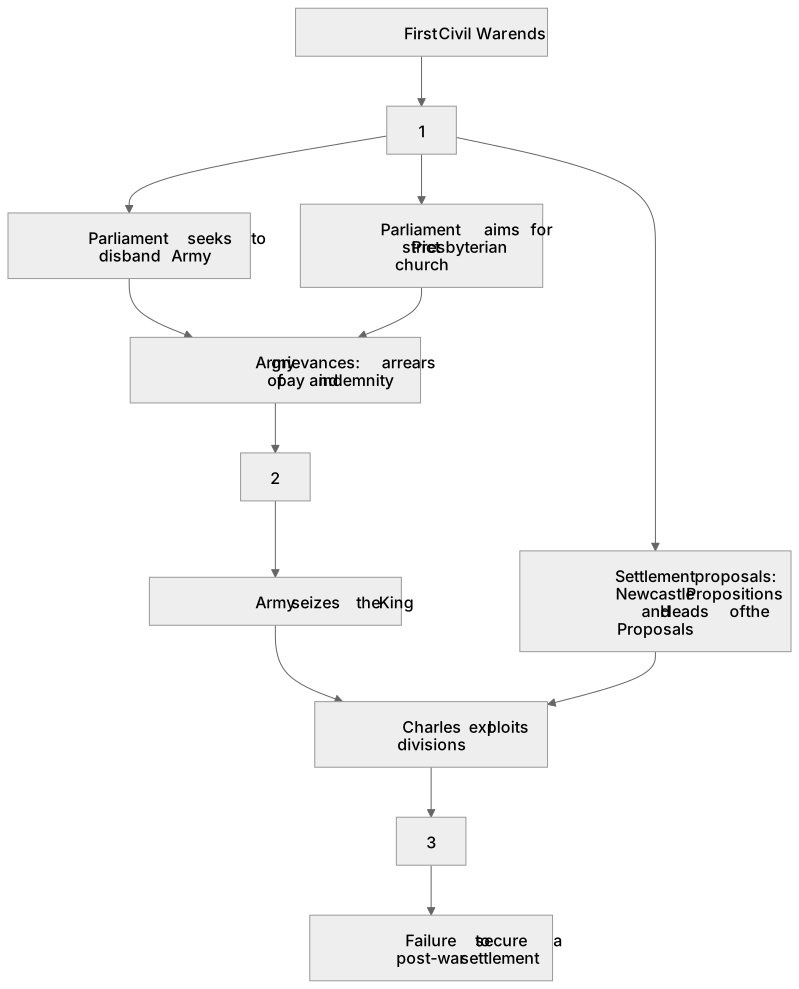
1Box 1
2Box 2
3Box 3
There is more to this lesson
The full lesson goes on to check your understanding and help you earn the marks. Create a free account to carry on, with your progress saved.
A week of Premium from your first lesson · Then the free plan continues · No card, no charge
Test your understanding of 1D Stuart Britain and the Crisis of Monarchy, 1603–1702 – Revolution, 1629–1649: Post-war divisions between Army and Parliament and the failure to secure a post-war settlement
Active recall beats re-reading. Take an instant quiz now to test what you’ve learned and lock it into long-term memory.
A week of Premium from your first lesson · Then the free plan continues · No card, no charge