AQA · A-Level · History
Course version: 7042 · Version from Sept 2017
Political developments and conflicts: Exclusion, its aims, methods and its…
Full specification wording
1D Stuart Britain and the Crisis of Monarchy, 1603–1702 – The establishment of constitutional monarchy, 1678–1702 (A-level only): Political developments and conflicts: Exclusion, its aims, methods and its failure; James II and the attempts at absolutism and the restoration of Catholicism
The Exclusion Crisis (1679–1681) aimed to prevent the Catholic Duke of York (later James II) from inheriting the throne, driven by Whig fears of popery and arbitrary government.
Checked against the AQA 7042 specification (opens in a new tab) on .
- Point 1 of 6
Study notes
From the checked teaching notes for this specification point.
The idea
The Exclusion Crisis (1679–1681) aimed to prevent the Catholic Duke of York (later James II) from inheriting the throne, driven by Whig fears of popery and arbitrary government. Methods included mass petitions, pamphlets, and parliamentary bills. It failed because Charles II skilfully dissolved parliaments, secured French subsidies to rule independently, and exploited fears of another civil war to rally Tory support. Upon his accession in 1685, James II pursued absolutist policies, expanding a standing army and using his dispensing power (e.g., Godden v Hales) to appoint Catholics to military and civic posts. His Declarations of Indulgence aimed to restore Catholic influence, alienating the Anglican establishment and precipitating his downfall.
What earns the marks
- Explain the aims of the Whigs during the Exclusion Crisis, focusing on preventing a Catholic succession and arbitrary rule.
- Evaluate the methods used by Exclusionists, such as parliamentary bills, propaganda, and the mobilisation of the London populace.
- Analyse the reasons for the failure of Exclusion, including Charles II's financial independence via French subsidies and the Tory royalist backlash.
- Assess James II's attempts to establish absolutism through the expansion of the standing army and the use of dispensing and suspending powers.
- Examine James II's religious policies, particularly the Declarations of Indulgence and the appointment of Catholics, as attempts to restore Catholic power.
Common mistakes and how to put them right
Confusing the aims of the Exclusion Crisis with a desire to establish a republic.
Put it right: Clarify that the Whigs primarily aimed to alter the succession to a Protestant heir, such as the Duke of Monmouth or Mary, not to abolish the monarchy.
Assuming James II wanted to forcibly convert the entire country to Catholicism immediately.
Put it right: Explain that James initially sought civic equality for Catholics and Dissenters to gradually restore Catholic influence and power in public life.
Stating that Charles II surrendered to the Exclusionists.
Put it right: Emphasise that Charles II successfully defeated the Exclusion bills by repeatedly dissolving Parliament and relying on French financial support.
Exam tips
- When discussing the failure of Exclusion, contrast the strengths of Charles II's political manoeuvring with the radicalism of the Whigs that alienated moderate support.
- Use specific legal cases, such as Godden v Hales (1686), to demonstrate how James II manipulated the judiciary to enforce his dispensing powers.
- Link James II's religious objectives directly to his absolutist methods, showing how his use of the royal prerogative to bypass Parliament alienated his natural Tory allies.
Try the lesson
The start of the 1D Stuart Britain and the Crisis of Monarchy, 1603–1702 – The establishment of constitutional monarchy, 1678–1702 (A-level only): Political developments and conflicts: Exclusion, its aims, methods and its failure; James II and the attempts at absolutism and the restoration of Catholicism lesson, made from checked teaching notes for this specification point.
Have a go first
What was the primary political aim of the Whigs during the Exclusion Crisis (1679–1681)?
Listen
The Exclusion Crisis (1679–1681) aimed to prevent the Catholic Duke of York (later James II) from inheriting the throne, driven by Whig fears of popery and arbitrary government. Methods included mass petitions, pamphlets, and parliamentary bills. It failed because Charles II skilfully dissolved parliaments, secured French subsidies to rule independently, and exploited fears of another civil war to rally Tory support. Upon his accession in 1685, James II pursued absolutist policies, expanding a standing army and using his dispensing power (e.g., Godden v Hales) to appoint Catholics to military and civic posts. His Declarations of Indulgence aimed to restore Catholic influence, alienating the Anglican establishment and precipitating his downfall. A strong answer earns marks for these points. Explain the aims of the Whigs during the Exclusion Crisis, focusing on preventing a Catholic succession and arbitrary rule. Evaluate the methods used by Exclusionists, such as parliamentary bills, propaganda, and the mobilisation of the London populace. Analyse the reasons for the failure of Exclusion, including Charles II's financial independence via French subsidies and the Tory royalist backlash. Assess James II's attempts to establish absolutism through the expansion of the standing army and the use of dispensing and suspending powers. A common slip: Confusing the aims of the Exclusion Crisis with a desire to establish a republic. Instead, Clarify that the Whigs primarily aimed to alter the succession to a Protestant heir, such as the Duke of Monmouth or Mary, not to abolish the monarchy. Exam tip: When discussing the failure of Exclusion, contrast the strengths of Charles II's political manoeuvring with the radicalism of the Whigs that alienated moderate support.
See it
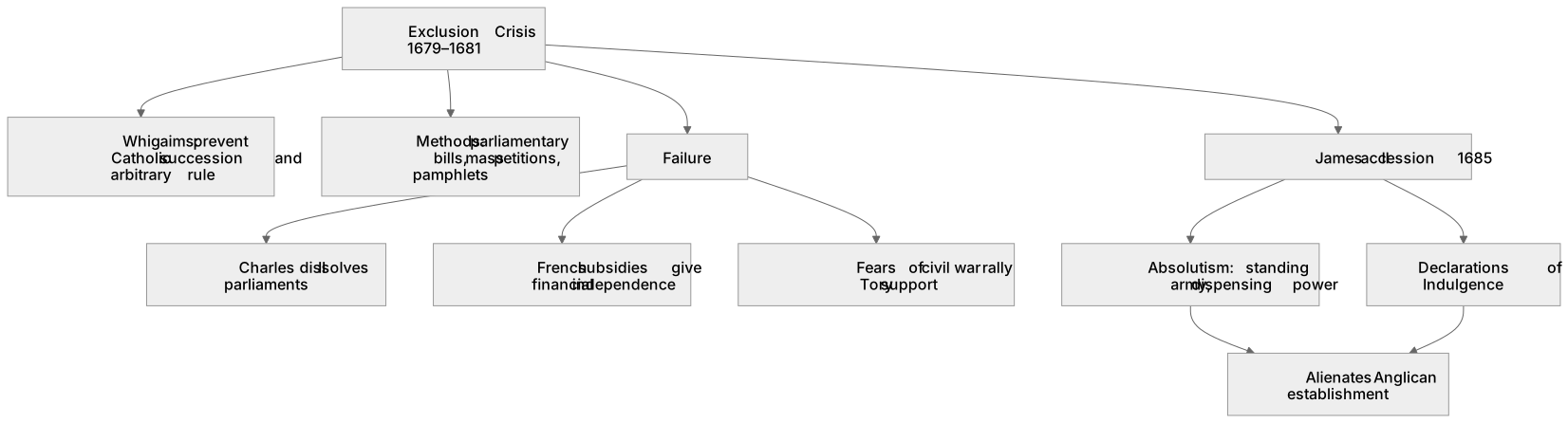
Put the events in order
Put these events in the order they happened, earliest first.
- 1. Exclusion Crisis aimed to prevent Catholic Duke of York inheriting throne
- 2. Godden v Hales used to enforce dispensing power
- 3. James II acceded to the throne
Label the diagram
Some boxes have lost their names. Pick the right name for each number.
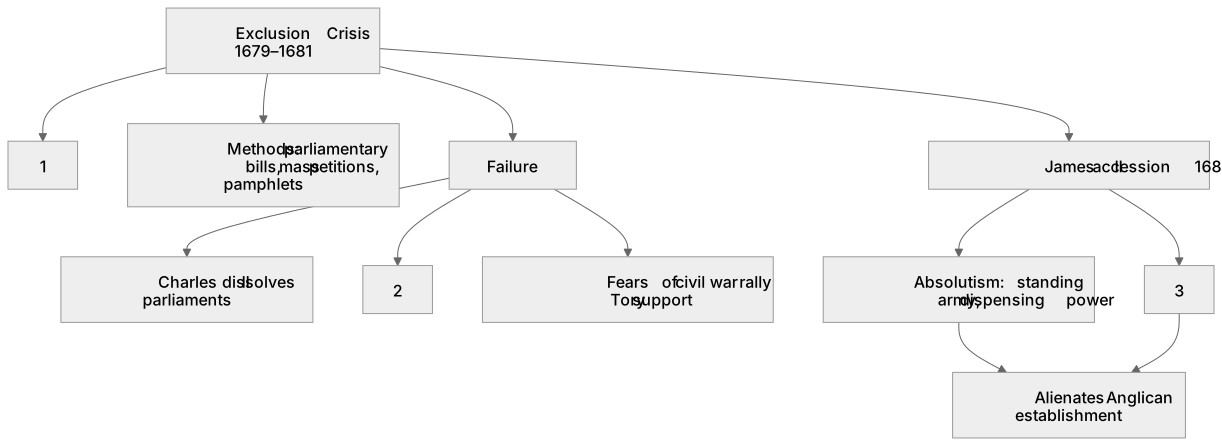
1Box 1
2Box 2
3Box 3
There is more to this lesson
The full lesson goes on to check your understanding and help you earn the marks. Create a free account to carry on, with your progress saved.
A week of Premium from your first lesson · Then the free plan continues · No card, no charge
Test your understanding of 1D Stuart Britain and the Crisis of Monarchy, 1603–1702 – The establishment of constitutional monarchy, 1678–1702 (A-level only): Political developments and conflicts: Exclusion, its aims, methods and its failure; James II and the attempts at absolutism and the restoration of Catholicism
Active recall beats re-reading. Take an instant quiz now to test what you’ve learned and lock it into long-term memory.
A week of Premium from your first lesson · Then the free plan continues · No card, no charge