AQA · A-Level · History
Course version: 7042 · Version from Sept 2017
Catherine: character and aims; extent of influence of the Enlightenment…
Full specification wording
1E Russia in the Age of Absolutism and Enlightenment, 1682–1796 (A-level only) – Catherine the Great and Russia, 1762–1796: Catherine: character and aims; extent of influence of the Enlightenment and the impact of the French Revolution on Catherine
Catherine II was a pragmatic ruler whose primary aim was to secure her usurped throne and strengthen Russian autocracy.
Checked against the AQA 7042 specification (opens in a new tab) on .
- Point 1 of 6
- 4 key terms
Study notes
From the checked teaching notes for this specification point.
The idea
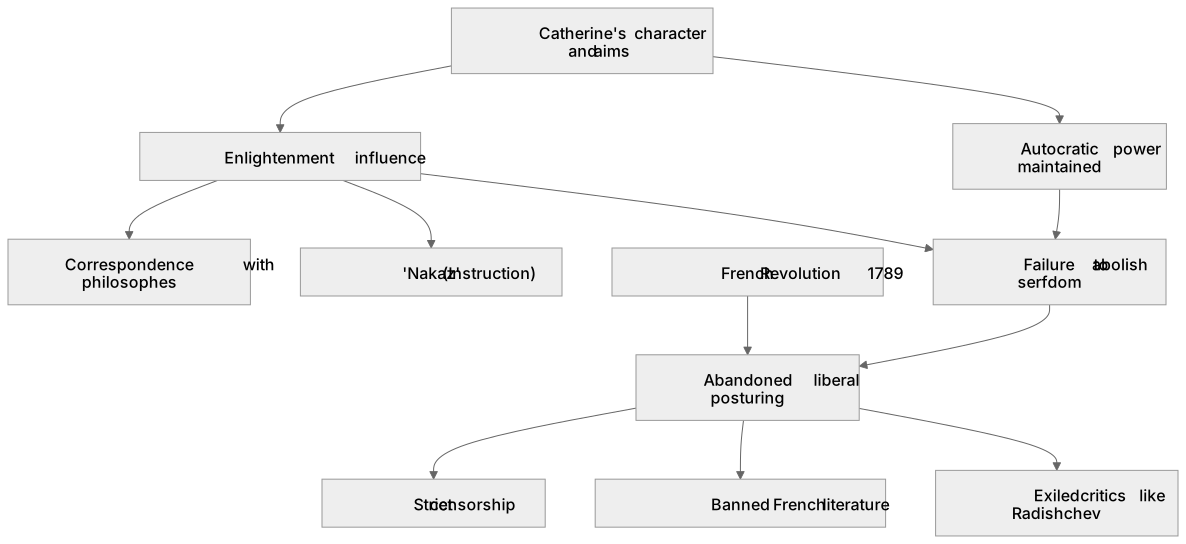
Catherine II was a pragmatic ruler whose primary aim was to secure her usurped throne and strengthen Russian autocracy. While she corresponded with philosophes like Voltaire, demonstrating genuine engagement with the Enlightenment, her application of these ideas was limited by political realities. She used Enlightenment rhetoric to project an image of an 'enlightened despot', yet domestic policies remained autocratic. The 1789 French Revolution profoundly shifted her stance. Horrified by the overthrow of the Bourbon monarchy, Catherine abandoned her liberal posturing. She implemented strict censorship, banned French literature, and exiled critics like Radishchev, proving her commitment to autocracy always superseded her Enlightenment ideals.
What earns the marks
- Assess Catherine's character as highly educated, politically astute, and driven by a desire for personal glory and national security.
- Evaluate her primary aims: legitimising her rule after the 1762 coup, expanding Russian borders, and modernising the state without diluting autocratic power.
- Analyse the extent of Enlightenment influence, noting her 'Nakaz' (Instruction) and correspondence with philosophes, contrasted with her failure to abolish serfdom.
- Examine the reactionary impact of the French Revolution, highlighting the censorship of the 1790s and the persecution of domestic critics like Alexander Radishchev.
Common mistakes and how to put them right
Claiming Catherine was a fully committed liberal who wanted to democratise Russia.
Put it right: Emphasise that she was an autocrat first; her engagement with the Enlightenment was intellectual and pragmatic, never intended to weaken her absolute power.
Stating the French Revolution caused her to introduce serfdom.
Put it right: Clarify that serfdom was already deeply entrenched; the Revolution instead caused her to abandon intellectual liberalism and introduce strict censorship.
Ignoring her personal insecurity as a usurper.
Put it right: Link her aims and policies back to her need to appease the nobility and military to secure her illegitimate hold on the throne.
Exam tips
- Use the term 'Enlightened Despotism' critically, questioning whether the noun 'despotism' always outweighed the adjective 'enlightened' in Catherine's Russia.
- Contrast Catherine's early reign (characterised by the Nakaz and the Great Commission) with her later reign (characterised by censorship post-1789) to show change over time.
- Support arguments about her character with specific examples, such as her strategic patronage of Diderot to enhance her European reputation.
Try the lesson
The start of the 1E Russia in the Age of Absolutism and Enlightenment, 1682–1796 (A-level only) – Catherine the Great and Russia, 1762–1796: Catherine: character and aims; extent of influence of the Enlightenment and the impact of the French Revolution on Catherine lesson, made from checked teaching notes for this specification point.
Have a go first
Which of the following best describes the primary impact of the French Revolution on Catherine the Great's domestic policies in the later years of her reign?
Listen
Catherine II was a pragmatic ruler whose primary aim was to secure her usurped throne and strengthen Russian autocracy. While she corresponded with philosophes like Voltaire, demonstrating genuine engagement with the Enlightenment, her application of these ideas was limited by political realities. She used Enlightenment rhetoric to project an image of an 'enlightened despot', yet domestic policies remained autocratic. The 1789 French Revolution profoundly shifted her stance. Horrified by the overthrow of the Bourbon monarchy, Catherine abandoned her liberal posturing. She implemented strict censorship, banned French literature, and exiled critics like Radishchev, proving her commitment to autocracy always superseded her Enlightenment ideals. A strong answer earns marks for these points. Assess Catherine's character as highly educated, politically astute, and driven by a desire for personal glory and national security. Evaluate her primary aims: legitimising her rule after the 1762 coup, expanding Russian borders, and modernising the state without diluting autocratic power. Analyse the extent of Enlightenment influence, noting her 'Nakaz' (Instruction) and correspondence with philosophes, contrasted with her failure to abolish serfdom. Examine the reactionary impact of the French Revolution, highlighting the censorship of the 1790s and the persecution of domestic critics like Alexander Radishchev. A common slip: Claiming Catherine was a fully committed liberal who wanted to democratise Russia. Instead, Emphasise that she was an autocrat first; her engagement with the Enlightenment was intellectual and pragmatic, never intended to weaken her absolute power. Exam tip: Use the term 'Enlightened Despotism' critically, questioning whether the noun 'despotism' always outweighed the adjective 'enlightened' in Catherine's Russia.
See it
Key words
Say what each word means before you turn the card.
Enlightened Absolutism
Try answering aloud or in your head before turning the card.
Autocracy and Power
Try answering aloud or in your head before turning the card.
Ideological Reaction
Try answering aloud or in your head before turning the card.
Legitimacy and Usurpation
Try answering aloud or in your head before turning the card.
See every definition
- Enlightened Absolutism
- Catherine used Enlightenment rhetoric to project an image of an 'enlightened despot', yet domestic policies remained autocratic.
- Autocracy and Power
- Her primary aim was to secure her usurped throne and strengthen Russian autocracy, and her commitment to autocracy always superseded her Enlightenment ideals.
- Ideological Reaction
- Horrified by the overthrow of the Bourbon monarchy, she abandoned her liberal posturing, implementing strict censorship, banning French literature and exiling critics.
- Legitimacy and Usurpation
- Her primary aim was to secure her usurped throne, legitimising her rule after the 1762 coup.
Label the diagram
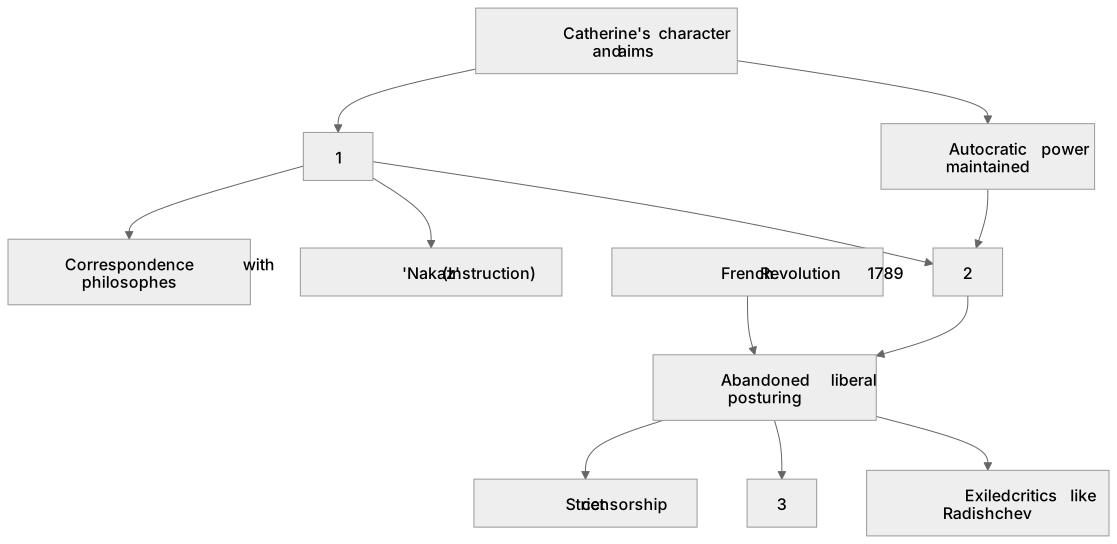
Some boxes have lost their names. Pick the right name for each number.
1Box 1
2Box 2
3Box 3
There is more to this lesson
The full lesson goes on to check your understanding and help you earn the marks. Create a free account to carry on, with your progress saved.
A week of Premium from your first lesson · Then the free plan continues · No card, no charge
Test your understanding of 1E Russia in the Age of Absolutism and Enlightenment, 1682–1796 (A-level only) – Catherine the Great and Russia, 1762–1796: Catherine: character and aims; extent of influence of the Enlightenment and the impact of the French Revolution on Catherine
Active recall beats re-reading. Take an instant quiz now to test what you’ve learned and lock it into long-term memory.
A week of Premium from your first lesson · Then the free plan continues · No card, no charge