AQA · A-Level · History
Course version: 7042 · Version from Sept 2017
How important was the role of key individuals and groups and how were they…
Full specification wording
1E Russia in the Age of Absolutism and Enlightenment, 1682–1796 (A-level only) – consequence in this period through the following key questions:: How important was the role of key individuals and groups and how were they affected by developments?
This topic requires evaluating the influence of pivotal figures and social groups in shaping Russia, alongside analysing how state developments impacted them.
Checked against the AQA 7042 specification (opens in a new tab) on .
- Point 6 of 6
Study notes
From the checked teaching notes for this specification point.
The idea
This topic requires evaluating the influence of pivotal figures and social groups in shaping Russia, alongside analysing how state developments impacted them. You must assess the importance of monarchs like Peter the Great and Catherine the Great, as well as influential advisors such as Menshikov or Potemkin, in driving military, administrative, and cultural reforms. Furthermore, evaluate the role of key groups, including the nobility, the Orthodox Church, and the serfs. The second clause demands an analysis of how these groups were affected by developments.
For example: Examine how Peter's Table of Ranks transformed the nobility into a service class, or how Catherine's Charter to the Nobility later entrenched their privileges while simultaneously worsening the conditions and legal status of the serfs.
What earns the marks
- Evaluate the contribution of key monarchs and their advisors in driving or resisting modernisation and territorial expansion.
- Analyse the changing role and power of the nobility, particularly in response to the Table of Ranks and the Charter to the Nobility.
- Assess the impact of state policies and economic developments on the peasantry and serfs, noting the increasing burdens placed upon them.
- Examine how the Orthodox Church and religious minorities, such as the Old Believers, were affected by state secularisation and cultural reforms.
Common mistakes and how to put them right
Providing biographical narratives of rulers.
Put it right: Focus on evaluating their specific historical importance and impact on state development.
Treating the nobility or peasantry as static groups.
Put it right: Analyse how their status, privileges, and burdens evolved across the period 1682 to 1796.
Ignoring the second part of the question.
Put it right: Explicitly address how developments, such as wars or administrative reforms, actively changed the lives of these groups.
Exam tips
- Link the actions of key individuals directly to the broader themes of absolutism and Enlightenment to demonstrate their historical importance.
- Use the Table of Ranks and the Charter to the Nobility as concrete evidence when discussing how the nobility was affected by state developments.
- Contrast the experiences of different groups, such as the expanding privileges of the nobility versus the deteriorating conditions of the serfs.
Try the lesson
The start of the 1E Russia in the Age of Absolutism and Enlightenment, 1682–1796 (A-level only) – consequence in this period through the following key questions:: How important was the role of key individuals and groups and how were they affected by developments? lesson, made from checked teaching notes for this specification point.
Have a go first
How was the role of the Russian nobility significantly affected by the Manifesto on the Freedom of the Nobility issued by Peter III in 1762?
Listen
This topic requires evaluating the influence of pivotal figures and social groups in shaping Russia, alongside analysing how state developments impacted them. You must assess the importance of monarchs like Peter the Great and Catherine the Great, as well as influential advisors such as Menshikov or Potemkin, in driving military, administrative, and cultural reforms. Furthermore, evaluate the role of key groups, including the nobility, the Orthodox Church, and the serfs. The second clause demands an analysis of how these groups were affected by developments. For example, examine how Peter's Table of Ranks transformed the nobility into a service class, or how Catherine's Charter to the Nobility later entrenched their privileges while simultaneously worsening the conditions and legal status of the serfs. A strong answer earns marks for these points. Evaluate the contribution of key monarchs and their advisors in driving or resisting modernisation and territorial expansion. Analyse the changing role and power of the nobility, particularly in response to the Table of Ranks and the Charter to the Nobility. Assess the impact of state policies and economic developments on the peasantry and serfs, noting the increasing burdens placed upon them. Examine how the Orthodox Church and religious minorities, such as the Old Believers, were affected by state secularisation and cultural reforms. A common slip: Providing biographical narratives of rulers. Instead, focus on evaluating their specific historical importance and impact on state development. Exam tip: Link the actions of key individuals directly to the broader themes of absolutism and Enlightenment to demonstrate their historical importance.
See it
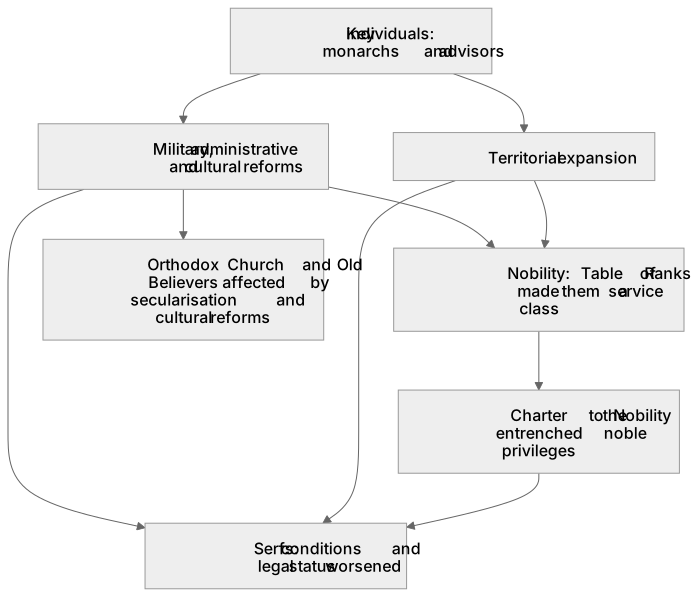
Label the diagram
Some boxes have lost their names. Pick the right name for each number.
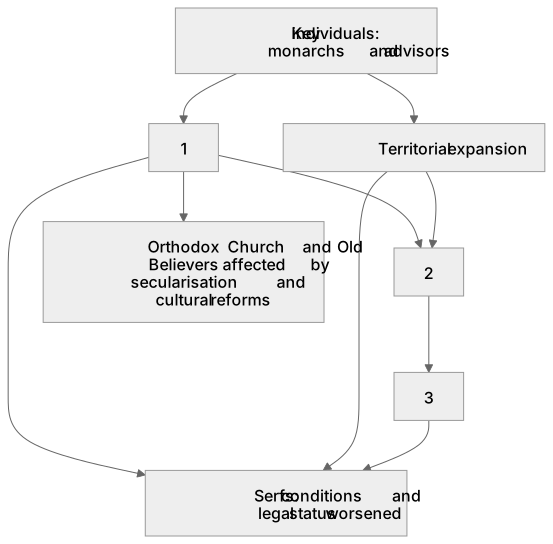
1Box 1
2Box 2
3Box 3
There is more to this lesson
The full lesson goes on to check your understanding and help you earn the marks. Create a free account to carry on, with your progress saved.
A week of Premium from your first lesson · Then the free plan continues · No card, no charge
Test your understanding of 1E Russia in the Age of Absolutism and Enlightenment, 1682–1796 (A-level only) – consequence in this period through the following key questions:: How important was the role of key individuals and groups and how were they affected by developments?
Active recall beats re-reading. Take an instant quiz now to test what you’ve learned and lock it into long-term memory.
A week of Premium from your first lesson · Then the free plan continues · No card, no charge