AQA · A-Level · History
Course version: 7042 · Version from Sept 2017
Britain, c1783–1885 – Economy, society and politics, 1846–1885 (A-level…
Full specification wording
1F Industrialisation and the people: Britain, c1783–1885 – Economy, society and politics, 1846–1885 (A-level only): Government and developing political organisation: the development of the political system and party realignment; the emergence of the Liberal Party
The mid-19th century witnessed profound transformations in British political organisation, moving away from loose aristocratic factions towards modern, disciplined political parties.
Checked against the AQA 7042 specification (opens in a new tab) on .
- Point 1 of 6
- 4 key terms
Study notes
From the checked teaching notes for this specification point.
The idea
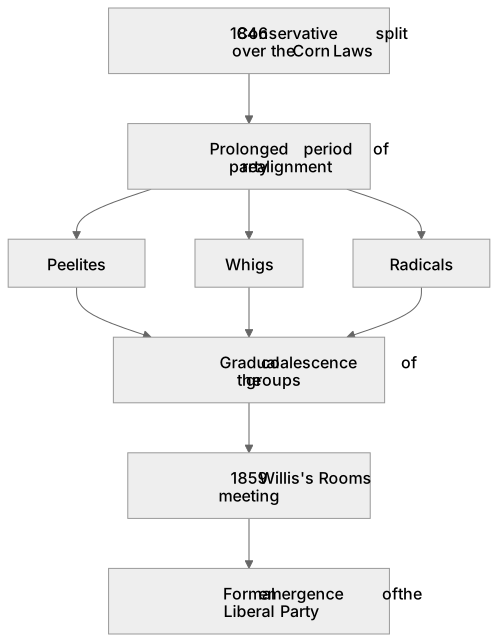
The mid-19th century witnessed profound transformations in British political organisation, moving away from loose aristocratic factions towards modern, disciplined political parties. Following the 1846 Conservative split over the Corn Laws, a prolonged period of party realignment occurred. The Peelites, Whigs, and Radicals gradually coalesced, culminating in the formal emergence of the Liberal Party at the Willis's Rooms meeting in 1859. This development of the political system was driven by the need to manage a growing electorate and address middle-class demands for free trade and administrative reform.
What earns the marks
- Explain the impact of the 1846 Conservative split on party realignment and the creation of the Peelites.
- Analyse the significance of the 1859 Willis's Rooms meeting in formally uniting Whigs, Peelites, and Radicals into the Liberal Party.
- Evaluate the role of key individuals, such as Palmerston and Gladstone, in bridging factional divides during the emergence of the Liberal Party.
- Assess how the development of the political system required new organisational structures to manage an expanding electorate and shifting parliamentary majorities.
Common mistakes and how to put them right
Assuming the Liberal Party emerged instantly in 1846.
Put it right: Recognise that it was a gradual realignment culminating in the 1859 Willis's Rooms agreement.
Confusing the Whigs with the Liberals as identical entities.
Put it right: Specify that the Whigs were just one component of the new Liberal Party, alongside Peelites and Radicals.
Overlooking the role of the Radicals.
Put it right: Ensure the Radicals' push for parliamentary reform and free trade is included as a key driver of the new political organisation.
Exam tips
- Use the 1859 Willis's Rooms meeting as a concrete turning point when discussing the formal emergence of the Liberal Party.
- Link party realignment directly to the ideological shift towards free trade and laissez-faire economics.
- When evaluating the development of the political system, contrast the loose factionalism of the 1850s with the more disciplined party structures that followed.
Try the lesson
The start of the 1F Industrialisation and the people: Britain, c1783–1885 – Economy, society and politics, 1846–1885 (A-level only): Government and developing political organisation: the development of the political system and party realignment; the emergence of the Liberal Party lesson, made from checked teaching notes for this specification point.
Have a go first
Which 1859 meeting is widely recognised by historians as the formal foundation of the Liberal Party?
Listen
The mid-19th century witnessed profound transformations in British political organisation, moving away from loose aristocratic factions towards modern, disciplined political parties. Following the 1846 Conservative split over the Corn Laws, a prolonged period of party realignment occurred. The Peelites, Whigs, and Radicals gradually coalesced, culminating in the formal emergence of the Liberal Party at the Willis's Rooms meeting in 1859. This development of the political system was driven by the need to manage a growing electorate and address middle-class demands for free trade and administrative reform. A strong answer earns marks for these points. Explain the impact of the 1846 Conservative split on party realignment and the creation of the Peelites. Analyse the significance of the 1859 Willis's Rooms meeting in formally uniting Whigs, Peelites, and Radicals into the Liberal Party. Evaluate the role of key individuals, such as Palmerston and Gladstone, in bridging factional divides during the emergence of the Liberal Party. Assess how the development of the political system required new organisational structures to manage an expanding electorate and shifting parliamentary majorities. A common slip: Assuming the Liberal Party emerged instantly in 1846. Instead, recognise that it was a gradual realignment culminating in the 1859 Willis's Rooms agreement. Exam tip: Use the 1859 Willis's Rooms meeting as a concrete turning point when discussing the formal emergence of the Liberal Party.
See it
Watch it explained
What is the one idea the video explains? Say it in a sentence.
Read the described scene instead
Between 1846 and 1885, British politics moved from loose aristocratic factions towards more modern, disciplined parties. The Conservative split over the Corn Laws in 1846 began a prolonged period of party realignment. This lesson traces how Whigs, Peelites, and Radicals gradually came together, and why that mattered for government. The 1846 Conservative split was the starting point, not the arrival of the Liberal Party. It created the Peelites, a group separated from the main Conservative Party after the Corn Laws. Realignment was gradual: the Peelites, Whigs, and Radicals did not become one party immediately. Their cooperation developed over the following decade. The key formal turning point came in 1859 at the Willis's Rooms meeting. There, Whigs, Peelites, and Radicals united to form the Liberal Party. This was not a simple rebranding of the Whigs: the Whigs were only one component alongside the Peelites and Radicals. The meeting marked the formal emergence of a party that could contest and hold government. Why did these groups coalesce? The pressures included managing a growing electorate and addressing middle-class demands for free trade and administrative reform. Party realignment was also tied to an ideological shift towards Free Trade and laissez-faire economics, and away from Protectionism. These pressures encouraged cooperation across old factional lines and helped create more organised political action. Leadership mattered in making the new party effective. Under leaders such as Palmerston and Gladstone, the Liberal Party became a dominant political force. But the development of the political system also required new organisational structures to manage an expanding electorate and shifting parliamentary majorities. Here, pause briefly and consider how leadership and organisation reinforced each other. Three corrections matter. Do not assume the Liberal Party emerged instantly in 1846; it was a gradual realignment culminating in the 1859 Willis's Rooms agreement. Do not confuse the Whigs with the Liberals as identical entities; the Whigs were only one component. And do not overlook the Radicals, whose push for parliamentary reform and free trade was a key driver of the new political organisation. In summary, the 1846 Conservative split over the Corn Laws opened a period of party realignment. The 1859 Willis's Rooms meeting formally united Whigs, Peelites, and Radicals as the Liberal Party. Free trade, administrative reform, a growing electorate, and new organisational structures all shaped this transition. The result was a political system less dominated by loose aristocratic factions and more organised around disciplined parties.
Key words
Say what each word means before you turn the card.
Party realignment and factionalism
Try answering aloud or in your head before turning the card.
The transition to modern political organisation
Try answering aloud or in your head before turning the card.
Ideological shifts regarding Free Trade and Protectionism
Try answering aloud or in your head before turning the card.
The decline of aristocratic dominance in government
Try answering aloud or in your head before turning the card.
See every definition
- Party realignment and factionalism
- A prolonged period of party realignment followed the 1846 Conservative split over the Corn Laws, moving away from loose aristocratic factions towards modern, disciplined political parties.
- The transition to modern political organisation
- The development of the political system required new organisational structures to manage an expanding electorate and shifting parliamentary majorities.
- Ideological shifts regarding Free Trade and Protectionism
- The development of the political system was driven by the need to address middle-class demands for free trade and administrative reform.
- The decline of aristocratic dominance in government
- The mid-19th century moved away from loose aristocratic factions towards modern, disciplined political parties.
Label the diagram
Some boxes have lost their names. Pick the right name for each number.
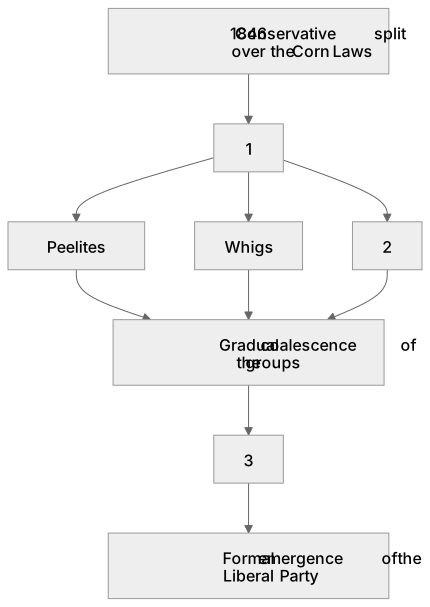
1Box 1
2Box 2
3Box 3
There is more to this lesson
The full lesson goes on to check your understanding and help you earn the marks. Create a free account to carry on, with your progress saved.
A week of Premium from your first lesson · Then the free plan continues · No card, no charge
Test your understanding of 1F Industrialisation and the people: Britain, c1783–1885 – Economy, society and politics, 1846–1885 (A-level only): Government and developing political organisation: the development of the political system and party realignment; the emergence of the Liberal Party
Active recall beats re-reading. Take an instant quiz now to test what you’ve learned and lock it into long-term memory.
A week of Premium from your first lesson · Then the free plan continues · No card, no charge