AQA · A-Level · History
Course version: 7042 · Version from Sept 2017
Britain, c1783–1885 – Government and a changing society, 1812–1832:…
Full specification wording
1F Industrialisation and the people: Britain, c1783–1885 – Government and a changing society, 1812–1832: Government: Lord Liverpool; the Corn Laws and other legislation; attitudes to reform and repression; the economy; the repeal of the Combination Acts
Lord Liverpool’s premiership (1812–1827) navigated severe post-war economic turbulence and radical agitation.
Checked against the AQA 7042 specification (opens in a new tab) on .
- Point 1 of 6
- 4 key terms
Study notes
From the checked teaching notes for this specification point.
The idea
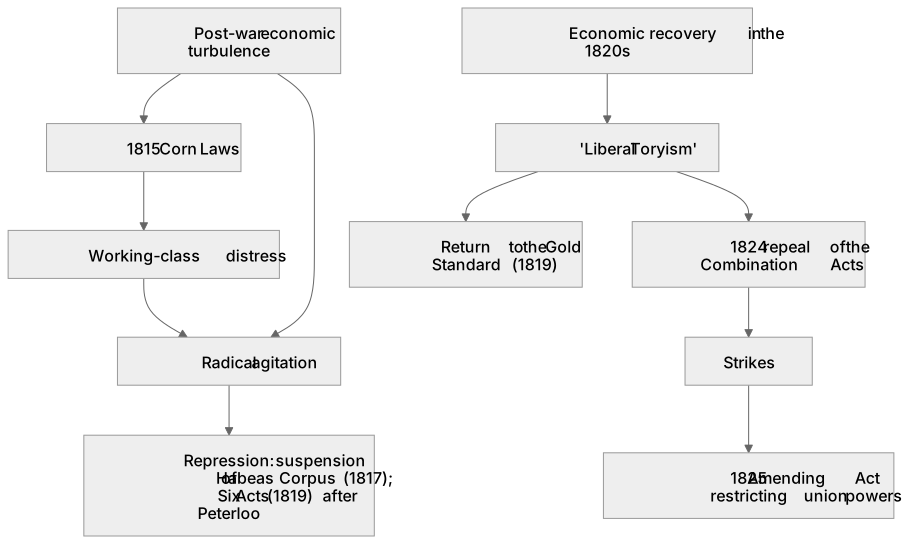
Lord Liverpool’s premiership (1812–1827) navigated severe post-war economic turbulence and radical agitation. The 1815 Corn Laws, designed to protect domestic agriculture by banning foreign wheat imports until prices reached 80 shillings a quarter, exacerbated working-class distress. Liverpool’s government initially adopted a repressive attitude towards reform, exemplified by the suspension of Habeas Corpus (1817) and the Six Acts (1819) following Peterloo. However, as the economy recovered in the 1820s, a shift towards 'Liberal Toryism' occurred. This included other legislation like the return to the Gold Standard (1819) and the pivotal 1824 repeal of the Combination Acts, which legalised trade unions, though subsequent strikes led to the 1825 Amending Act restricting their powers.
What earns the marks
- Evaluate the impact of the 1815 Corn Laws on different social classes, particularly the tension between landed interests and the urban poor.
- Analyse the government's repressive measures, such as the Six Acts of 1819, as a direct response to radical threats like the Peterloo Massacre.
- Assess the significance of economic fluctuations, noting how post-war depression fuelled radicalism while the 1820s recovery reduced popular unrest.
- Explain the motivations behind the 1824 repeal of the Combination Acts and the subsequent 1825 Amending Act which restricted union activities.
Common mistakes and how to put them right
Claiming the Corn Laws were universally popular.
Put it right: They were deeply resented by the working classes and manufacturers, benefiting only the landed elite.
Confusing the 1824 repeal of the Combination Acts with full trade union freedom.
Put it right: The 1825 Amending Act severely restricted their right to strike.
Viewing Liverpool's government as entirely reactionary.
Put it right: This ignores the pragmatic economic and penal reforms introduced during the 1820s 'Liberal Tory' phase.
Exam tips
- Use the term 'Liberal Toryism' critically, debating whether the 1820s represented a genuine ideological shift or merely pragmatic adjustments to economic recovery.
- Link economic conditions directly to the rise and fall of radical agitation to build a strong analytical argument.
- When discussing 'other legislation', reference specific economic policies like the 1819 Resumption of Cash Payments to demonstrate depth of knowledge.
Try the lesson
The start of the 1F Industrialisation and the people: Britain, c1783–1885 – Government and a changing society, 1812–1832: Government: Lord Liverpool; the Corn Laws and other legislation; attitudes to reform and repression; the economy; the repeal of the Combination Acts lesson, made from checked teaching notes for this specification point.
Have a go first
What was the primary purpose of the 1815 Corn Laws passed by Lord Liverpool's government?
Listen
Lord Liverpool’s premiership (1812–1827) navigated severe post-war economic turbulence and radical agitation. The 1815 Corn Laws, designed to protect domestic agriculture by banning foreign wheat imports until prices reached 80 shillings a quarter, exacerbated working-class distress. Liverpool’s government initially adopted a repressive attitude towards reform, exemplified by the suspension of Habeas Corpus (1817) and the Six Acts (1819) following Peterloo. However, as the economy recovered in the 1820s, a shift towards 'Liberal Toryism' occurred. This included other legislation like the return to the Gold Standard (1819) and the pivotal 1824 repeal of the Combination Acts, which legalised trade unions, though subsequent strikes led to the 1825 Amending Act restricting their powers. A strong answer earns marks for these points. Evaluate the impact of the 1815 Corn Laws on different social classes, particularly the tension between landed interests and the urban poor. Analyse the government's repressive measures, such as the Six Acts of 1819, as a direct response to radical threats like the Peterloo Massacre. Assess the significance of economic fluctuations, noting how post-war depression fuelled radicalism while the 1820s recovery reduced popular unrest. Explain the motivations behind the 1824 repeal of the Combination Acts and the subsequent 1825 Amending Act which restricted union activities. Exam tip: Use the term 'Liberal Toryism' critically, debating whether the 1820s represented a genuine ideological shift or merely pragmatic adjustments to economic recovery.
See it
Put the events in order
Put these events in the order they happened, earliest first.
- 1. Suspension of Habeas Corpus
- 2. Corn Laws introduced to protect domestic agriculture
- 3. Amending Act restricted trade union powers
- 4. Six Acts passed following Peterloo
- 5. Repeal of the Combination Acts legalised trade unions
Key words
Say what each word means before you turn the card.
Liberal Toryism
Try answering aloud or in your head before turning the card.
Repression vs Reform
Try answering aloud or in your head before turning the card.
Economic Fluctuations
Try answering aloud or in your head before turning the card.
Class Conflict
Try answering aloud or in your head before turning the card.
See every definition
- Liberal Toryism
- A shift towards reform that occurred as the economy recovered in the 1820s, including other legislation like the return to the Gold Standard.
- Repression vs Reform
- An initial repressive attitude towards reform, exemplified by the suspension of Habeas Corpus and the Six Acts, later shifting towards Liberal Toryism.
- Economic Fluctuations
- Post-war depression fuelled radicalism, while the 1820s recovery reduced popular unrest.
- Class Conflict
- Tension between landed interests and the urban poor, with the Corn Laws benefiting only the landed elite and being resented by the working classes and manufacturers.
Label the diagram
Some boxes have lost their names. Pick the right name for each number.
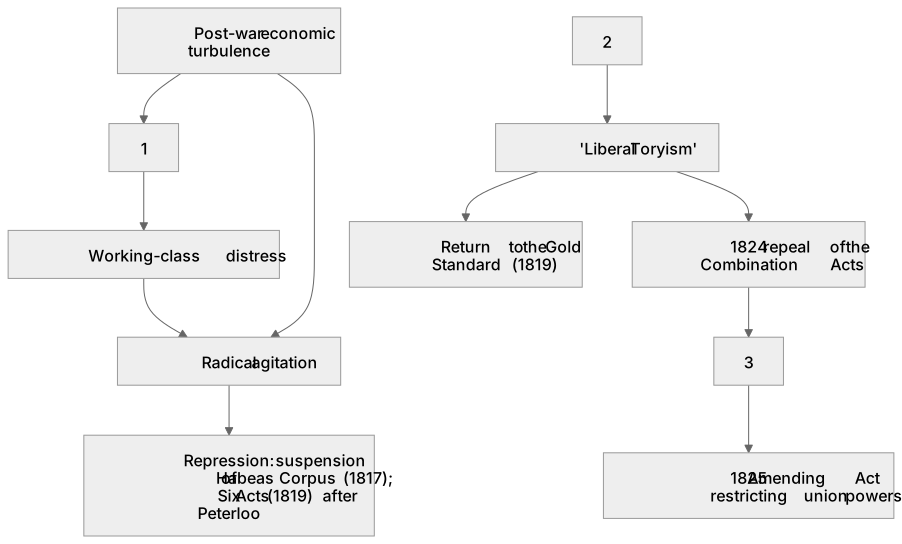
1Box 1
2Box 2
3Box 3
There is more to this lesson
The full lesson goes on to check your understanding and help you earn the marks. Create a free account to carry on, with your progress saved.
A week of Premium from your first lesson · Then the free plan continues · No card, no charge
Test your understanding of 1F Industrialisation and the people: Britain, c1783–1885 – Government and a changing society, 1812–1832: Government: Lord Liverpool; the Corn Laws and other legislation; attitudes to reform and repression; the economy; the repeal of the Combination Acts
Active recall beats re-reading. Take an instant quiz now to test what you’ve learned and lock it into long-term memory.
A week of Premium from your first lesson · Then the free plan continues · No card, no charge