AQA · A-Level · History
Course version: 7042 · Version from Sept 2017
Britain, c1783–1885 – Political change and social reform, 1832-1846…
Full specification wording
1F Industrialisation and the people: Britain, c1783–1885 – Political change and social reform, 1832-1846 (A-level only): Government: Grey, Melbourne and the ideas and ideology of the Whig Party; the Tories in opposition and government; Peel and the transformation of the Conservative party
The Whig governments of Grey and Melbourne (1830–1841) were driven by an ideology of aristocratic paternalism and moderate reform to prevent revolution, exemplified by the 1832 Reform Act.
Checked against the AQA 7042 specification (opens in a new tab) on .
- Point 1 of 6
- 4 key terms
Study notes
From the checked teaching notes for this specification point.
The idea
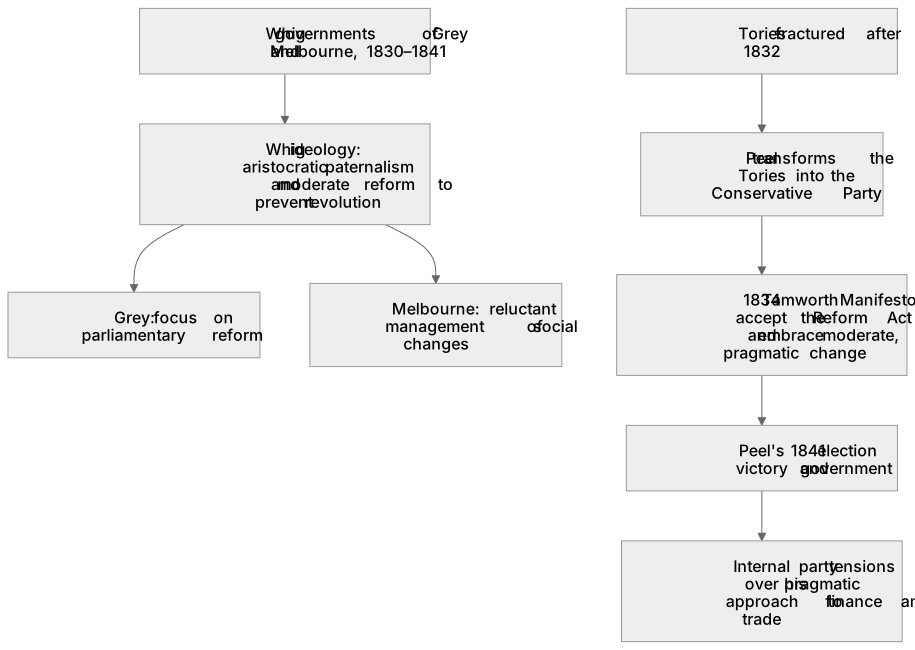
The Whig governments of Grey and Melbourne (1830–1841) were driven by an ideology of aristocratic paternalism and moderate reform to prevent revolution, exemplified by the 1832 Reform Act. Grey focused on parliamentary reform, while Melbourne reluctantly managed subsequent social changes. Meanwhile, the Tories, fractured after 1832, transitioned into the modern Conservative Party under Robert Peel. Peel’s 1834 Tamworth Manifesto was pivotal, committing the party to accept the Reform Act and embrace moderate, pragmatic change. This transformed the Tories from a reactionary faction into a broad-based Conservative party capable of governing, culminating in Peel's 1841 election victory and his subsequent government.
What earns the marks
- Explain the core Whig ideology under Grey and Melbourne, focusing on aristocratic leadership, civil and religious liberty, and reform to preserve the constitution.
- Assess the difficulties faced by the Tories in opposition following the 1832 Reform Act and their initial resistance to change.
- Evaluate Robert Peel's role in transforming the Tories into the Conservative Party, specifically the significance of the 1834 Tamworth Manifesto.
- Analyse the Conservative Party in government under Peel, noting his pragmatic approach to finance and trade, and the internal party tensions this created.
Common mistakes and how to put them right
Confusing the Whig ideology with radical democracy.
Put it right: Emphasise that Whigs like Grey believed in aristocratic paternalism and reformed the system specifically to prevent democratic revolution.
Assuming the Tories and Conservatives were entirely different parties.
Put it right: Explain that 'Conservative' was a rebranding and ideological shift of the Tory party led by Peel to appeal to the newly enfranchised middle classes.
Viewing Melbourne as a radical reformer.
Put it right: Recognise that Melbourne was highly conservative by nature and often opposed further reform after 1832, acting primarily to maintain his parliamentary majority.
Exam tips
- Use the Tamworth Manifesto as a primary piece of evidence when discussing the ideological shift from Tory to Conservative.
- Contrast Grey's focus on constitutional reform with Melbourne's reluctant management of social and administrative reforms.
- When evaluating Peel's leadership, balance his electoral success in 1841 against the underlying fractures within his party over protectionism.
Try the lesson
The start of the 1F Industrialisation and the people: Britain, c1783–1885 – Political change and social reform, 1832-1846 (A-level only): Government: Grey, Melbourne and the ideas and ideology of the Whig Party; the Tories in opposition and government; Peel and the transformation of the Conservative party lesson, made from checked teaching notes for this specification point.
Have a go first
What was a central ideological principle of the Whig Party under Earl Grey during the early 1830s?
Listen
The Whig governments of Grey and Melbourne (1830–1841) were driven by an ideology of aristocratic paternalism and moderate reform to prevent revolution, exemplified by the 1832 Reform Act. Grey focused on parliamentary reform, while Melbourne reluctantly managed subsequent social changes. Meanwhile, the Tories, fractured after 1832, transitioned into the modern Conservative Party under Robert Peel. Peel’s 1834 Tamworth Manifesto was pivotal, committing the party to accept the Reform Act and embrace moderate, pragmatic change. This transformed the Tories from a reactionary faction into a broad-based Conservative party capable of governing, culminating in Peel's 1841 election victory and his subsequent government. A strong answer earns marks for these points. Explain the core Whig ideology under Grey and Melbourne, focusing on aristocratic leadership, civil and religious liberty, and reform to preserve the constitution. Assess the difficulties faced by the Tories in opposition following the 1832 Reform Act and their initial resistance to change. Evaluate Robert Peel's role in transforming the Tories into the Conservative Party, specifically the significance of the 1834 Tamworth Manifesto. Analyse the Conservative Party in government under Peel, noting his pragmatic approach to finance and trade, and the internal party tensions this created. A common slip: Confusing the Whig ideology with radical democracy. Instead, Emphasise that Whigs like Grey believed in aristocratic paternalism and reformed the system specifically to prevent democratic revolution. Exam tip: Use the Tamworth Manifesto as a primary piece of evidence when discussing the ideological shift from Tory to Conservative.
See it
Put the events in order
Put these events in the order they happened, earliest first.
- 1. Reform Act passed under Grey's Whig government
- 2. Peel's election victory and subsequent government
- 3. Peel's Tamworth Manifesto commits party to moderate change
Key words
Say what each word means before you turn the card.
Aristocratic paternalism
Try answering aloud or in your head before turning the card.
Tamworth Manifesto
Try answering aloud or in your head before turning the card.
Conservative Party
Try answering aloud or in your head before turning the card.
Reform Act
Try answering aloud or in your head before turning the card.
See every definition
- Aristocratic paternalism
- An ideology of moderate reform led by aristocrats to prevent revolution, exemplified by the 1832 Reform Act under Grey and Melbourne.
- Tamworth Manifesto
- Peel's 1834 commitment for the party to accept the Reform Act and embrace moderate, pragmatic change.
- Conservative Party
- The rebranding and ideological shift of the Tory party led by Peel to appeal to the newly enfranchised middle classes.
- Reform Act
- The 1832 measure exemplifying the Whig ideology of aristocratic paternalism and moderate reform to prevent revolution.
Label the diagram
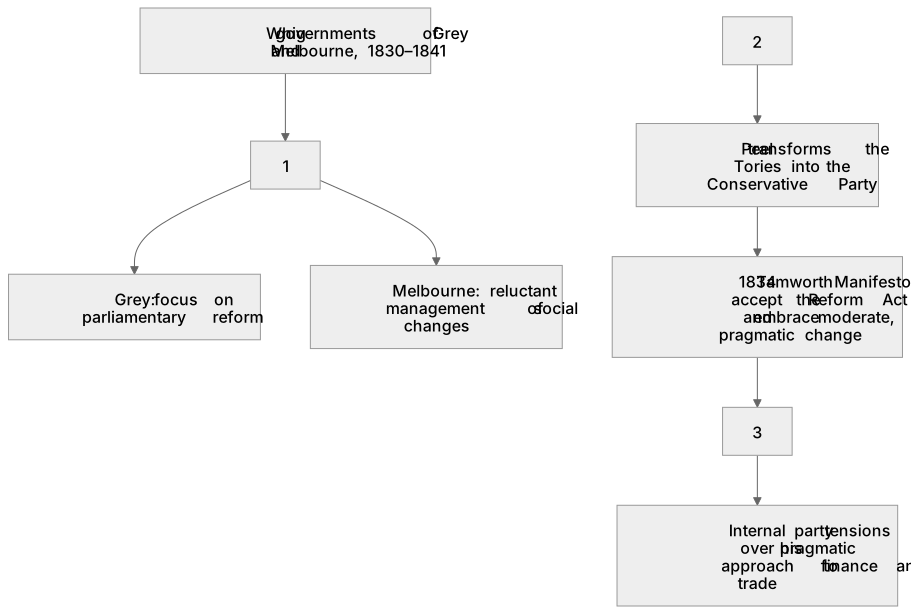
Some boxes have lost their names. Pick the right name for each number.
1Box 1
2Box 2
3Box 3
There is more to this lesson
The full lesson goes on to check your understanding and help you earn the marks. Create a free account to carry on, with your progress saved.
A week of Premium from your first lesson · Then the free plan continues · No card, no charge
Test your understanding of 1F Industrialisation and the people: Britain, c1783–1885 – Political change and social reform, 1832-1846 (A-level only): Government: Grey, Melbourne and the ideas and ideology of the Whig Party; the Tories in opposition and government; Peel and the transformation of the Conservative party
Active recall beats re-reading. Take an instant quiz now to test what you’ve learned and lock it into long-term memory.
A week of Premium from your first lesson · Then the free plan continues · No card, no charge