AQA · A-Level · History
Course version: 7042 · Version from Sept 2017
Britain, c1783–1885 – through the following key questions:: How important…
Full specification wording
1F Industrialisation and the people: Britain, c1783–1885 – through the following key questions:: How important was the role of individuals and groups and how were they affected by developments?
This question demands an evaluation of the impact of key individuals and groups on Britain from 1783 to 1885, alongside an analysis of how broader developments affected them.
Checked against the AQA 7042 specification (opens in a new tab) on .
- Point 6 of 6
Study notes
From the checked teaching notes for this specification point.
The idea
This question demands an evaluation of the impact of key individuals and groups on Britain from 1783 to 1885, alongside an analysis of how broader developments affected them. For instance, while Peel's leadership was crucial in repealing the Corn Laws, his actions were heavily influenced by the Anti-Corn Law League and the Irish Famine.
What earns the marks
- Assess the contribution of prominent political leaders in shaping domestic and economic policy.
- Evaluate the effectiveness of extra-parliamentary groups, such as the Chartists or the Anti-Corn Law League, in achieving their aims.
- Analyse how structural developments, particularly industrialisation and urbanisation, impacted the living and working conditions of different social groups.
- Examine the reciprocal relationship between individuals/groups and historical developments, demonstrating how people both shaped and were shaped by their environment.
Common mistakes and how to put them right
Focusing solely on the actions of individuals without addressing how they were affected by broader developments.
Put it right: Ensure answers address both parts of the question by explaining how events like industrialisation altered the circumstances of specific groups.
Overstating the power of individuals to enact change independently.
Put it right: Contextualise the actions of leaders by discussing the social, economic, and political pressures that constrained or enabled them.
Treating 'the working class' as a single, uniform group.
Put it right: Differentiate between skilled artisans, factory workers, and agricultural labourers, as developments affected them in diverse ways.
Exam tips
- When discussing a key individual, explicitly link their decisions to the broader context of industrial or political developments.
- Use specific examples of groups, such as the Tolpuddle Martyrs or the Rochdale Pioneers, to illustrate the varied responses to economic change.
- Structure your essays to explicitly address both the 'importance of the role' and 'how they were affected' to ensure full coverage of the statement.
Try the lesson
The start of the 1F Industrialisation and the people: Britain, c1783–1885 – through the following key questions:: How important was the role of individuals and groups and how were they affected by developments? lesson, made from checked teaching notes for this specification point.
Have a go first
Which group of early 19th-century British workers protested against the introduction of new machinery, which they believed threatened their livelihoods, by breaking into factories and destroying equipment?
Listen
This question demands an evaluation of the impact of key individuals and groups on Britain from 1783 to 1885, alongside an analysis of how broader developments affected them. For instance, while Peel's leadership was crucial in repealing the Corn Laws, his actions were heavily influenced by the Anti-Corn Law League and the Irish Famine. A strong answer earns marks for these points. Assess the contribution of prominent political leaders in shaping domestic and economic policy. Evaluate the effectiveness of extra-parliamentary groups, such as the Chartists or the Anti-Corn Law League, in achieving their aims. Analyse how structural developments, particularly industrialisation and urbanisation, impacted the living and working conditions of different social groups. Examine the reciprocal relationship between individuals/groups and historical developments, demonstrating how people both shaped and were shaped by their environment. A common slip: Focusing solely on the actions of individuals without addressing how they were affected by broader developments. Instead, Ensure answers address both parts of the question by explaining how events like industrialisation altered the circumstances of specific groups. Exam tip: When discussing a key individual, explicitly link their decisions to the broader context of industrial or political developments.
See it
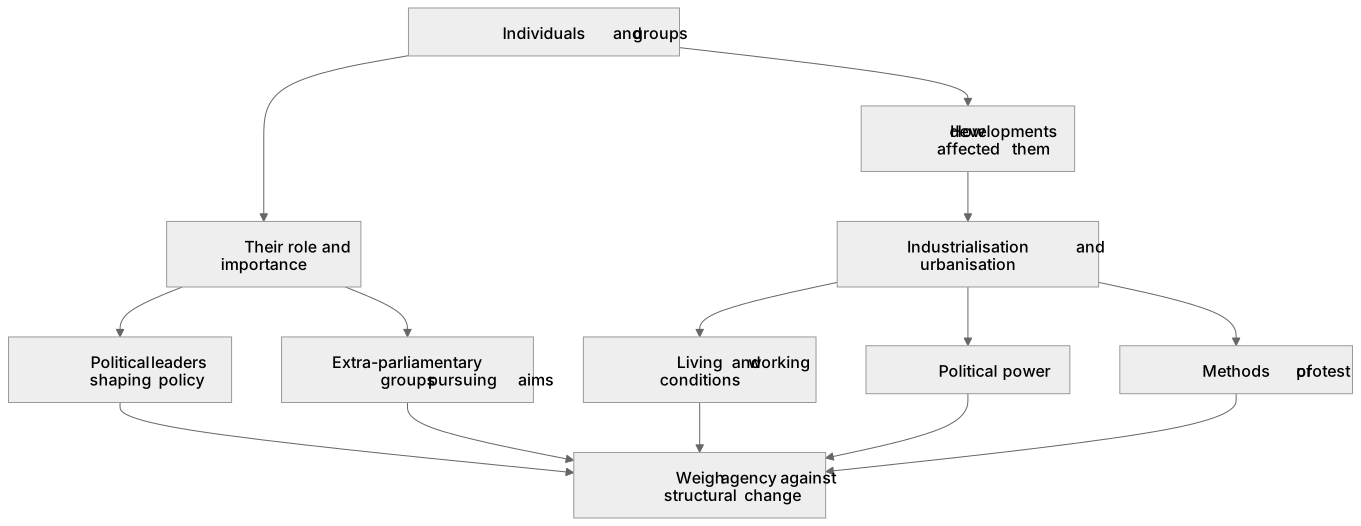
Label the diagram
Some boxes have lost their names. Pick the right name for each number.
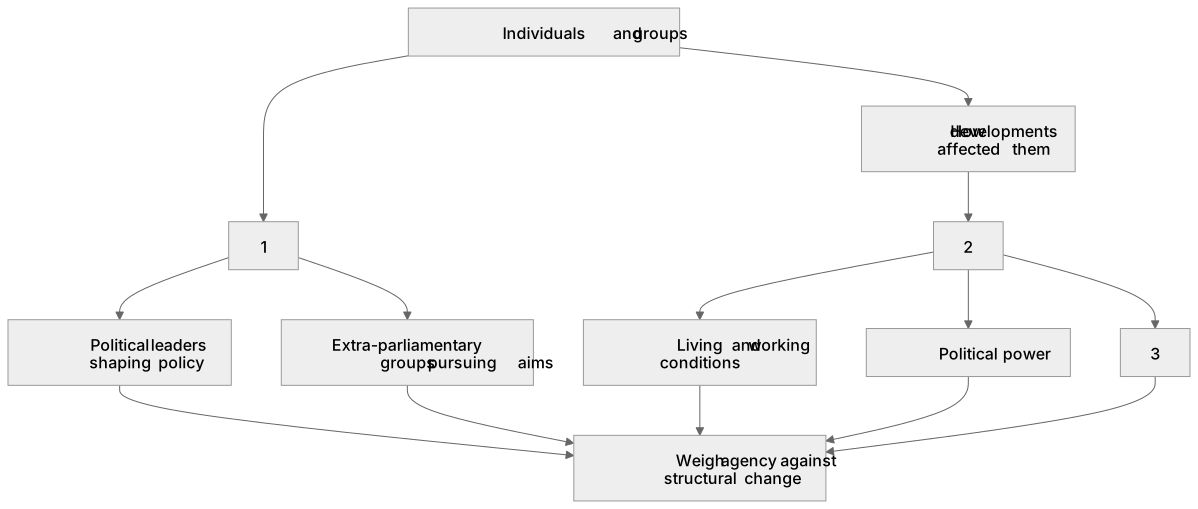
1Box 1
2Box 2
3Box 3
There is more to this lesson
The full lesson goes on to check your understanding and help you earn the marks. Create a free account to carry on, with your progress saved.
A week of Premium from your first lesson · Then the free plan continues · No card, no charge
Test your understanding of 1F Industrialisation and the people: Britain, c1783–1885 – through the following key questions:: How important was the role of individuals and groups and how were they affected by developments?
Active recall beats re-reading. Take an instant quiz now to test what you’ve learned and lock it into long-term memory.
A week of Premium from your first lesson · Then the free plan continues · No card, no charge