AQA · A-Level · History
Course version: 7042 · Version from Sept 2017
Britain, c1851–1964 – Challenges to the status quo, c1886–1914: Political…
Full specification wording
1G Challenge and transformation: Britain, c1851–1964 – Challenges to the status quo, c1886–1914: Political developments: the reasons for Conservative dominance to 1905; the problems of the Liberal Party; socialism, Fabianism and the emergence of the Labour Party
Between 1886 and 1905, the Conservative Party dominated British politics, largely due to their alliance with Liberal Unionists over Irish Home Rule, exploiting middle-class fears of radicalism,…
Checked against the AQA 7042 specification (opens in a new tab) on .
- Point 1 of 6
- 4 key terms
Study notes
From the checked teaching notes for this specification point.
The idea
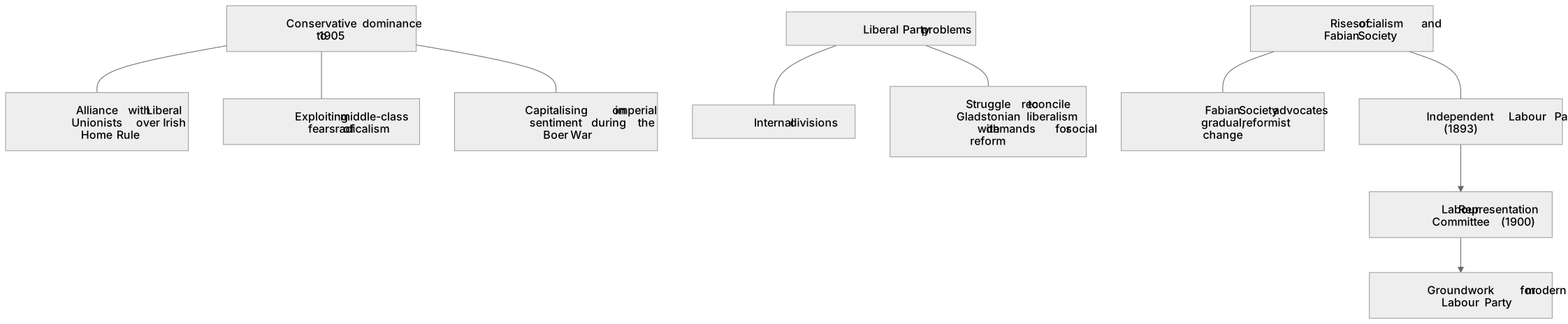
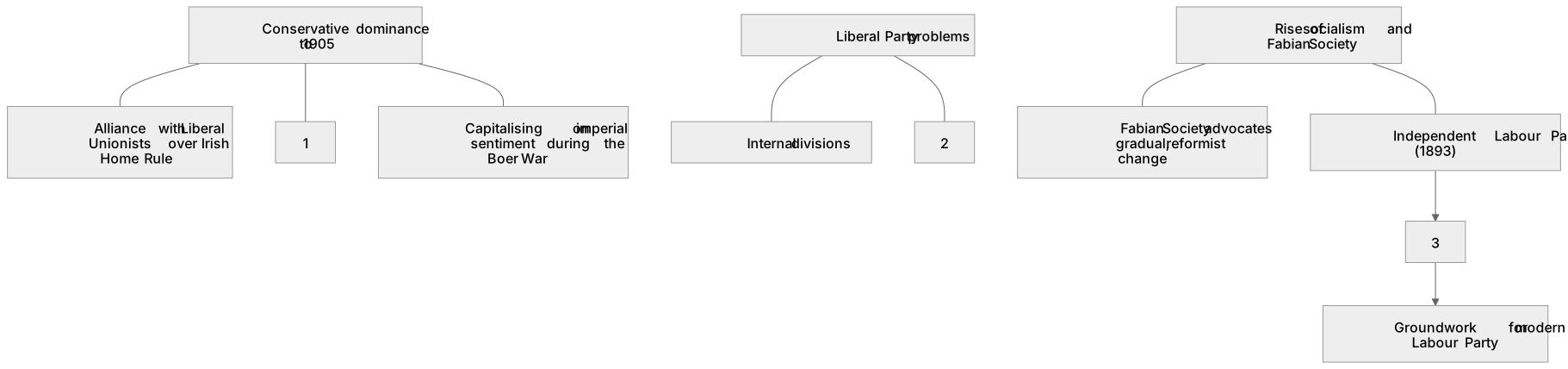
Between 1886 and 1905, the Conservative Party dominated British politics, largely due to their alliance with Liberal Unionists over Irish Home Rule, exploiting middle-class fears of radicalism, and capitalising on imperial sentiment during the Boer War. Conversely, the Liberal Party suffered deep internal divisions, struggling to reconcile traditional Gladstonian liberalism with emerging demands for social reform. Concurrently, working-class political representation grew through the rise of socialism and the intellectual influence of the Fabian Society, which advocated gradual, reformist change. This ideological shift culminated in the formation of the Independent Labour Party (1893) and the Labour Representation Committee (1900), laying the crucial groundwork for the emergence of the modern Labour Party as a distinct political force.
What earns the marks
- Explain the impact of the 1886 Home Rule split on Liberal weakness and Conservative-Unionist electoral success.
- Analyse how 'Villa Toryism' and imperialist foreign policy, such as the Boer War 'Khaki Election' of 1900, sustained Conservative dominance.
- Evaluate the role of the Fabian Society in promoting gradualist socialism and influencing social policy debates.
- Trace the institutional emergence of the Labour Party from the Trades Union Congress's creation of the Labour Representation Committee in 1900.
Common mistakes and how to put them right
Confusing the Independent Labour Party (ILP) with the Labour Representation Committee (LRC).
Put it right: The ILP was formed in 1893, whereas the LRC, which was the direct precursor to the Labour Party, was established in 1900.
Assuming the Conservative Party ruled entirely alone.
Put it right: They relied heavily on the Liberal Unionists, formally merging to become the Conservative and Unionist Party only in 1912.
Overstating the immediate electoral success of the Labour Party before 1906.
Put it right: Early Labour representation was minimal and heavily dependent on the Lib-Lab pact.
Exam tips
- When discussing Conservative dominance, always weigh the importance of their own strengths against the internal divisions of the Liberal Party.
- Use the 1900 'Khaki Election' as a prime example of how the Conservatives successfully weaponised imperialism for electoral gain.
- Link the intellectual foundation provided by Fabianism to the practical trade union backing of the LRC when explaining Labour's emergence.
Try the lesson
The start of the 1G Challenge and transformation: Britain, c1851–1964 – Challenges to the status quo, c1886–1914: Political developments: the reasons for Conservative dominance to 1905; the problems of the Liberal Party; socialism, Fabianism and the emergence of the Labour Party lesson, made from checked teaching notes for this specification point.
Have a go first
Which of the following best describes the primary approach advocated by the Fabian Society towards achieving socialism in Britain during the late 19th and early 20th centuries?
Listen
Between 1886 and 1905, the Conservative Party dominated British politics, largely due to their alliance with Liberal Unionists over Irish Home Rule, exploiting middle-class fears of radicalism, and capitalising on imperial sentiment during the Boer War. Conversely, the Liberal Party suffered deep internal divisions, struggling to reconcile traditional Gladstonian liberalism with emerging demands for social reform. Concurrently, working-class political representation grew through the rise of socialism and the intellectual influence of the Fabian Society, which advocated gradual, reformist change. This ideological shift culminated in the formation of the Independent Labour Party (1893) and the Labour Representation Committee (1900), laying the crucial groundwork for the emergence of the modern Labour Party as a distinct political force. A strong answer earns marks for these points. Explain the impact of the 1886 Home Rule split on Liberal weakness and Conservative-Unionist electoral success. Analyse how 'Villa Toryism' and imperialist foreign policy, such as the Boer War 'Khaki Election' of 1900, sustained Conservative dominance. Evaluate the role of the Fabian Society in promoting gradualist socialism and influencing social policy debates. Trace the institutional emergence of the Labour Party from the Trades Union Congress's creation of the Labour Representation Committee in 1900. Exam tip: When discussing Conservative dominance, always weigh the importance of their own strengths against the internal divisions of the Liberal Party.
See it
Put the events in order
Put these events in the order they happened, earliest first.
- 1. Home Rule split weakens the Liberal Party
- 2. Trades Union Congress creates the Labour Representation Committee
- 3. Formation of the Independent Labour Party
Key words
Say what each word means before you turn the card.
Conservative dominance
Try answering aloud or in your head before turning the card.
Problems of the Liberal Party
Try answering aloud or in your head before turning the card.
Fabian Society
Try answering aloud or in your head before turning the card.
Emergence of the Labour Party
Try answering aloud or in your head before turning the card.
See every definition
- Conservative dominance
- The period to 1905 in which the Conservative Party dominated British politics, largely due to their alliance with Liberal Unionists over Irish Home Rule.
- Problems of the Liberal Party
- Deep internal divisions, struggling to reconcile traditional Gladstonian liberalism with emerging demands for social reform.
- Fabian Society
- An intellectual influence advocating gradual, reformist change, which promoted gradualist socialism and influenced social policy debates.
- Emergence of the Labour Party
- The formation of the Independent Labour Party in 1893 and the Labour Representation Committee in 1900, laying the groundwork for a distinct political force.
Label the diagram
Some boxes have lost their names. Pick the right name for each number.
1Box 1
2Box 2
3Box 3
There is more to this lesson
The full lesson goes on to check your understanding and help you earn the marks. Create a free account to carry on, with your progress saved.
A week of Premium from your first lesson · Then the free plan continues · No card, no charge
Test your understanding of 1G Challenge and transformation: Britain, c1851–1964 – Challenges to the status quo, c1886–1914: Political developments: the reasons for Conservative dominance to 1905; the problems of the Liberal Party; socialism, Fabianism and the emergence of the Labour Party
Active recall beats re-reading. Take an instant quiz now to test what you’ve learned and lock it into long-term memory.
A week of Premium from your first lesson · Then the free plan continues · No card, no charge