AQA · A-Level · History
Course version: 7042 · Version from Sept 2017
Britain, c1851–1964 – Challenges to the status quo, c1886–1914: Social…
Full specification wording
1G Challenge and transformation: Britain, c1851–1964 – Challenges to the status quo, c1886–1914: Social change; trade unions and new unionism; syndicalism; the issue of female emancipation; the growth of the urban population; the expansion of service industries; standards of living
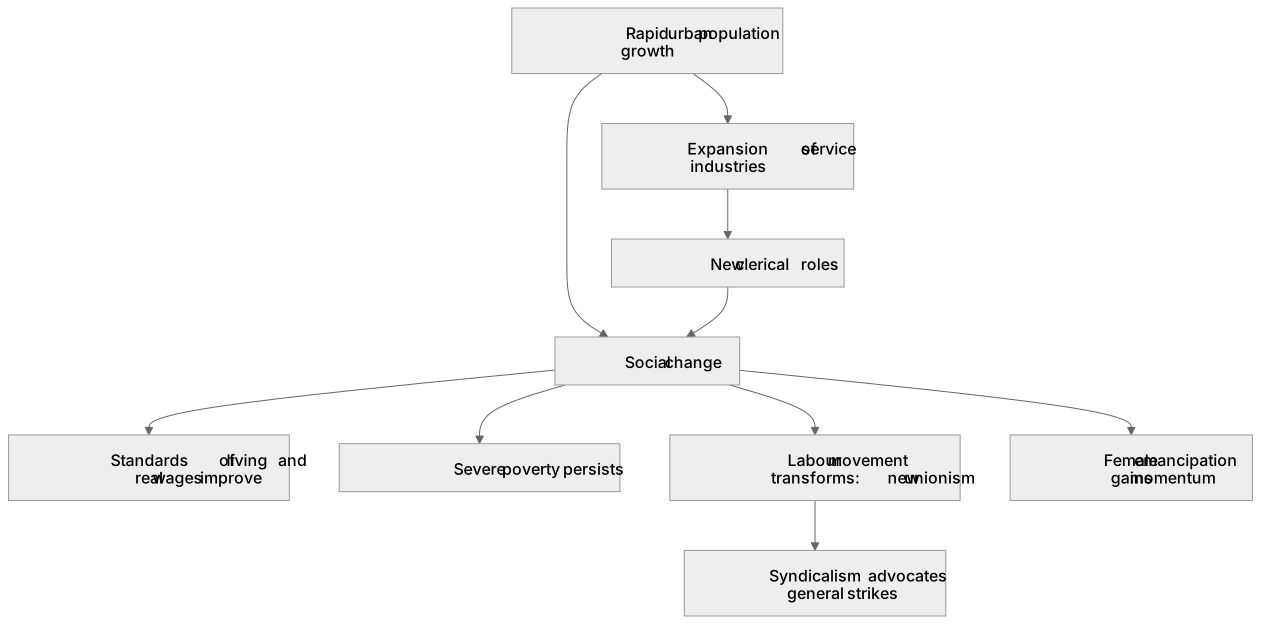
Late nineteenth-century Britain saw profound social change, driven by rapid urban population growth and the expansion of service industries, which created new clerical roles.
Checked against the AQA 7042 specification (opens in a new tab) on .
- Point 4 of 6
- 3 key terms
Study notes
From the checked teaching notes for this specification point.
The idea
Late nineteenth-century Britain saw profound social change, driven by rapid urban population growth and the expansion of service industries, which created new clerical roles. While overall standards of living and real wages improved, severe poverty persisted. The labour movement transformed through 'new unionism', organising unskilled workers like those in the 1889 Dockers' strike. Later, radical syndicalism advocated using general strikes to overthrow capitalism. Simultaneously, the issue of female emancipation gained unprecedented momentum, with women demanding political enfranchisement, better employment opportunities, and improved legal rights, fundamentally challenging the traditional Victorian domestic sphere and societal norms.
What earns the marks
- Analyse the shift from craft unions to 'new unionism', focusing on the mobilisation of unskilled workers and key strikes in the late 1880s.
- Evaluate the influence of syndicalism on industrial militancy, particularly in the years immediately preceding the First World War.
- Assess the multifaceted nature of female emancipation, encompassing suffrage campaigns, legal rights, and changing employment patterns.
- Explain the demographic shift towards urbanisation and the corresponding rise of the service sector and white-collar employment.
- Evaluate the debate surrounding standards of living, contrasting rising real wages with the persistent, structural poverty documented by contemporary social investigators.
Common mistakes and how to put them right
Confusing 'new unionism' with syndicalism.
Put it right by defining new unionism as the organisation of unskilled workers for better conditions, whereas syndicalism sought to overthrow capitalism via general strikes.
Equating female emancipation solely with the suffrage movement.
Put it right by including broader social changes such as property rights, education, and entry into service industries.
Assuming living standards improved uniformly.
Put it right by acknowledging that while average real wages rose, up to a third of urban populations remained in severe poverty.
Exam tips
- Use the findings of Charles Booth and Seebohm Rowntree to provide concrete evidence when discussing standards of living and urban poverty.
- Differentiate clearly between the methods and aims of various labour movements, contrasting moderate trade unionism with militant syndicalism.
- Link the expansion of service industries directly to social changes, such as the emergence of the lower-middle class and new employment opportunities for women.
Try the lesson
The start of the 1G Challenge and transformation: Britain, c1851–1964 – Challenges to the status quo, c1886–1914: Social change; trade unions and new unionism; syndicalism; the issue of female emancipation; the growth of the urban population; the expansion of service industries; standards of living lesson, made from checked teaching notes for this specification point.
Have a go first
Which of the following was a defining characteristic of the 'new unionism' that emerged in Britain during the late 1880s?
Listen
Late nineteenth-century Britain saw profound social change, driven by rapid urban population growth and the expansion of service industries, which created new clerical roles. While overall standards of living and real wages improved, severe poverty persisted. The labour movement transformed through 'new unionism', organising unskilled workers like those in the 1889 Dockers' strike. Later, radical syndicalism advocated using general strikes to overthrow capitalism. Simultaneously, the issue of female emancipation gained unprecedented momentum, with women demanding political enfranchisement, better employment opportunities, and improved legal rights, fundamentally challenging the traditional Victorian domestic sphere and societal norms. A strong answer earns marks for these points. Analyse the shift from craft unions to 'new unionism', focusing on the mobilisation of unskilled workers and key strikes in the late 1880s. Evaluate the influence of syndicalism on industrial militancy, particularly in the years immediately preceding the First World War. Assess the multifaceted nature of female emancipation, encompassing suffrage campaigns, legal rights, and changing employment patterns. Explain the demographic shift towards urbanisation and the corresponding rise of the service sector and white-collar employment. A common slip: Confusing 'new unionism' with syndicalism. Instead, defining new unionism as the organisation of unskilled workers for better conditions, whereas syndicalism sought to overthrow capitalism via general strikes. Exam tip: Use the findings of Charles Booth and Seebohm Rowntree to provide concrete evidence when discussing standards of living and urban poverty.
See it
Key words
Say what each word means before you turn the card.
Class and labour relations
Try answering aloud or in your head before turning the card.
Gender and society
Try answering aloud or in your head before turning the card.
Poverty and welfare
Try answering aloud or in your head before turning the card.
See every definition
- Class and labour relations
- The labour movement transformed through 'new unionism', organising unskilled workers, while radical syndicalism later advocated using general strikes to overthrow capitalism.
- Gender and society
- The issue of female emancipation gained unprecedented momentum, with women demanding political enfranchisement, better employment opportunities and improved legal rights, challenging the traditional Victorian domestic sphere.
- Poverty and welfare
- While overall standards of living and real wages improved, severe poverty persisted.
Label the diagram
Some boxes have lost their names. Pick the right name for each number.
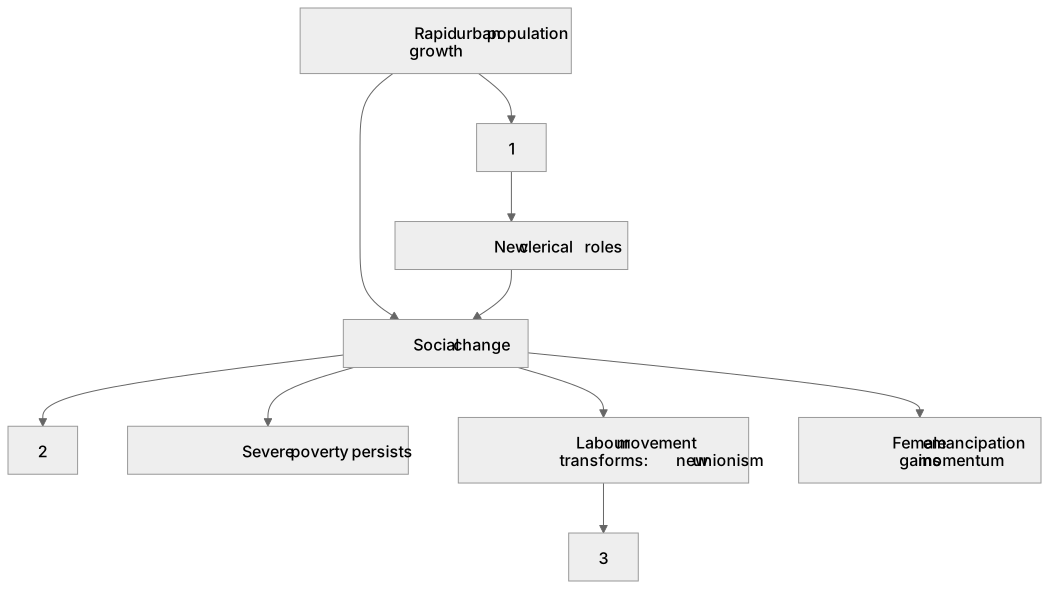
1Box 1
2Box 2
3Box 3
There is more to this lesson
The full lesson goes on to check your understanding and help you earn the marks. Create a free account to carry on, with your progress saved.
A week of Premium from your first lesson · Then the free plan continues · No card, no charge
Test your understanding of 1G Challenge and transformation: Britain, c1851–1964 – Challenges to the status quo, c1886–1914: Social change; trade unions and new unionism; syndicalism; the issue of female emancipation; the growth of the urban population; the expansion of service industries; standards of living
Active recall beats re-reading. Take an instant quiz now to test what you’ve learned and lock it into long-term memory.
A week of Premium from your first lesson · Then the free plan continues · No card, no charge