AQA · A-Level · History
Course version: 7042 · Version from Sept 2017
Britain, c1851–1964 – Challenges to the status quo, c1886–1914: The…
Full specification wording
1G Challenge and transformation: Britain, c1851–1964 – Challenges to the status quo, c1886–1914: The condition of Ireland and Anglo-Irish relations: the Home Rule movement, opposition and the Home Rule Bills
Anglo-Irish relations from 1886 to 1914 were dominated by the condition of Ireland, characterised by agrarian distress and nationalist demands.
Checked against the AQA 7042 specification (opens in a new tab) on .
- Point 6 of 6
- 4 key terms
Study notes
From the checked teaching notes for this specification point.
The idea
Anglo-Irish relations from 1886 to 1914 were dominated by the condition of Ireland, characterised by agrarian distress and nationalist demands. The Home Rule movement, led by Parnell and later Redmond, sought an independent Irish parliament. This provoked fierce opposition, particularly from Ulster Unionists who feared Catholic domination and economic ruin, declaring 'Home Rule is Rome Rule'. The struggle culminated in three Home Rule Bills. Gladstone’s First (1886) and Second (1893) Bills failed, but the Third Home Rule Bill (1912) passed the Commons, sparking the Curragh Mutiny and the formation of rival paramilitary groups. By 1914, Ireland stood on the brink of civil war before WWI suspended the legislation.
What earns the marks
- Assess the socio-economic condition of Ireland, including land ownership issues and the legacy of the Land Wars, as a primary driver for political change.
- Trace the development of the Home Rule movement under Charles Stewart Parnell and John Redmond, evaluating their political strategies at Westminster.
- Analyse the nature of opposition to Home Rule, focusing on Ulster Unionism, Edward Carson, and the fear of Catholic political and economic dominance.
- Compare the political contexts and outcomes of the First (1886), Second (1893), and Third (1912-1914) Home Rule Bills.
- Evaluate the impact of the 1911 Parliament Act on Anglo-Irish relations, as it removed the House of Lords' absolute veto, making Home Rule inevitable and escalating tensions.
Common mistakes and how to put them right
Confusing Home Rule with complete Irish independence or a republic.
Put it right: Define Home Rule accurately as the restoration of an Irish parliament in Dublin to manage domestic affairs, while remaining part of the British Empire.
Treating Irish opposition to Home Rule as uniform across the country.
Put it right: Distinguish clearly between the predominantly Protestant, industrialised Ulster opposition and the Catholic, agrarian nationalist support in the south.
Stating the Third Home Rule Bill was defeated in Parliament.
Put it right: Clarify that the Third Home Rule Bill was passed and received Royal Assent in 1914, but its implementation was suspended due to the outbreak of the First World War.
Exam tips
- Use the phrase 'Home Rule is Rome Rule' to succinctly illustrate the religious and cultural fears underpinning Ulster Unionist opposition.
- When discussing the failure of the first two Home Rule Bills, explicitly mention the role of the Conservative Party and the House of Lords in blocking the legislation.
- Connect the constitutional crisis of 1910-1911 directly to the Irish question, showing how the Liberal reliance on Irish Nationalist votes forced the introduction of the Third Home Rule Bill.
Try the lesson
The start of the 1G Challenge and transformation: Britain, c1851–1964 – Challenges to the status quo, c1886–1914: The condition of Ireland and Anglo-Irish relations: the Home Rule movement, opposition and the Home Rule Bills lesson, made from checked teaching notes for this specification point.
Have a go first
Which British Prime Minister introduced the First and Second Irish Home Rule Bills in 1886 and 1893 respectively?
Listen
Anglo-Irish relations from 1886 to 1914 were dominated by the condition of Ireland, characterised by agrarian distress and nationalist demands. The Home Rule movement, led by Parnell and later Redmond, sought an independent Irish parliament. This provoked fierce opposition, particularly from Ulster Unionists who feared Catholic domination and economic ruin, declaring 'Home Rule is Rome Rule'. The struggle culminated in three Home Rule Bills. Gladstone’s First (1886) and Second (1893) Bills failed, but the Third Home Rule Bill (1912) passed the Commons, sparking the Curragh Mutiny and the formation of rival paramilitary groups. By 1914, Ireland stood on the brink of civil war before WWI suspended the legislation. A strong answer earns marks for these points. Assess the socio-economic condition of Ireland, including land ownership issues and the legacy of the Land Wars, as a primary driver for political change. Trace the development of the Home Rule movement under Charles Stewart Parnell and John Redmond, evaluating their political strategies at Westminster. Analyse the nature of opposition to Home Rule, focusing on Ulster Unionism, Edward Carson, and the fear of Catholic political and economic dominance. Compare the political contexts and outcomes of the First (1886), Second (1893), and Third (1912-1914) Home Rule Bills. A common slip: Confusing Home Rule with complete Irish independence or a republic. Instead, Define Home Rule accurately as the restoration of an Irish parliament in Dublin to manage domestic affairs, while remaining part of the British Empire. Exam tip: Use the phrase 'Home Rule is Rome Rule' to succinctly illustrate the religious and cultural fears underpinning Ulster Unionist opposition.
See it
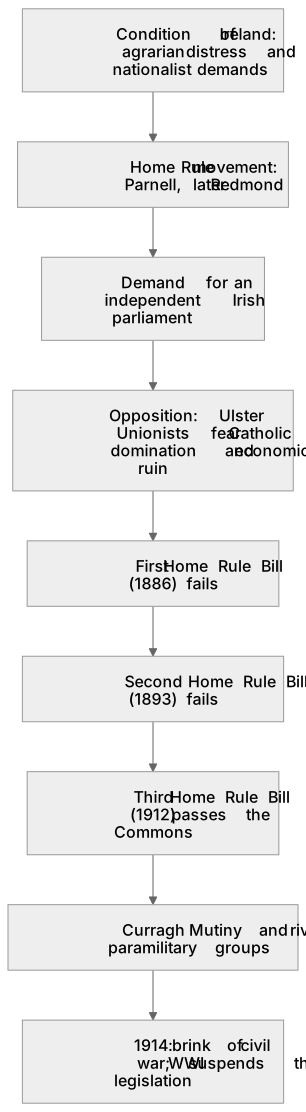
Put the events in order
Put these events in the order they happened, earliest first.
- 1. Third Home Rule Bill received Royal Assent
- 2. Gladstone's First Home Rule Bill failed
- 3. Third Home Rule Bill passed the Commons
- 4. Gladstone's Second Home Rule Bill failed
Key words
Say what each word means before you turn the card.
Home Rule
Try answering aloud or in your head before turning the card.
Home Rule movement
Try answering aloud or in your head before turning the card.
Ulster Unionists
Try answering aloud or in your head before turning the card.
Home Rule Bills
Try answering aloud or in your head before turning the card.
See every definition
- Home Rule
- The restoration of an Irish parliament in Dublin to manage domestic affairs, while remaining part of the British Empire.
- Home Rule movement
- A movement led by Parnell and later Redmond that sought an independent Irish parliament.
- Ulster Unionists
- Opponents of Home Rule who feared Catholic domination and economic ruin, declaring 'Home Rule is Rome Rule'.
- Home Rule Bills
- Three bills, of which the First and Second failed and the Third passed the Commons, sparking the Curragh Mutiny and rival paramilitary groups.
Label the diagram
Some boxes have lost their names. Pick the right name for each number.
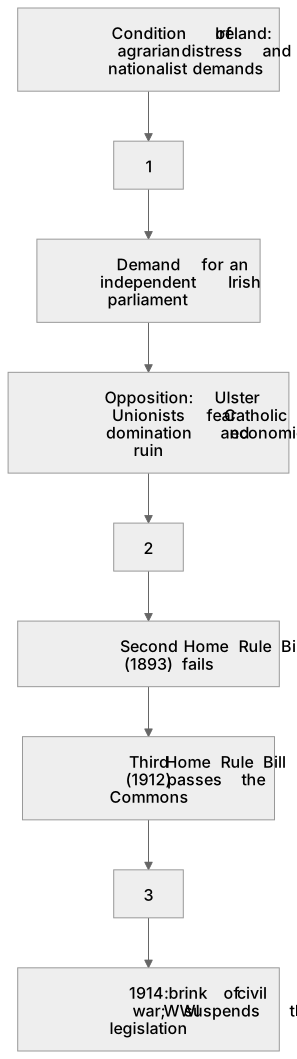
1Box 1
2Box 2
3Box 3
There is more to this lesson
The full lesson goes on to check your understanding and help you earn the marks. Create a free account to carry on, with your progress saved.
A week of Premium from your first lesson · Then the free plan continues · No card, no charge
Test your understanding of 1G Challenge and transformation: Britain, c1851–1964 – Challenges to the status quo, c1886–1914: The condition of Ireland and Anglo-Irish relations: the Home Rule movement, opposition and the Home Rule Bills
Active recall beats re-reading. Take an instant quiz now to test what you’ve learned and lock it into long-term memory.
A week of Premium from your first lesson · Then the free plan continues · No card, no charge