AQA · A-Level · History
Course version: 7042 · Version from Sept 2017
Britain, c1851–1964 – consequence in this period through the following key…
Full specification wording
1G Challenge and transformation: Britain, c1851–1964 – consequence in this period through the following key questions:: How did democracy and political organisations develop in Britain?
Between 1851 and 1964, British democracy developed through franchise expansion and the evolution of political organisations.
Checked against the AQA 7042 specification (opens in a new tab) on .
- Point 1 of 6
- 4 key terms
Study notes
From the checked teaching notes for this specification point.
The idea
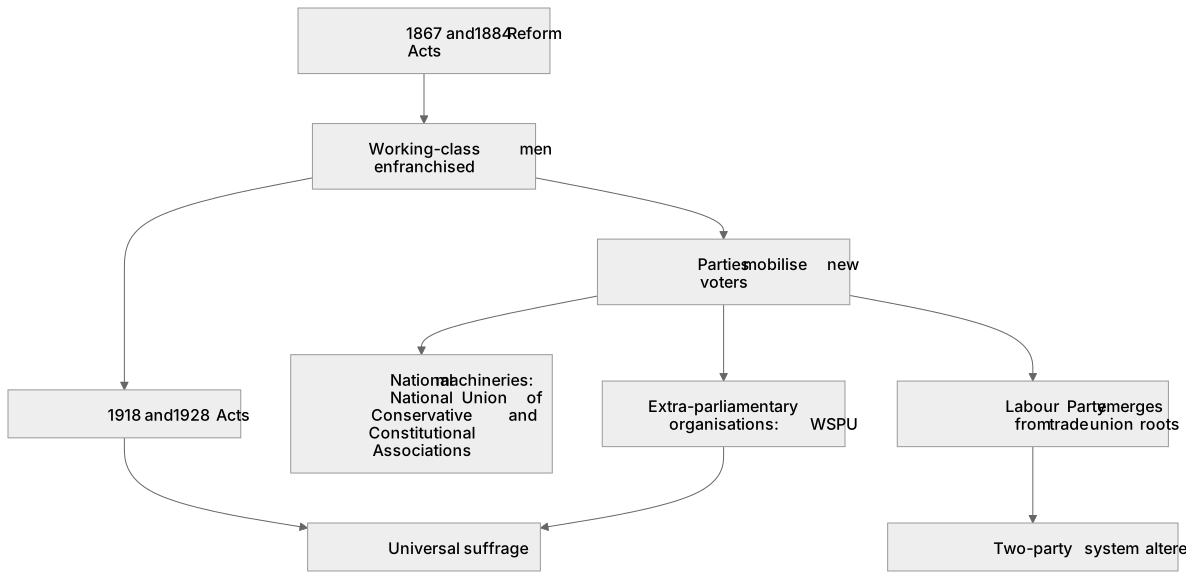
Between 1851 and 1964, British democracy developed through franchise expansion and the evolution of political organisations. Political organisations transformed to mobilise new voters. The Liberal and Conservative parties developed national machineries, such as the National Union of Conservative and Constitutional Associations. Furthermore, the period saw the emergence of the Labour Party from trade union roots, altering the two-party system, alongside extra-parliamentary organisations like the WSPU campaigning for democratic inclusion.
What earns the marks
- Assess the impact of key legislative milestones on democratic development, including the 1867, 1884, 1918, and 1928 Reform Acts.
- Evaluate the structural evolution of political parties, such as the creation of the Conservative Central Office and the National Liberal Federation.
- Analyse the origins and rise of the Labour Party, linking its development to trade unionism and the enfranchisement of the working class.
- Examine the role of extra-parliamentary political organisations, such as the suffragists and suffragettes, in forcing democratic change.
Common mistakes and how to put them right
Assuming the 1918 Representation of the People Act granted equal voting rights to all women.
Put it right: It only enfranchised women over 30 with property qualifications, whereas equal franchise was achieved in 1928.
Confusing the roles of the NUWSS and the WSPU.
Put it right: The NUWSS used constitutional methods, while the WSPU employed militant tactics.
Treating the decline of the Liberal Party as a sudden event in the 1920s.
Put it right: It was a complex process beginning earlier, exacerbated by the First World War and the rise of Labour.
Exam tips
- When discussing democratic development, always link franchise extensions to the corresponding changes in how political parties organised themselves to win over new voters.
- Use specific examples of extra-parliamentary pressure, such as the Chartist legacy or the Suffragette movement, to evaluate whether democracy developed from above or below.
- Track the shifting electoral dominance between the Conservatives, Liberals, and Labour across the period to demonstrate an understanding of long-term political transformation.
Try the lesson
The start of the 1G Challenge and transformation: Britain, c1851–1964 – consequence in this period through the following key questions:: How did democracy and political organisations develop in Britain? lesson, made from checked teaching notes for this specification point.
Have a go first
Which of the following changes to the democratic franchise was introduced by the Representation of the People Act 1918?
Listen
Between 1851 and 1964, British democracy developed through franchise expansion and the evolution of political organisations. Political organisations transformed to mobilise new voters. The Liberal and Conservative parties developed national machineries, such as the National Union of Conservative and Constitutional Associations. Furthermore, the period saw the emergence of the Labour Party from trade union roots, altering the two-party system, alongside extra-parliamentary organisations like the WSPU campaigning for democratic inclusion. A strong answer earns marks for these points. Assess the impact of key legislative milestones on democratic development, including the 1867, 1884, 1918, and 1928 Reform Acts. Evaluate the structural evolution of political parties, such as the creation of the Conservative Central Office and the National Liberal Federation. Analyse the origins and rise of the Labour Party, linking its development to trade unionism and the enfranchisement of the working class. Examine the role of extra-parliamentary political organisations, such as the suffragists and suffragettes, in forcing democratic change. Exam tip: When discussing democratic development, always link franchise extensions to the corresponding changes in how political parties organised themselves to win over new voters.
See it
Put the events in order
Put these events in the order they happened, earliest first.
- 1. Act achieved equal franchise for women
- 2. Reform Act enfranchised working-class men
- 3. Reform Act granted votes to women over thirty
- 4. Reform Act further extended the franchise
Key words
Say what each word means before you turn the card.
Franchise extension and electoral reform
Try answering aloud or in your head before turning the card.
The rise of the Labour Party
Try answering aloud or in your head before turning the card.
Extra-parliamentary pressure groups
Try answering aloud or in your head before turning the card.
The decline of the Liberal Party
Try answering aloud or in your head before turning the card.
See every definition
- Franchise extension and electoral reform
- The expansion of democratic rights from the 1867 and 1884 Reform Acts, enfranchising working-class men, to the 1918 and 1928 Acts granting universal suffrage.
- The rise of the Labour Party
- The emergence of the Labour Party from trade union roots, altering the two-party system.
- Extra-parliamentary pressure groups
- Organisations outside Parliament, such as the WSPU, campaigning for democratic inclusion.
- The decline of the Liberal Party
- A complex process beginning earlier, exacerbated by the First World War and the rise of Labour.
Label the diagram
Some boxes have lost their names. Pick the right name for each number.
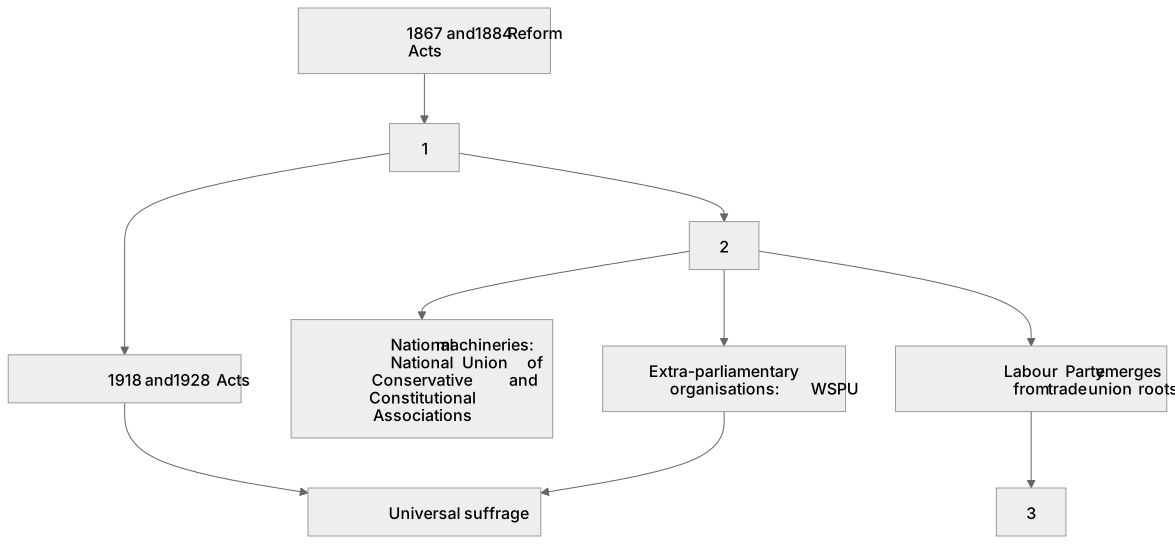
1Box 1
2Box 2
3Box 3
There is more to this lesson
The full lesson goes on to check your understanding and help you earn the marks. Create a free account to carry on, with your progress saved.
A week of Premium from your first lesson · Then the free plan continues · No card, no charge
Test your understanding of 1G Challenge and transformation: Britain, c1851–1964 – consequence in this period through the following key questions:: How did democracy and political organisations develop in Britain?
Active recall beats re-reading. Take an instant quiz now to test what you’ve learned and lock it into long-term memory.
A week of Premium from your first lesson · Then the free plan continues · No card, no charge