AQA · A-Level · History
Course version: 7042 · Version from Sept 2017
Britain, c1851–1964 – Reform and challenge, c1851–c1886: The condition of…
Full specification wording
1G Challenge and transformation: Britain, c1851–1964 – Reform and challenge, c1851–c1886: The condition of Ireland and Anglo-Irish relations: land agitation and the political response; Home Rule
Anglo-Irish relations from 1851 to 1886 were defined by Ireland's poor economic condition and surging nationalism.
Checked against the AQA 7042 specification (opens in a new tab) on .
- Point 6 of 6
- 3 key terms
Study notes
From the checked teaching notes for this specification point.
The idea
Anglo-Irish relations from 1851 to 1886 were defined by Ireland's poor economic condition and surging nationalism. Agricultural depression sparked intense land agitation, led by the Land League from 1879, which used boycotting to demand fair rent, fixity of tenure, and free sale. The British political response under Gladstone combined coercion with conciliation, passing the 1881 Land Act to grant these demands. This failed to quell broader unrest. Under Charles Stewart Parnell, the Irish Parliamentary Party linked the land question to the constitutional demand for Home Rule. Parnell's leverage at Westminster forced Gladstone to introduce the First Home Rule Bill in 1886, fracturing the Liberal Party and reshaping British politics.
What earns the marks
- Analyse the economic and social conditions in post-famine Ireland that fuelled the Land War and the creation of the Land League.
- Evaluate the effectiveness of Gladstone's dual policy of coercion (e.g., the Protection of Person and Property Act 1881) and conciliation (e.g., the Land Act 1881).
- Assess the role of Charles Stewart Parnell in uniting agrarian radicalism with constitutional nationalism to advance the Home Rule agenda.
- Examine the political fallout of the 1886 Home Rule Bill, specifically the split within the Liberal Party and the emergence of the Liberal Unionists.
Common mistakes and how to put them right
Confusing the demands of the Land League with the demands for Home Rule.
Put it right: Clarify that the Land League focused on agrarian reform (the 'Three Fs'), whereas Home Rule was a constitutional demand for a separate Irish parliament in Dublin.
Stating that the 1886 Home Rule Bill was passed into law.
Put it right: Emphasise that the First Home Rule Bill was defeated in the House of Commons by 343 votes to 311, leading to the fall of Gladstone's government.
Assuming Gladstone's policies were universally welcomed in Ireland.
Put it right: Note that while the 1881 Land Act addressed key grievances, the accompanying Coercion Acts deeply alienated the Irish population and led to Parnell's imprisonment.
Exam tips
- Use the 'New Departure' to explain how Parnell successfully bridged the gap between physical force republicanism (Fenians) and constitutional politics.
- When discussing the political response, explicitly contrast Gladstone's approach to Ireland in his first ministry (1868 to 1874) with his second ministry (1880 to 1885).
- Highlight the significance of the 1885 general election, where the Irish Parliamentary Party won 86 seats, giving them the balance of power at Westminster.
Try the lesson
The start of the 1G Challenge and transformation: Britain, c1851–1964 – Reform and challenge, c1851–c1886: The condition of Ireland and Anglo-Irish relations: land agitation and the political response; Home Rule lesson, made from checked teaching notes for this specification point.
Have a go first
Which organisation was founded in 1879 by Michael Davitt to campaign for the 'Three Fs' (fair rent, fixity of tenure, and free sale) for Irish tenant farmers?
Listen
Anglo-Irish relations from 1851 to 1886 were defined by Ireland's poor economic condition and surging nationalism. Agricultural depression sparked intense land agitation, led by the Land League from 1879, which used boycotting to demand fair rent, fixity of tenure, and free sale. The British political response under Gladstone combined coercion with conciliation, passing the 1881 Land Act to grant these demands. This failed to quell broader unrest. Under Charles Stewart Parnell, the Irish Parliamentary Party linked the land question to the constitutional demand for Home Rule. Parnell's leverage at Westminster forced Gladstone to introduce the First Home Rule Bill in 1886, fracturing the Liberal Party and reshaping British politics. A strong answer earns marks for these points. Analyse the economic and social conditions in post-famine Ireland that fuelled the Land War and the creation of the Land League. Evaluate the effectiveness of Gladstone's dual policy of coercion (e.g., the Protection of Person and Property Act 1881) and conciliation (e.g., the Land Act 1881). Assess the role of Charles Stewart Parnell in uniting agrarian radicalism with constitutional nationalism to advance the Home Rule agenda. Examine the political fallout of the 1886 Home Rule Bill, specifically the split within the Liberal Party and the emergence of the Liberal Unionists. A common slip: Confusing the demands of the Land League with the demands for Home Rule. Instead, Clarify that the Land League focused on agrarian reform (the 'Three Fs'), whereas Home Rule was a constitutional demand for a separate Irish parliament in Dublin. Exam tip: Use the 'New Departure' to explain how Parnell successfully bridged the gap between physical force republicanism (Fenians) and constitutional politics.
See it
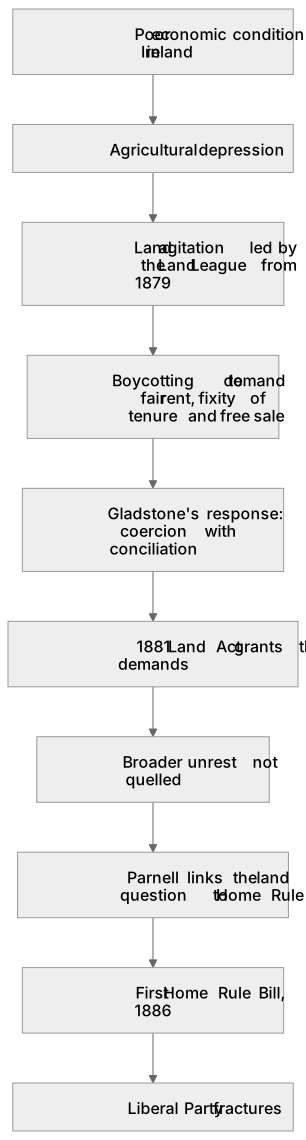
Put the events in order
Put these events in the order they happened, earliest first.
- 1. Gladstone introduced the First Home Rule Bill
- 2. Land League led land agitation using boycotting
- 3. Irish Parliamentary Party won seats in the general election
- 4. Land Act passed to grant fair rent, fixity of tenure and free sale
Key words
Say what each word means before you turn the card.
Agrarian Reform vs Constitutional Change
Try answering aloud or in your head before turning the card.
Coercion and Conciliation
Try answering aloud or in your head before turning the card.
Party Political Realignment
Try answering aloud or in your head before turning the card.
See every definition
- Agrarian Reform vs Constitutional Change
- The Land League focused on agrarian reform, the 'Three Fs', whereas Home Rule was a constitutional demand for a separate Irish parliament in Dublin.
- Coercion and Conciliation
- Gladstone's dual policy combined coercion, such as the Protection of Person and Property Act 1881, with conciliation, such as the Land Act 1881.
- Party Political Realignment
- The First Home Rule Bill in 1886 fractured the Liberal Party and reshaped British politics, with the emergence of the Liberal Unionists.
Label the diagram
Some boxes have lost their names. Pick the right name for each number.
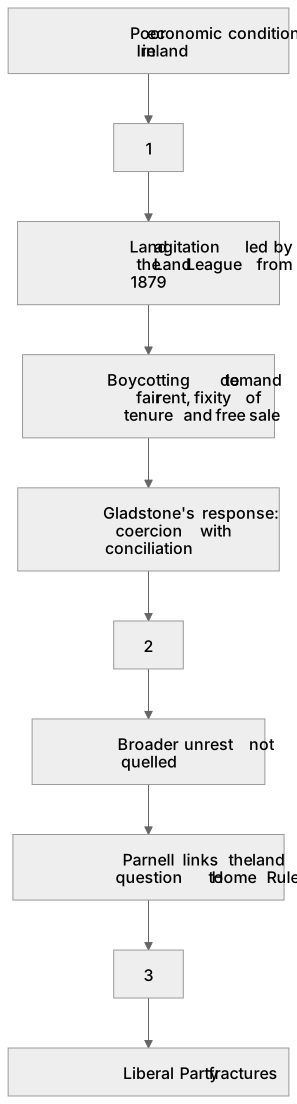
1Box 1
2Box 2
3Box 3
There is more to this lesson
The full lesson goes on to check your understanding and help you earn the marks. Create a free account to carry on, with your progress saved.
A week of Premium from your first lesson · Then the free plan continues · No card, no charge
Test your understanding of 1G Challenge and transformation: Britain, c1851–1964 – Reform and challenge, c1851–c1886: The condition of Ireland and Anglo-Irish relations: land agitation and the political response; Home Rule
Active recall beats re-reading. Take an instant quiz now to test what you’ve learned and lock it into long-term memory.
A week of Premium from your first lesson · Then the free plan continues · No card, no charge