AQA · A-Level · History
Course version: 7042 · Version from Sept 2017
Britain, c1851–1964 – The Great War and its impact, 1914–1939 (A-level…
Full specification wording
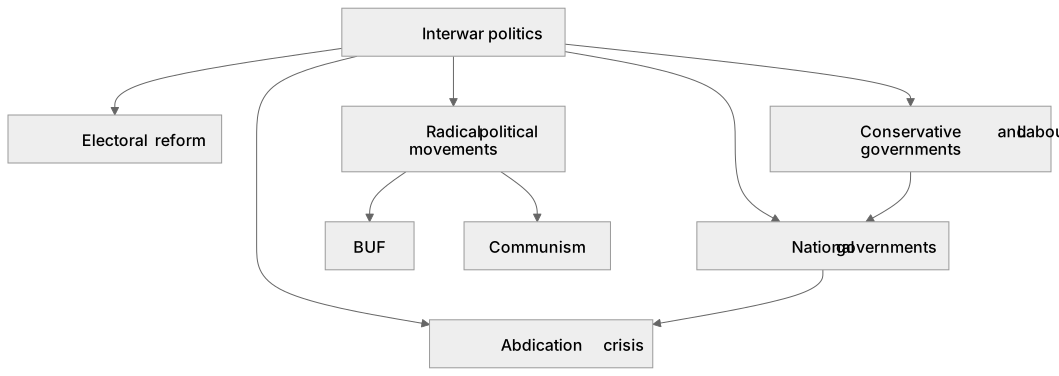
1G Challenge and transformation: Britain, c1851–1964 – The Great War and its impact, 1914–1939 (A-level only): Political developments in the interwar years: electoral reform; Conservative and Labour governments; National governments; the abdication crisis and emergence of radical political movements, including the BUF and Communism
Interwar politics saw democratic expansion alongside economic crises.
Checked against the AQA 7042 specification (opens in a new tab) on .
- Point 2 of 6
- 4 key terms
Study notes
From the checked teaching notes for this specification point.
The idea
Interwar politics saw democratic expansion alongside economic crises. The 1928 Equal Franchise Act granted women voting parity. The era featured Conservative dominance and brief minority Labour governments, confirming Labour as the official opposition. The 1931 financial crisis triggered the National Government, a Conservative-dominated coalition providing stability during the Depression. This stability helped Britain weather the 1936 Abdication Crisis of Edward VIII with minimal damage. Despite economic hardship, radical movements like Mosley's British Union of Fascists (BUF) and the Communist Party failed to achieve mainstream success, constrained by the entrenched two-party system and the moderate consensus of the National Government.
What earns the marks
- Evaluate the reasons for the formation of the National Government in 1931 and its subsequent electoral dominance.
- Assess the achievements and limitations of the first two minority Labour governments (1924 and 1929-1931).
- Analyse the reasons why radical political movements, specifically the BUF and the Communist Party, failed to gain significant electoral traction in Britain.
- Explain the political significance of the 1928 Equal Franchise Act in completing the democratic reforms of the era.
- Evaluate Stanley Baldwin's handling of the 1936 Abdication Crisis and its impact on the monarchy and government stability.
Common mistakes and how to put them right
Stating that the National Government was a balanced coalition of all parties.
Put it right: Emphasise that while it contained members of Labour and the Liberals, it was overwhelmingly dominated by the Conservative Party.
Overstating the threat of the BUF and Communism to the British state.
Put it right: Acknowledge their visibility (e.g., Cable Street) but highlight their marginal electoral impact and the resilience of mainstream British political institutions.
Confusing the 1918 and 1928 franchise acts.
Put it right: Specify that 1918 gave the vote to women over 30 with property qualifications, whereas 1928 equalised the franchise for all adults over 21.
Exam tips
- Use the 1931 crisis to demonstrate the transition from traditional party politics to the National Government consensus.
- When evaluating the failure of extremism, contrast Britain's political stability and economic recovery policies with the situations in Germany or Italy.
- Discuss the Abdication Crisis not just as a royal scandal, but as a test of constitutional monarchy and prime ministerial authority under Baldwin.
Try the lesson
The start of the 1G Challenge and transformation: Britain, c1851–1964 – The Great War and its impact, 1914–1939 (A-level only): Political developments in the interwar years: electoral reform; Conservative and Labour governments; National governments; the abdication crisis and emergence of radical political movements, including the BUF and Communism lesson, made from checked teaching notes for this specification point.
Have a go first
Which significant electoral reform was introduced by the Conservative government in 1928?
Listen
Interwar politics saw democratic expansion alongside economic crises. The 1928 Equal Franchise Act granted women voting parity. The era featured Conservative dominance and brief minority Labour governments, confirming Labour as the official opposition. The 1931 financial crisis triggered the National Government, a Conservative-dominated coalition providing stability during the Depression. This stability helped Britain weather the 1936 Abdication Crisis of Edward VIII with minimal damage. Despite economic hardship, radical movements like Mosley's British Union of Fascists (BUF) and the Communist Party failed to achieve mainstream success, constrained by the entrenched two-party system and the moderate consensus of the National Government. A strong answer earns marks for these points. Evaluate the reasons for the formation of the National Government in 1931 and its subsequent electoral dominance. Assess the achievements and limitations of the first two minority Labour governments (1924 and 1929-1931). Analyse the reasons why radical political movements, specifically the BUF and the Communist Party, failed to gain significant electoral traction in Britain. Explain the political significance of the 1928 Equal Franchise Act in completing the democratic reforms of the era. A common slip: Stating that the National Government was a balanced coalition of all parties. Instead, Emphasise that while it contained members of Labour and the Liberals, it was overwhelmingly dominated by the Conservative Party. Exam tip: Use the 1931 crisis to demonstrate the transition from traditional party politics to the National Government consensus.
See it
Put the events in order
Put these events in the order they happened, earliest first.
- 1. Equal Franchise Act granted women voting parity
- 2. First minority Labour government took office
- 3. Abdication Crisis of Edward VIII
- 4. Second minority Labour government began
- 5. Financial crisis triggered the National Government
Key words
Say what each word means before you turn the card.
Democratic expansion
Try answering aloud or in your head before turning the card.
Economic crisis and consensus
Try answering aloud or in your head before turning the card.
Political extremism
Try answering aloud or in your head before turning the card.
Constitutional stability
Try answering aloud or in your head before turning the card.
See every definition
- Democratic expansion
- Interwar politics saw this alongside economic crises, with the 1928 Equal Franchise Act granting women voting parity.
- Economic crisis and consensus
- The 1931 financial crisis triggered the National Government, a Conservative-dominated coalition providing stability during the Depression.
- Political extremism
- Radical movements like Mosley's British Union of Fascists and the Communist Party failed to achieve mainstream success, constrained by the entrenched two-party system and moderate consensus.
- Constitutional stability
- This helped Britain weather the 1936 Abdication Crisis of Edward VIII with minimal damage.
Label the diagram
Some boxes have lost their names. Pick the right name for each number.
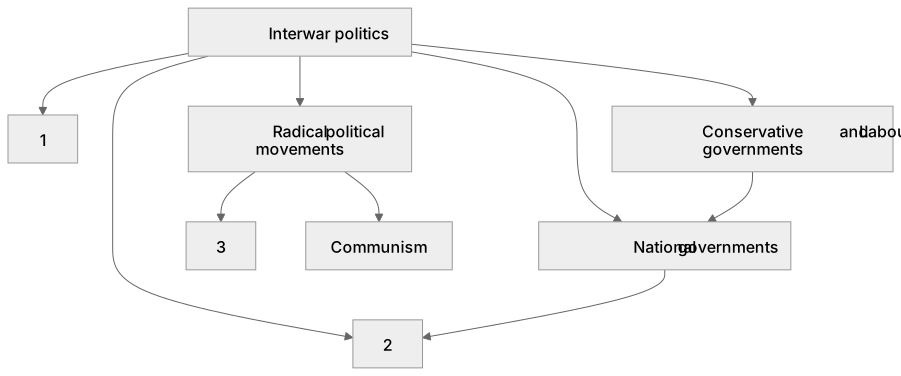
1Box 1
2Box 2
3Box 3
There is more to this lesson
The full lesson goes on to check your understanding and help you earn the marks. Create a free account to carry on, with your progress saved.
A week of Premium from your first lesson · Then the free plan continues · No card, no charge
Test your understanding of 1G Challenge and transformation: Britain, c1851–1964 – The Great War and its impact, 1914–1939 (A-level only): Political developments in the interwar years: electoral reform; Conservative and Labour governments; National governments; the abdication crisis and emergence of radical political movements, including the BUF and Communism
Active recall beats re-reading. Take an instant quiz now to test what you’ve learned and lock it into long-term memory.
A week of Premium from your first lesson · Then the free plan continues · No card, no charge