AQA · A-Level · History
Course version: 7042 · Version from Sept 2017
Britain, c1851–1964 – The Great War and its impact, 1914–1939 (A-level…
Full specification wording
1G Challenge and transformation: Britain, c1851–1964 – The Great War and its impact, 1914–1939 (A-level only): Social developments: changes in the role of women during and after war; the condition of the working classes; regional divisions; changing attitudes in the twenties and 'the hungry thirties'; the growth of the media
WWI transformed women's roles as they entered munitions factories, aiding the 1918 enfranchisement, though many returned to domesticity post-war.
Checked against the AQA 7042 specification (opens in a new tab) on .
- Point 4 of 6
- 4 key terms
Study notes
From the checked teaching notes for this specification point.
The idea
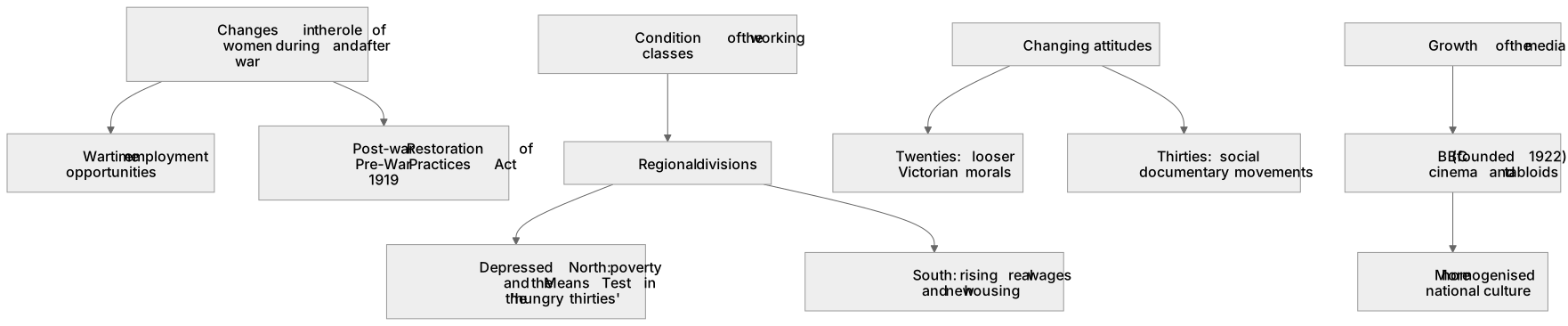
WWI transformed women's roles as they entered munitions factories, aiding the 1918 enfranchisement, though many returned to domesticity post-war. Working-class conditions were defined by stark regional divisions. Workers in the depressed North endured poverty and the Means Test during the 'hungry thirties', whereas those in the South enjoyed rising real wages and new housing. Changing attitudes emerged in the twenties with looser Victorian morals, contrasting with the social documentary movements of the 1930s. Simultaneously, the growth of the media, particularly the BBC (founded 1922), cinema, and tabloids, forged a more homogenised national culture despite deep economic fractures.
What earns the marks
- Assess the extent of change for women, contrasting wartime employment opportunities with the post-war Restoration of Pre-War Practices Act 1919.
- Evaluate the living standards of the working classes, noting the impact of the 1934 Unemployment Act and the hated Means Test.
- Analyse the regional divisions, comparing the structural unemployment in Jarrow or Merthyr Tydfil with the consumer boom in London and the Midlands.
- Examine changing social attitudes, from the 'flapper' culture of the 1920s to the politically conscious literature of the 1930s.
- Discuss the social impact of mass media, including the role of the BBC under John Reith in shaping national identity and the immense popularity of cinema.
Common mistakes and how to put them right
Assuming WWI permanently liberated women in the workplace.
Put it right: Emphasise that most women were dismissed from industrial jobs when men returned, and the marriage bar remained common in many professions.
Treating the 'hungry thirties' as a period of universal destitution.
Put it right: Contrast the severe poverty in depressed areas with the rising living standards, better diets, and home ownership enjoyed by those in work.
Ignoring the cultural impact of radio and cinema.
Put it right: Explicitly link the growth of the media to the creation of a shared national culture that helped bridge some regional and class divides.
Exam tips
- Use the Jarrow Crusade (1936) as a specific case study to illustrate both the condition of the working classes and the stark regional divisions of the 1930s.
- When discussing changing attitudes, contrast the escapism of the 1920s with the growing social awareness and political polarisation of the 1930s.
- Always qualify statements about working-class poverty by acknowledging the overall rise in real wages due to falling prices during the Depression.
Try the lesson
The start of the 1G Challenge and transformation: Britain, c1851–1964 – The Great War and its impact, 1914–1939 (A-level only): Social developments: changes in the role of women during and after war; the condition of the working classes; regional divisions; changing attitudes in the twenties and 'the hungry thirties'; the growth of the media lesson, made from checked teaching notes for this specification point.
Have a go first
Which development most significantly transformed the growth of the media and mass culture in Britain during the 1920s?
Listen
WWI transformed women's roles as they entered munitions factories, aiding the 1918 enfranchisement, though many returned to domesticity post-war. Working-class conditions were defined by stark regional divisions. Workers in the depressed North endured poverty and the Means Test during the 'hungry thirties', whereas those in the South enjoyed rising real wages and new housing. Changing attitudes emerged in the twenties with looser Victorian morals, contrasting with the social documentary movements of the 1930s. Simultaneously, the growth of the media, particularly the BBC (founded 1922), cinema, and tabloids, forged a more homogenised national culture despite deep economic fractures. A strong answer earns marks for these points. Assess the extent of change for women, contrasting wartime employment opportunities with the post-war Restoration of Pre-War Practices Act 1919. Evaluate the living standards of the working classes, noting the impact of the 1934 Unemployment Act and the hated Means Test. Analyse the regional divisions, comparing the structural unemployment in Jarrow or Merthyr Tydfil with the consumer boom in London and the Midlands. Examine changing social attitudes, from the 'flapper' culture of the 1920s to the politically conscious literature of the 1930s. A common slip: Assuming WWI permanently liberated women in the workplace. Instead, Emphasise that most women were dismissed from industrial jobs when men returned, and the marriage bar remained common in many professions. Exam tip: Use the Jarrow Crusade (1936) as a specific case study to illustrate both the condition of the working classes and the stark regional divisions of the 1930s.
See it
Key words
Say what each word means before you turn the card.
Regional divisions
Try answering aloud or in your head before turning the card.
Growth of the media
Try answering aloud or in your head before turning the card.
Changing attitudes
Try answering aloud or in your head before turning the card.
Role of women
Try answering aloud or in your head before turning the card.
See every definition
- Regional divisions
- Stark differences that defined working-class conditions, with the depressed North enduring poverty and the Means Test while the South enjoyed rising real wages and new housing.
- Growth of the media
- The rise of the BBC, founded 1922, cinema and tabloids, which forged a more homogenised national culture despite deep economic fractures.
- Changing attitudes
- Looser Victorian morals emerging in the twenties, contrasting with the social documentary movements of the 1930s.
- Role of women
- Changes during and after war, as women entered munitions factories, aiding the 1918 enfranchisement, though many returned to domesticity post-war.
Label the diagram
Some boxes have lost their names. Pick the right name for each number.
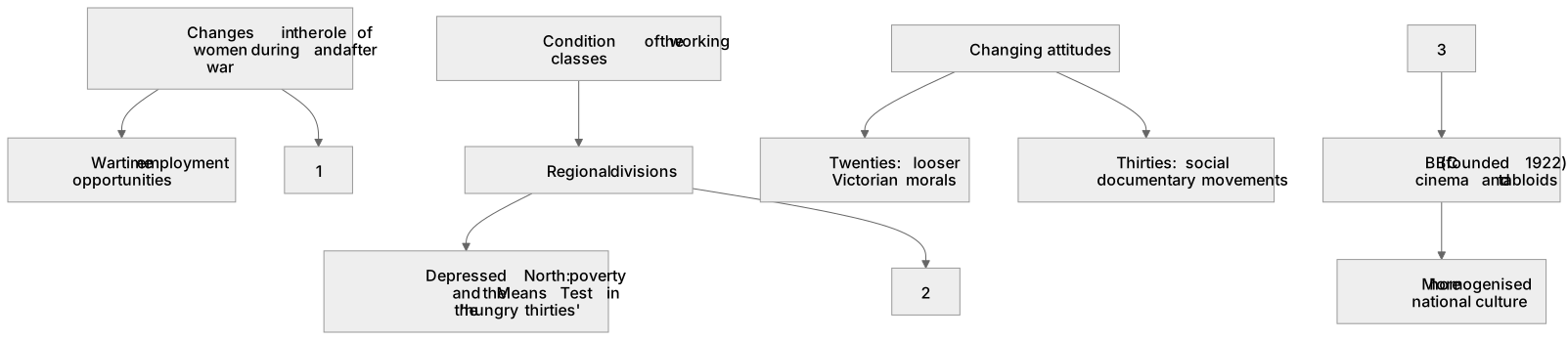
1Box 1
2Box 2
3Box 3
There is more to this lesson
The full lesson goes on to check your understanding and help you earn the marks. Create a free account to carry on, with your progress saved.
A week of Premium from your first lesson · Then the free plan continues · No card, no charge
Test your understanding of 1G Challenge and transformation: Britain, c1851–1964 – The Great War and its impact, 1914–1939 (A-level only): Social developments: changes in the role of women during and after war; the condition of the working classes; regional divisions; changing attitudes in the twenties and 'the hungry thirties'; the growth of the media
Active recall beats re-reading. Take an instant quiz now to test what you’ve learned and lock it into long-term memory.
A week of Premium from your first lesson · Then the free plan continues · No card, no charge