AQA · A-Level · History
Course version: 7042 · Version from Sept 2017
Britain, c1851–1964 – The Great War and its impact, 1914–1939 (A-level…
Full specification wording
1G Challenge and transformation: Britain, c1851–1964 – The Great War and its impact, 1914–1939 (A-level only): The condition of Ireland and Anglo-Irish relations: the Easter Rising; the Anglo-Irish War; Government of Ireland Act and Anglo-Irish Treaty; divided Ireland before the Second World War
Anglo-Irish relations deteriorated sharply following the 1916 Easter Rising.
Checked against the AQA 7042 specification (opens in a new tab) on .
- Point 6 of 6
Study notes
From the checked teaching notes for this specification point.
The idea
Anglo-Irish relations deteriorated sharply following the 1916 Easter Rising. The harsh British execution of its leaders radicalised nationalism, leading to Sinn Féin's 1918 victory and the brutal Anglo-Irish War (1919–1921). To resolve the crisis, the 1920 Government of Ireland Act partitioned the island, creating Northern Ireland. The 1921 Anglo-Irish Treaty then established the Irish Free State as a dominion, sparking a bitter civil war. Before the Second World War, the divided island saw contrasting fortunes: Northern Ireland entrenched unionist control, while the Free State, under Éamon de Valera, systematically dismantled the Treaty's terms, culminating in the 1937 Constitution and an economic war with Britain.
What earns the marks
- Assess the impact of the Easter Rising and the British government's response on the radicalisation of Irish public opinion.
- Evaluate the tactics and consequences of the Anglo-Irish War, including the deployment of the Black and Tans.
- Analyse the terms of the 1920 Government of Ireland Act and the 1921 Anglo-Irish Treaty in establishing partition and dominion status.
- Examine the political and economic development of a divided Ireland up to 1939, including de Valera's constitutional changes and the Anglo-Irish trade war.
Common mistakes and how to put them right
Confusing the Government of Ireland Act with the Anglo-Irish Treaty.
Put it right: Clarify that the 1920 Act partitioned Ireland and created two devolved parliaments, whereas the 1921 Treaty ended the Anglo-Irish War and created the Irish Free State.
Stating that the 1916 Easter Rising had immediate widespread popular support.
Put it right: Note that the Rising was initially unpopular with the Irish public; it was the harsh British executions that shifted public sympathy.
Assuming the Irish Free State became a fully independent republic in 1921.
Put it right: Emphasise that the 1921 Treaty granted dominion status within the British Empire, which was a primary cause of the subsequent Irish Civil War.
Exam tips
- Trace the shift in Irish nationalism from the constitutional approach of the Irish Parliamentary Party to the republicanism of Sinn Féin.
- Consider the British domestic political context, particularly Lloyd George's coalition government, when analysing the negotiation of the 1921 Treaty.
- Compare the differing political trajectories of Northern Ireland and the Irish Free State during the 1930s to address the 'divided Ireland' clause.
Try the lesson
The start of the 1G Challenge and transformation: Britain, c1851–1964 – The Great War and its impact, 1914–1939 (A-level only): The condition of Ireland and Anglo-Irish relations: the Easter Rising; the Anglo-Irish War; Government of Ireland Act and Anglo-Irish Treaty; divided Ireland before the Second World War lesson, made from checked teaching notes for this specification point.
Have a go first
What was the principal outcome of the Anglo-Irish Treaty signed in December 1921?
Listen
Anglo-Irish relations deteriorated sharply following the 1916 Easter Rising. The harsh British execution of its leaders radicalised nationalism, leading to Sinn Féin's 1918 victory and the brutal Anglo-Irish War (1919–1921). To resolve the crisis, the 1920 Government of Ireland Act partitioned the island, creating Northern Ireland. The 1921 Anglo-Irish Treaty then established the Irish Free State as a dominion, sparking a bitter civil war. Before the Second World War, the divided island saw contrasting fortunes: Northern Ireland entrenched unionist control, while the Free State, under Éamon de Valera, systematically dismantled the Treaty's terms, culminating in the 1937 Constitution and an economic war with Britain. A strong answer earns marks for these points. Assess the impact of the Easter Rising and the British government's response on the radicalisation of Irish public opinion. Evaluate the tactics and consequences of the Anglo-Irish War, including the deployment of the Black and Tans. Analyse the terms of the 1920 Government of Ireland Act and the 1921 Anglo-Irish Treaty in establishing partition and dominion status. Examine the political and economic development of a divided Ireland up to 1939, including de Valera's constitutional changes and the Anglo-Irish trade war. A common slip: Confusing the Government of Ireland Act with the Anglo-Irish Treaty. Instead, Clarify that the 1920 Act partitioned Ireland and created two devolved parliaments, whereas the 1921 Treaty ended the Anglo-Irish War and created the Irish Free State. Exam tip: Trace the shift in Irish nationalism from the constitutional approach of the Irish Parliamentary Party to the republicanism of Sinn Féin.
See it
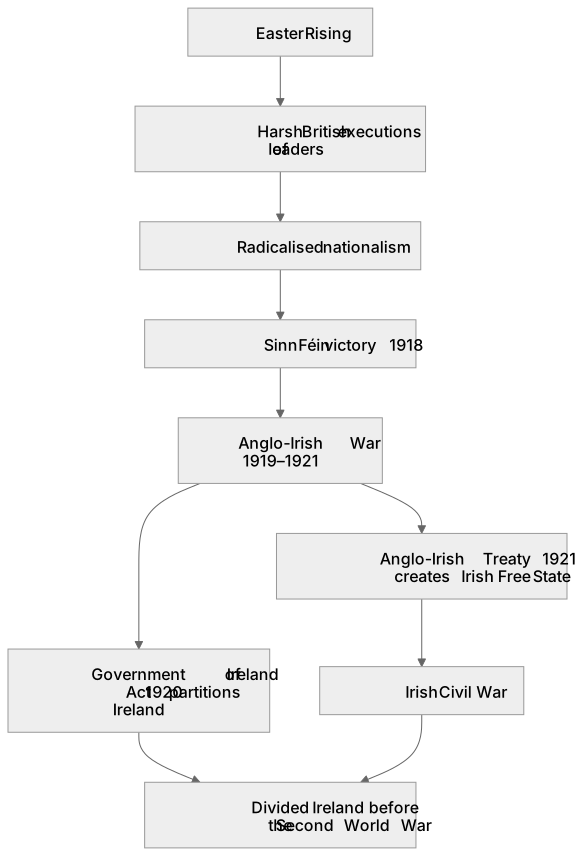
Put the events in order
Put these events in the order they happened, earliest first.
- 1. Sinn Féin's election victory
- 2. Easter Rising in Ireland
- 3. New Constitution under Éamon de Valera
- 4. Government of Ireland Act partitions the island
- 5. Anglo-Irish Treaty establishes the Irish Free State
Label the diagram
Some boxes have lost their names. Pick the right name for each number.
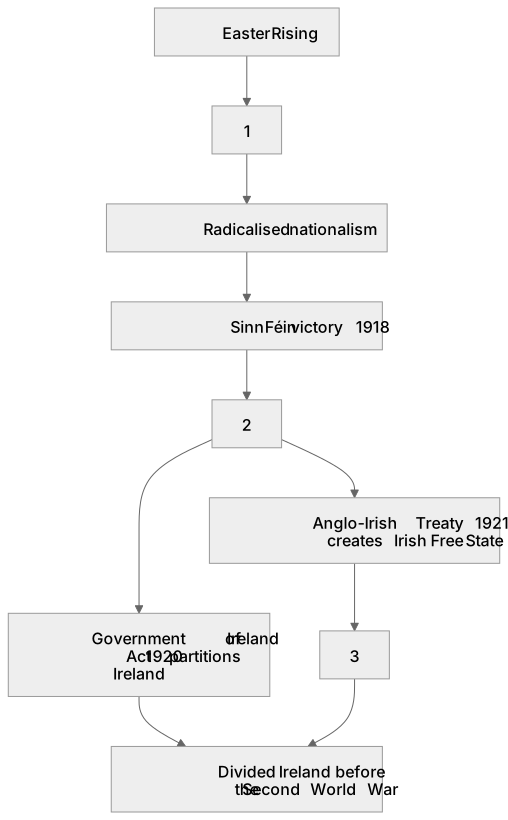
1Box 1
2Box 2
3Box 3
There is more to this lesson
The full lesson goes on to check your understanding and help you earn the marks. Create a free account to carry on, with your progress saved.
A week of Premium from your first lesson · Then the free plan continues · No card, no charge
Test your understanding of 1G Challenge and transformation: Britain, c1851–1964 – The Great War and its impact, 1914–1939 (A-level only): The condition of Ireland and Anglo-Irish relations: the Easter Rising; the Anglo-Irish War; Government of Ireland Act and Anglo-Irish Treaty; divided Ireland before the Second World War
Active recall beats re-reading. Take an instant quiz now to test what you’ve learned and lock it into long-term memory.
A week of Premium from your first lesson · Then the free plan continues · No card, no charge