AQA · A-Level · History
Course version: 7042 · Version from Sept 2017
Britain, c1851–1964 – Transformation and change, 1939–1964 (A-level only):…
Full specification wording
1G Challenge and transformation: Britain, c1851–1964 – Transformation and change, 1939–1964 (A-level only): Economic developments: mobilisation of resources in wartime; post-war boom; balance of payments issues and 'stop-go' policies; changes to British industry and trade; new technology
The Second World War necessitated total economic mobilisation, with the government directing labour and rationing resources to maximise munitions production.
Checked against the AQA 7042 specification (opens in a new tab) on .
- Point 3 of 6
Study notes
From the checked teaching notes for this specification point.
The idea
The Second World War necessitated total economic mobilisation, with the government directing labour and rationing resources to maximise munitions production. Following 1945, Britain experienced a sustained post-war boom characterised by full employment and rising living standards. However, structural weaknesses persisted, leading to chronic balance of payments deficits as imports outstripped exports. To manage inflation and protect the pound, Chancellors utilised 'stop-go' economics, alternating between deflationary tax rises (stop) and expansionary credit easing (go). Concurrently, British industry and trade shifted away from traditional staples like coal towards consumer goods and European markets, aided by new technology such as nuclear power and jet aviation.
What earns the marks
- Evaluate the effectiveness of wartime economic controls, such as the Essential Work Orders, in mobilising resources.
- Analyse the causes of the post-war economic boom, including global recovery and Keynesian demand management.
- Explain the mechanics and impact of 'stop-go' policies on long-term industrial investment and economic stability.
- Assess the shift in British trade patterns, noting the decline of Empire trade and the increasing importance of European markets.
- Identify the role of new technologies, such as the development of the commercial jet airliner and nuclear energy, in attempting to modernise British industry.
Common mistakes and how to put them right
Confusing 'stop' and 'go' phases.
Put it right: 'stop' refers to deflationary measures like raising interest rates to cool inflation, not stimulating the economy.
Assuming the post-war boom eliminated all economic problems.
Put it right by noting the persistent balance of payments crises that plagued successive governments.
Overstating the immediate success of new technologies.
Put it right: While innovations like nuclear power emerged, traditional industries still suffered from chronic underinvestment.
Exam tips
- Link 'stop-go' policies directly to balance of payments issues to demonstrate an understanding of why these short-term measures were repeatedly used.
- Use specific examples of new technology, such as the opening of Calder Hall nuclear power station in 1956, to support arguments about industrial change.
- When evaluating the post-war boom, contrast the visible rise in consumer affluence with underlying structural weaknesses in British manufacturing.
Try the lesson
The start of the 1G Challenge and transformation: Britain, c1851–1964 – Transformation and change, 1939–1964 (A-level only): Economic developments: mobilisation of resources in wartime; post-war boom; balance of payments issues and 'stop-go' policies; changes to British industry and trade; new technology lesson, made from checked teaching notes for this specification point.
Have a go first
Which of the following best describes the 'stop-go' economic policies implemented by British governments in the 1950s and early 1960s?
Listen
The Second World War necessitated total economic mobilisation, with the government directing labour and rationing resources to maximise munitions production. Following 1945, Britain experienced a sustained post-war boom characterised by full employment and rising living standards. However, structural weaknesses persisted, leading to chronic balance of payments deficits as imports outstripped exports. To manage inflation and protect the pound, Chancellors utilised 'stop-go' economics, alternating between deflationary tax rises (stop) and expansionary credit easing (go). Concurrently, British industry and trade shifted away from traditional staples like coal towards consumer goods and European markets, aided by new technology such as nuclear power and jet aviation. A strong answer earns marks for these points. Evaluate the effectiveness of wartime economic controls, such as the Essential Work Orders, in mobilising resources. Analyse the causes of the post-war economic boom, including global recovery and Keynesian demand management. Explain the mechanics and impact of 'stop-go' policies on long-term industrial investment and economic stability. Assess the shift in British trade patterns, noting the decline of Empire trade and the increasing importance of European markets. A common slip: Assuming the post-war boom eliminated all economic problems. Instead, noting the persistent balance of payments crises that plagued successive governments. Exam tip: Link 'stop-go' policies directly to balance of payments issues to demonstrate an understanding of why these short-term measures were repeatedly used.
See it
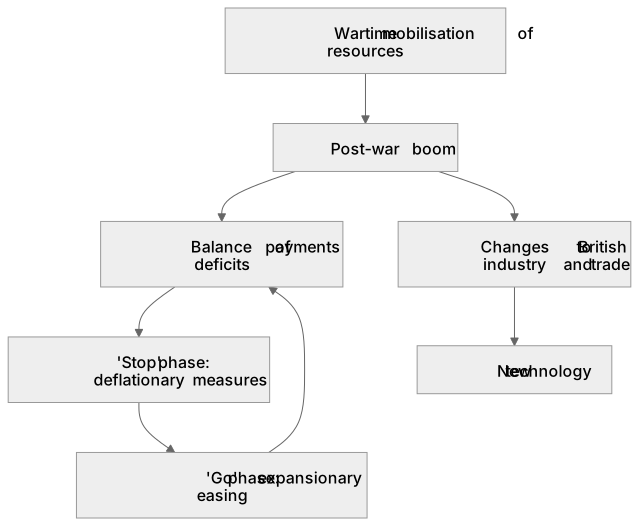
Label the diagram
Some boxes have lost their names. Pick the right name for each number.
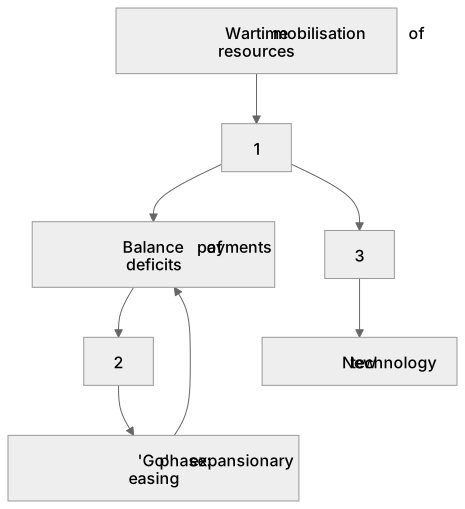
1Box 1
2Box 2
3Box 3
There is more to this lesson
The full lesson goes on to check your understanding and help you earn the marks. Create a free account to carry on, with your progress saved.
A week of Premium from your first lesson · Then the free plan continues · No card, no charge
Test your understanding of 1G Challenge and transformation: Britain, c1851–1964 – Transformation and change, 1939–1964 (A-level only): Economic developments: mobilisation of resources in wartime; post-war boom; balance of payments issues and 'stop-go' policies; changes to British industry and trade; new technology
Active recall beats re-reading. Take an instant quiz now to test what you’ve learned and lock it into long-term memory.
A week of Premium from your first lesson · Then the free plan continues · No card, no charge