AQA · A-Level · History
Course version: 7042 · Version from Sept 2017
Britain, c1851–1964 – Transformation and change, 1939–1964 (A-level only):…
Full specification wording
1G Challenge and transformation: Britain, c1851–1964 – Transformation and change, 1939–1964 (A-level only): The impact of the Second World War on British politics: Churchill as wartime leader; ‘the Labour landslide’ of 1945; Labour ideology and policies
The Second World War profoundly reshaped British politics, shifting public appetite towards state intervention and egalitarianism.
Checked against the AQA 7042 specification (opens in a new tab) on .
- Point 1 of 6
- 4 key terms
Study notes
From the checked teaching notes for this specification point.
The idea
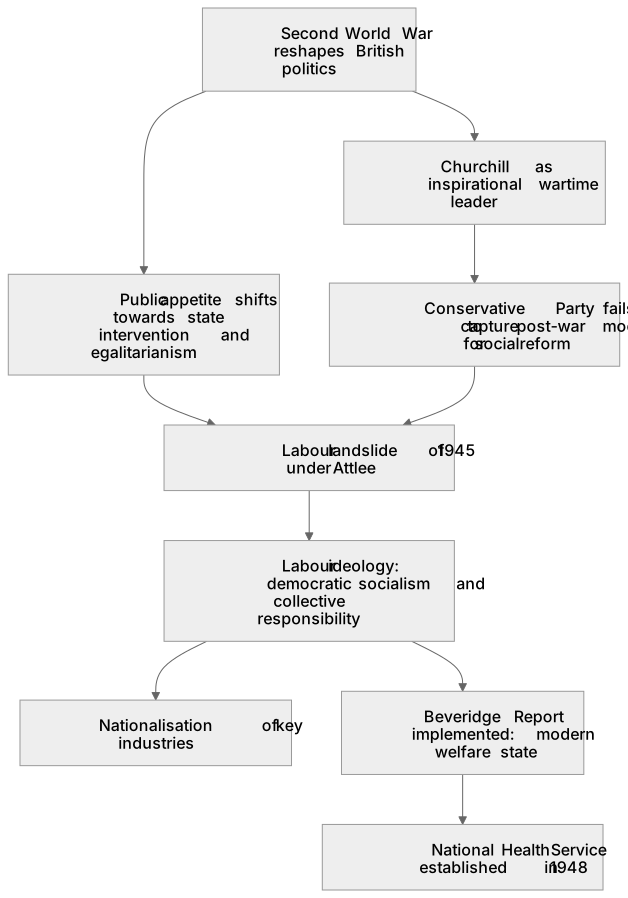
The Second World War profoundly reshaped British politics, shifting public appetite towards state intervention and egalitarianism. While Winston Churchill proved an inspirational wartime leader, unifying the nation and directing military strategy, his Conservative Party failed to capture the post-war mood for social reform. Consequently, the 1945 general election resulted in a 'Labour landslide' under Clement Attlee. Labour's ideology, rooted in democratic socialism and collective responsibility, translated into transformative policies. These included the nationalisation of key industries like coal and railways, and the implementation of the Beveridge Report to create the modern welfare state, most notably establishing the National Health Service in 1948.
What earns the marks
- Evaluate Churchill's strengths in wartime strategy and rhetoric against his misjudgement of the 1945 electorate's desire for social reform.
- Analyse the factors contributing to the 1945 Labour landslide, including the memory of the 1930s Depression and the radicalising effect of total war.
- Assess Labour's ideological commitment to democratic socialism and how this drove the creation of the welfare state.
- Examine specific Labour policies, such as the nationalisation of the Bank of England, coal, and railways, and the establishment of the NHS.
Common mistakes and how to put them right
Assuming Churchill was universally unpopular in 1945.
Put it right: He remained personally popular, but the electorate rejected the Conservative Party's domestic platform.
Claiming Labour invented the welfare state from scratch.
Put it right: They built upon the wartime coalition's Beveridge Report and earlier Liberal reforms.
Confusing Labour's democratic socialism with communism.
Put it right: Labour pursued a mixed economy and parliamentary reform, not a total state command economy.
Exam tips
- When discussing the 1945 election, contrast Churchill's 'Gestapo' speech with Labour's positive 'Let Us Face the Future' manifesto.
- Link Labour's nationalisation policies directly to their ideological goals of full employment and economic planning.
- Use the Beveridge Report's 'Five Giants' as a framework to evaluate the success of Labour's post-war social policies.
Try the lesson
The start of the 1G Challenge and transformation: Britain, c1851–1964 – Transformation and change, 1939–1964 (A-level only): The impact of the Second World War on British politics: Churchill as wartime leader; ‘the Labour landslide’ of 1945; Labour ideology and policies lesson, made from checked teaching notes for this specification point.
Have a go first
Which factor was a primary reason for the Labour Party's landslide victory in the 1945 general election?
Listen
The Second World War profoundly reshaped British politics, shifting public appetite towards state intervention and egalitarianism. While Winston Churchill proved an inspirational wartime leader, unifying the nation and directing military strategy, his Conservative Party failed to capture the post-war mood for social reform. Consequently, the 1945 general election resulted in a 'Labour landslide' under Clement Attlee. Labour's ideology, rooted in democratic socialism and collective responsibility, translated into transformative policies. These included the nationalisation of key industries like coal and railways, and the implementation of the Beveridge Report to create the modern welfare state, most notably establishing the National Health Service in 1948. A strong answer earns marks for these points. Evaluate Churchill's strengths in wartime strategy and rhetoric against his misjudgement of the 1945 electorate's desire for social reform. Analyse the factors contributing to the 1945 Labour landslide, including the memory of the 1930s Depression and the radicalising effect of total war. Assess Labour's ideological commitment to democratic socialism and how this drove the creation of the welfare state. Examine specific Labour policies, such as the nationalisation of the Bank of England, coal, and railways, and the establishment of the NHS. Exam tip: When discussing the 1945 election, contrast Churchill's 'Gestapo' speech with Labour's positive 'Let Us Face the Future' manifesto.
See it
Key words
Say what each word means before you turn the card.
The role of the individual in history
Try answering aloud or in your head before turning the card.
Ideological shifts and electoral realignments
Try answering aloud or in your head before turning the card.
The expansion of the state and collectivism
Try answering aloud or in your head before turning the card.
Social reform and the welfare state
Try answering aloud or in your head before turning the card.
See every definition
- The role of the individual in history
- Churchill proved an inspirational wartime leader, unifying the nation and directing military strategy, but his Conservative Party failed to capture the post-war mood for social reform.
- Ideological shifts and electoral realignments
- The Second World War shifted public appetite towards state intervention and egalitarianism, and the 1945 general election resulted in a Labour landslide under Clement Attlee.
- The expansion of the state and collectivism
- Labour's ideology, rooted in democratic socialism and collective responsibility, translated into transformative policies including the nationalisation of key industries like coal and railways.
- Social reform and the welfare state
- Labour implemented the Beveridge Report to create the modern welfare state, most notably establishing the National Health Service in 1948.
Label the diagram
Some boxes have lost their names. Pick the right name for each number.
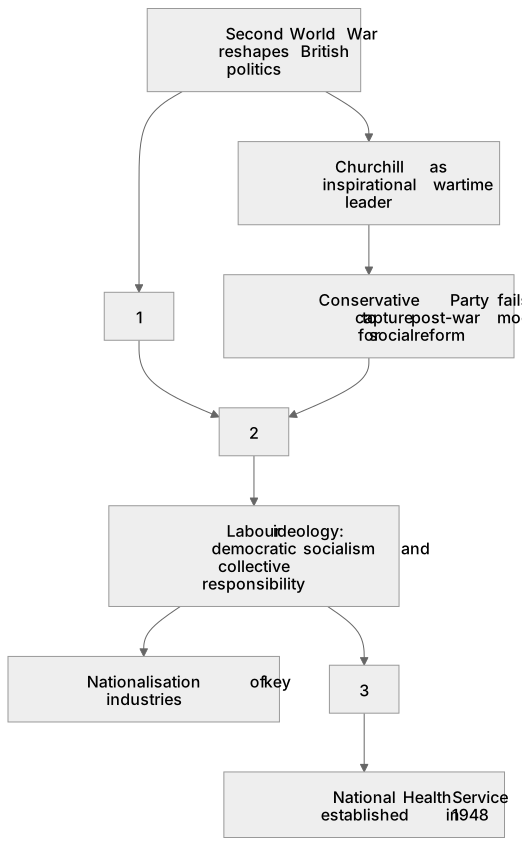
1Box 1
2Box 2
3Box 3
There is more to this lesson
The full lesson goes on to check your understanding and help you earn the marks. Create a free account to carry on, with your progress saved.
A week of Premium from your first lesson · Then the free plan continues · No card, no charge
Test your understanding of 1G Challenge and transformation: Britain, c1851–1964 – Transformation and change, 1939–1964 (A-level only): The impact of the Second World War on British politics: Churchill as wartime leader; ‘the Labour landslide’ of 1945; Labour ideology and policies
Active recall beats re-reading. Take an instant quiz now to test what you’ve learned and lock it into long-term memory.
A week of Premium from your first lesson · Then the free plan continues · No card, no charge