AQA · A-Level · History
Course version: 7042 · Version from Sept 2017
Why did opposition develop and how effective was it?
Full specification wording
1H Tsarist and Communist Russia, 1855–1964 – consequence in this period through the following key questions:: Why did opposition develop and how effective was it?
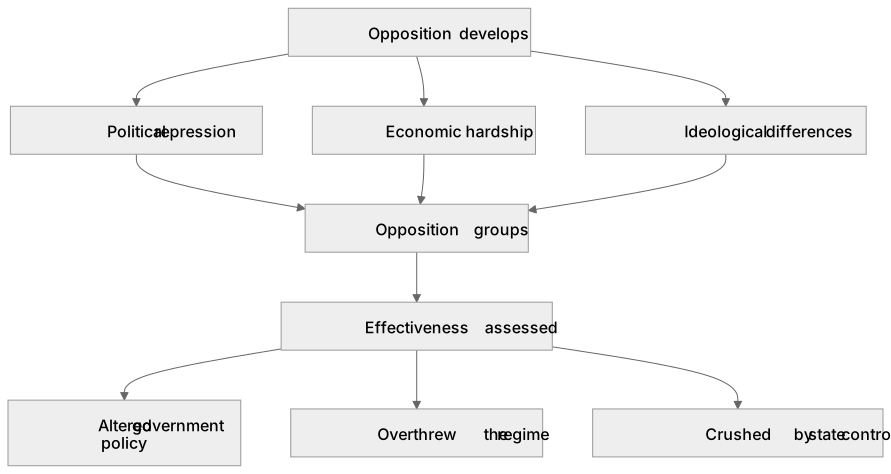
Opposition emerged due to political repression, economic hardship, and ideological differences, ranging from the Populists and Social Democrats under the Tsars to internal party factions and…
Checked against the AQA 7042 specification (opens in a new tab) on .
- Point 2 of 6
- 4 key terms
Study notes
From the checked teaching notes for this specification point.
The idea
Opposition emerged due to political repression, economic hardship, and ideological differences, ranging from the Populists and Social Democrats under the Tsars to internal party factions and dissidents under the Communists.
For example: While the Bolsheviks effectively seized power in 1917, later opposition to Stalin, such as the Ryutin platform, was ruthlessly crushed, demonstrating a lack of effectiveness against state control.
What earns the marks
- Identify the varied causes of opposition, including peasant land grievances, worker exploitation, and demands for political reform.
- Differentiate between the types of opposition groups, such as liberal intelligentsia, radical revolutionaries, and internal party factions.
- Evaluate the effectiveness of opposition by measuring their success in forcing concessions, such as the October Manifesto of 1905.
- Analyse the reasons for the failure of opposition, focusing on state repression, lack of unity, and the use of secret police.
Common mistakes and how to put them right
Treating all opposition groups as having the same aims.
Put it right: Clearly distinguish between liberals seeking constitutional reform and radicals demanding complete revolution.
Assuming opposition ceased entirely after the Bolshevik consolidation of power.
Put it right: Discuss internal party opposition, such as Trotsky's Left Opposition, and peasant resistance to collectivisation.
Overstating the effectiveness of the 1905 Revolution.
Put it right: Acknowledge that while it forced the creation of the Duma, the Tsar quickly reasserted control and limited its power.
Exam tips
- Always link the development of opposition to specific government policies, such as Alexander III's Russification or Stalin's forced collectivisation.
- When assessing effectiveness, define what 'success' meant for different groups, whether it was survival, policy change, or regime overthrow.
- Compare the methods used by the state to suppress opposition across the period to explain why opposition was often ineffective.
Try the lesson
The start of the 1H Tsarist and Communist Russia, 1855–1964 – consequence in this period through the following key questions:: Why did opposition develop and how effective was it? lesson, made from checked teaching notes for this specification point.
Have a go first
Which opposition group in the late 19th century believed that the future of Russia lay in the hands of the peasantry and attempted to incite them to revolution by 'going to the people'?
Listen
Opposition emerged due to political repression, economic hardship, and ideological differences, ranging from the Populists and Social Democrats under the Tsars to internal party factions and dissidents under the Communists. For example, while the Bolsheviks effectively seized power in 1917, later opposition to Stalin, such as the Ryutin platform, was ruthlessly crushed, demonstrating a lack of effectiveness against state control. A strong answer earns marks for these points. Identify the varied causes of opposition, including peasant land grievances, worker exploitation, and demands for political reform. Differentiate between the types of opposition groups, such as liberal intelligentsia, radical revolutionaries, and internal party factions. Evaluate the effectiveness of opposition by measuring their success in forcing concessions, such as the October Manifesto of 1905. Analyse the reasons for the failure of opposition, focusing on state repression, lack of unity, and the use of secret police. A common slip: Treating all opposition groups as having the same aims. Instead, clearly distinguish between liberals seeking constitutional reform and radicals demanding complete revolution. Exam tip: Always link the development of opposition to specific government policies, such as Alexander III's Russification or Stalin's forced collectivisation.
See it
Key words
Say what each word means before you turn the card.
Political and Social Opposition
Try answering aloud or in your head before turning the card.
State Repression and Control
Try answering aloud or in your head before turning the card.
Reform and Revolution
Try answering aloud or in your head before turning the card.
Ideological Conflict
Try answering aloud or in your head before turning the card.
See every definition
- Political and Social Opposition
- Movements that developed against both Tsarist and Communist regimes for varied reasons, ranging from the Populists and Social Democrats under the Tsars to internal party factions and dissidents under the Communists.
- State Repression and Control
- A reason for the failure of opposition, focusing on repression, lack of unity, and the use of secret police, as when later opposition to Stalin was ruthlessly crushed.
- Reform and Revolution
- A distinction between liberals seeking constitutional reform and radicals demanding complete revolution, which students must draw rather than treating all opposition groups as having the same aims.
- Ideological Conflict
- A reason why opposition emerged, alongside political repression and economic hardship, reflecting ideological differences against both Tsarist and Communist regimes.
Label the diagram
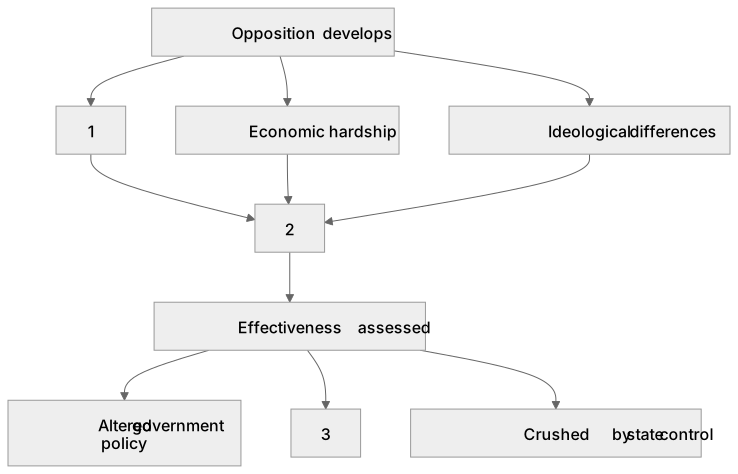
Some boxes have lost their names. Pick the right name for each number.
1Box 1
2Box 2
3Box 3
There is more to this lesson
The full lesson goes on to check your understanding and help you earn the marks. Create a free account to carry on, with your progress saved.
A week of Premium from your first lesson · Then the free plan continues · No card, no charge
Test your understanding of 1H Tsarist and Communist Russia, 1855–1964 – consequence in this period through the following key questions:: Why did opposition develop and how effective was it?
Active recall beats re-reading. Take an instant quiz now to test what you’ve learned and lock it into long-term memory.
A week of Premium from your first lesson · Then the free plan continues · No card, no charge