AQA · A-Level · History
Course version: 7042 · Version from Sept 2017
Economic developments to 1914: industrial and agricultural growth and change
Full specification wording
1H Tsarist and Communist Russia, 1855–1964 – The collapse of autocracy, 1894–1917: Economic developments to 1914: industrial and agricultural growth and change
Economic developments to 1914 transformed Russia through state-sponsored industrial growth and belated agricultural change.
Checked against the AQA 7042 specification (opens in a new tab) on .
- Point 2 of 6
Study notes
From the checked teaching notes for this specification point.
The idea
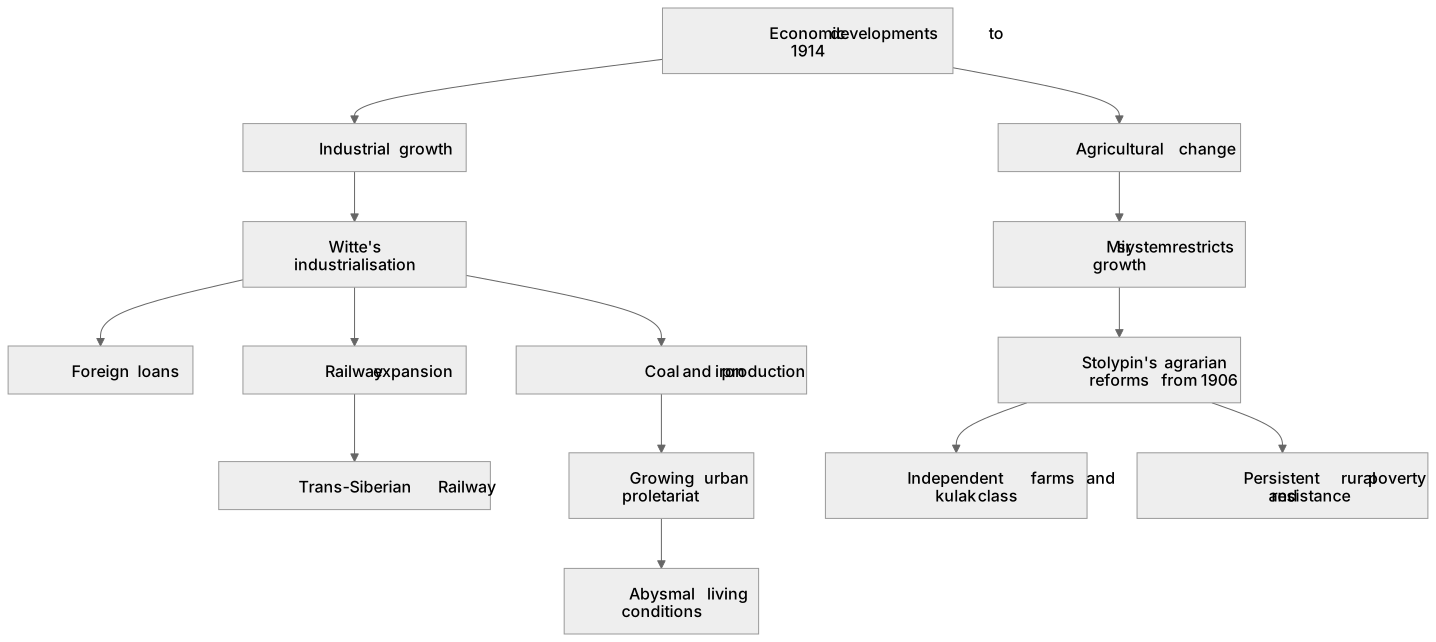
Economic developments to 1914 transformed Russia through state-sponsored industrial growth and belated agricultural change. Sergei Witte spearheaded industrialisation using foreign loans and railway expansion, notably the Trans-Siberian Railway. This stimulated coal and iron production, creating a rapidly growing urban proletariat, though living conditions remained abysmal. Conversely, agricultural growth initially lagged due to the restrictive mir system. Pyotr Stolypin attempted to resolve this through his agrarian reforms from 1906, encouraging peasants to consolidate land into independent farms. While this created a wealthier kulak class and increased grain exports, widespread rural poverty and resistance to change persisted up to 1914.
What earns the marks
- Evaluate the impact of Witte's policies on industrial growth, focusing on railways, foreign investment, and heavy industry.
- Analyse the social consequences of rapid industrialisation, particularly the emergence of an urban proletariat.
- Assess the aims and effectiveness of Stolypin's agricultural reforms in promoting growth and change.
- Compare the relative success of industrial developments against the persistent challenges in the agricultural sector by 1914.
Common mistakes and how to put them right
Assuming Stolypin's reforms completely modernised Russian agriculture.
Put it right: In reality, only a minority of peasants consolidated their land by 1914.
Stating that industrial growth improved living standards.
Put it right: Rapid urbanisation actually led to severe overcrowding and poor working conditions.
Ignoring the role of foreign capital; students often overlook that French and Belgian loans were crucial for Witte's industrial expansion.
Exam tips
- Contrast the impressive macroeconomic statistics of industrial growth with the microeconomic reality of poor living standards for workers.
- Use specific examples, such as the Trans-Siberian Railway or coal production in the Donbas, to support arguments about economic developments.
- Evaluate Stolypin's agricultural changes by considering both his political aim of creating conservative peasant landowners and his economic aims.
Try the lesson
The start of the 1H Tsarist and Communist Russia, 1855–1964 – The collapse of autocracy, 1894–1917: Economic developments to 1914: industrial and agricultural growth and change lesson, made from checked teaching notes for this specification point.
Have a go first
Which Russian Minister of Finance was primarily responsible for driving rapid industrial growth in the 1890s and early 1900s through state capitalism and foreign investment?
Listen
Economic developments to 1914 transformed Russia through state-sponsored industrial growth and belated agricultural change. Sergei Witte spearheaded industrialisation using foreign loans and railway expansion, notably the Trans-Siberian Railway. This stimulated coal and iron production, creating a rapidly growing urban proletariat, though living conditions remained abysmal. Conversely, agricultural growth initially lagged due to the restrictive mir system. Pyotr Stolypin attempted to resolve this through his agrarian reforms from 1906, encouraging peasants to consolidate land into independent farms. While this created a wealthier kulak class and increased grain exports, widespread rural poverty and resistance to change persisted up to 1914. A strong answer earns marks for these points. Evaluate the impact of Witte's policies on industrial growth, focusing on railways, foreign investment, and heavy industry. Analyse the social consequences of rapid industrialisation, particularly the emergence of an urban proletariat. Assess the aims and effectiveness of Stolypin's agricultural reforms in promoting growth and change. Compare the relative success of industrial developments against the persistent challenges in the agricultural sector by 1914. Exam tip: Contrast the impressive macroeconomic statistics of industrial growth with the microeconomic reality of poor living standards for workers.
See it
Label the diagram
Some boxes have lost their names. Pick the right name for each number.
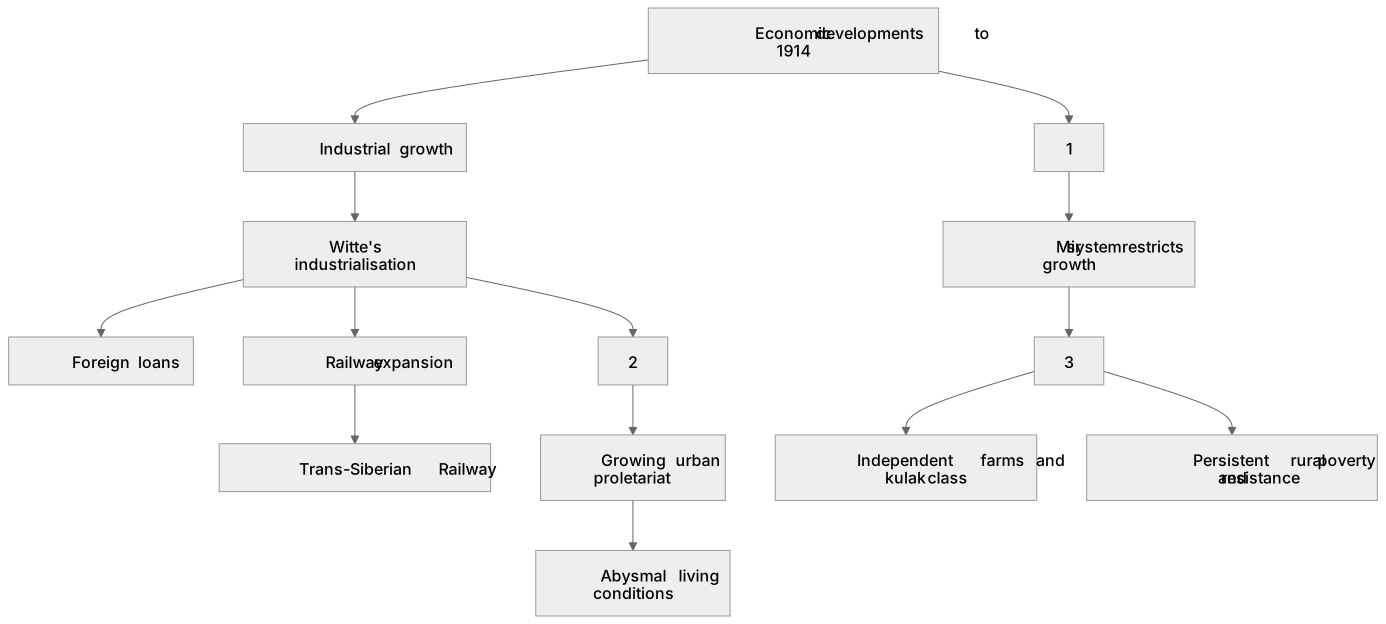
1Box 1
2Box 2
3Box 3
There is more to this lesson
The full lesson goes on to check your understanding and help you earn the marks. Create a free account to carry on, with your progress saved.
A week of Premium from your first lesson · Then the free plan continues · No card, no charge
Test your understanding of 1H Tsarist and Communist Russia, 1855–1964 – The collapse of autocracy, 1894–1917: Economic developments to 1914: industrial and agricultural growth and change
Active recall beats re-reading. Take an instant quiz now to test what you’ve learned and lock it into long-term memory.
A week of Premium from your first lesson · Then the free plan continues · No card, no charge