AQA · A-Level · History
Course version: 7042 · Version from Sept 2017
Expansion and contraction of empire: the impact of the First and Second…
Full specification wording
1J The British Empire, c1857–1967 – Imperialism challenged, 1914–1947 (A-level only): Expansion and contraction of empire: the impact of the First and Second World Wars; the Mandates; withdrawal from India and the Middle East
The British Empire experienced both expansion and contraction.
Checked against the AQA 7042 specification (opens in a new tab) on .
- Point 1 of 6
- 4 key terms
Study notes
From the checked teaching notes for this specification point.
The idea
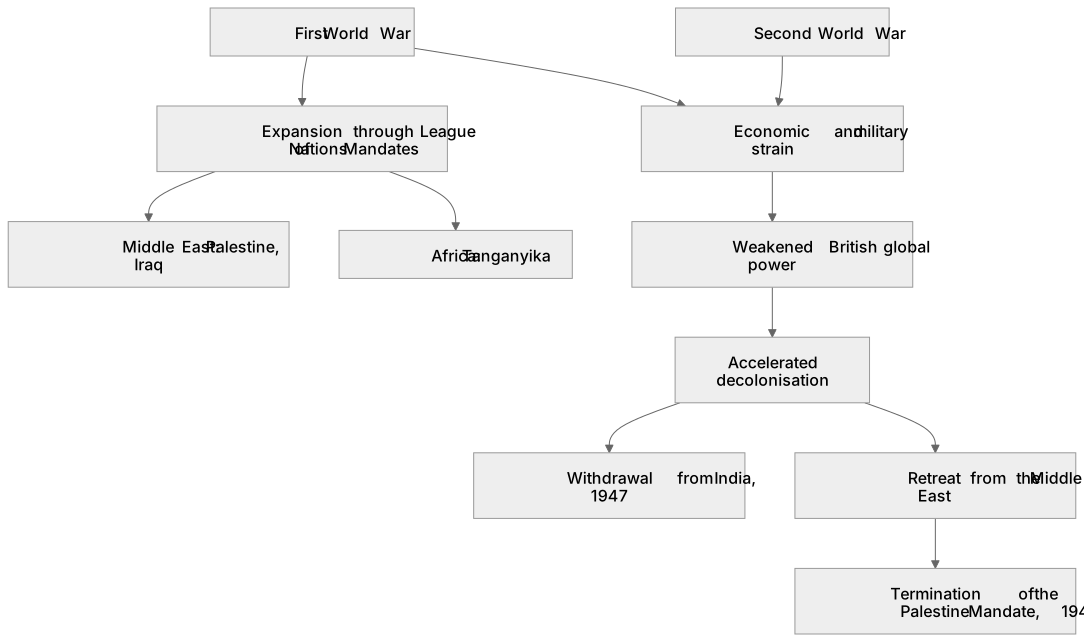
The British Empire experienced both expansion and contraction. Following the First World War, it reached its greatest territorial extent through League of Nations Mandates, expanding into the Middle East (Palestine, Iraq) and Africa (Tanganyika). However, the immense economic and military strain of the First and Second World Wars catalysed the Empire's contraction. The Second World War critically weakened British global power, accelerating decolonisation. This contraction is evidenced by the hasty withdrawal from India in 1947, driven by nationalist pressure and financial exhaustion, and the subsequent retreat from the Middle East, notably the termination of the Palestine Mandate in 1948.
What earns the marks
- Assess the expansion of empire post-First World War through Mandates, noting specific acquisitions like Palestine and Tanganyika.
- Evaluate the contraction of empire caused by the economic and military exhaustion of the First and Second World Wars.
- Analyse the specific factors leading to the 1947 withdrawal from India, including nationalist pressure and financial inability to sustain control.
- Examine the withdrawal from the Middle East, focusing on the unmanageable Arab-Jewish conflict in Palestine and the strategic retreat from regional commitments.
Common mistakes and how to put them right
Confusing Mandates with formal colonies.
Put it right: Define Mandates as territories administered on behalf of the League of Nations, unlike direct colonies.
Assuming the Second World War was the sole cause of Indian independence.
Put it right: Acknowledge that while the war accelerated the process, Indian nationalism laid the groundwork.
Misattributing post-1914 events to the pre-1914 period.
Put it right: Ensure that the impact of the World Wars, the Mandates, and the withdrawals from India and the Middle East are correctly situated in the 1914–1967 timeframe, despite any section misassignments.
Exam tips
- Compare the differing impacts of the First World War, which led to expansion via Mandates, and the Second World War, which precipitated rapid contraction.
- Use specific examples of economic debt to the USA to illustrate Britain's inability to fund its empire post-1945.
- Link the withdrawal from India to the broader geopolitical shift, noting how the loss of the Indian Army altered the strategic viability of holding the Middle East.
Try the lesson
The start of the 1J The British Empire, c1857–1967 – Imperialism challenged, 1914–1947 (A-level only): Expansion and contraction of empire: the impact of the First and Second World Wars; the Mandates; withdrawal from India and the Middle East lesson, made from checked teaching notes for this specification point.
Have a go first
Following the First World War, how did the League of Nations Mandate system primarily affect the territorial extent of the British Empire?
Listen
The British Empire experienced both expansion and contraction. Following the First World War, it reached its greatest territorial extent through League of Nations Mandates, expanding into the Middle East (Palestine, Iraq) and Africa (Tanganyika). However, the immense economic and military strain of the First and Second World Wars catalysed the Empire's contraction. The Second World War critically weakened British global power, accelerating decolonisation. This contraction is evidenced by the hasty withdrawal from India in 1947, driven by nationalist pressure and financial exhaustion, and the subsequent retreat from the Middle East, notably the termination of the Palestine Mandate in 1948. A strong answer earns marks for these points. Assess the expansion of empire post-First World War through Mandates, noting specific acquisitions like Palestine and Tanganyika. Evaluate the contraction of empire caused by the economic and military exhaustion of the First and Second World Wars. Analyse the specific factors leading to the 1947 withdrawal from India, including nationalist pressure and financial inability to sustain control. Examine the withdrawal from the Middle East, focusing on the unmanageable Arab-Jewish conflict in Palestine and the strategic retreat from regional commitments. A common slip: Confusing Mandates with formal colonies. Instead, Define Mandates as territories administered on behalf of the League of Nations, unlike direct colonies. Exam tip: Compare the differing impacts of the First World War, which led to expansion via Mandates, and the Second World War, which precipitated rapid contraction.
See it
Watch it explained
Why did Britain withdraw from India in 1947?
Read the described scene instead
Between 1914 and 1947 the British Empire both expanded and contracted. Victory in the First World War brought new territory, while the strain of two world wars pulled the Empire apart. This lesson traces that double movement, from the Mandates to the withdrawal from India and the Middle East. After the First World War the Empire reached its greatest territorial extent. The League of Nations granted Britain Mandates — territories administered on behalf of the League of Nations, not direct colonies. Britain took on Palestine and Iraq in the Middle East, and Tanganyika in Africa. So 1918 marks expansion, not decline. The First World War left Britain in debt; the Second World War left it critically weakened. Post-1945 Britain owed large sums to the USA. That financial exhaustion made holding the Empire unaffordable, and the loss of the Indian Army changed the strategic viability of holding the Middle East. Why did Britain leave India in 1947? Pause here and weigh which pressure mattered most. Once you have a view, here is one reading grounded in the source. Two pressures combined: Indian nationalist pressure, which laid the groundwork, and financial exhaustion that made control unsustainable. The Second World War accelerated the process rather than causing it alone. Withdrawal in 1947 was therefore hasty, driven by nationalism and the inability to pay for continued control. Three errors to avoid. First, Mandates were not colonies: they were administered on behalf of the League of Nations. Second, the Second World War was not the sole cause of Indian independence — nationalism laid the groundwork. Third, place these events in 1914–1967: the Mandates, the World Wars and the withdrawals all belong after 1914. To recap: the First World War expanded the Empire through Mandates in Palestine, Iraq and Tanganyika. The Second World War weakened Britain critically and accelerated decolonisation. India was left in 1947 under nationalist pressure and financial exhaustion. The Palestine Mandate ended in 1948 as Britain retreated from Middle Eastern commitments.
Key words
Say what each word means before you turn the card.
Expansion and contraction of empire
Try answering aloud or in your head before turning the card.
Impact of the World Wars
Try answering aloud or in your head before turning the card.
The Mandate system
Try answering aloud or in your head before turning the card.
Decolonisation and withdrawal
Try answering aloud or in your head before turning the card.
See every definition
- Expansion and contraction of empire
- The British Empire reached its greatest territorial extent after the First World War, but the strain of the First and Second World Wars catalysed its contraction.
- Impact of the World Wars
- The immense economic and military strain of the First and Second World Wars catalysed the Empire's contraction, with the Second World War critically weakening British global power.
- The Mandate system
- Territories administered on behalf of the League of Nations, unlike direct colonies, through which the Empire expanded into the Middle East and Africa.
- Decolonisation and withdrawal
- The Empire's contraction, evidenced by the hasty withdrawal from India in 1947 and the subsequent retreat from the Middle East.
Label the diagram
Some boxes have lost their names. Pick the right name for each number.
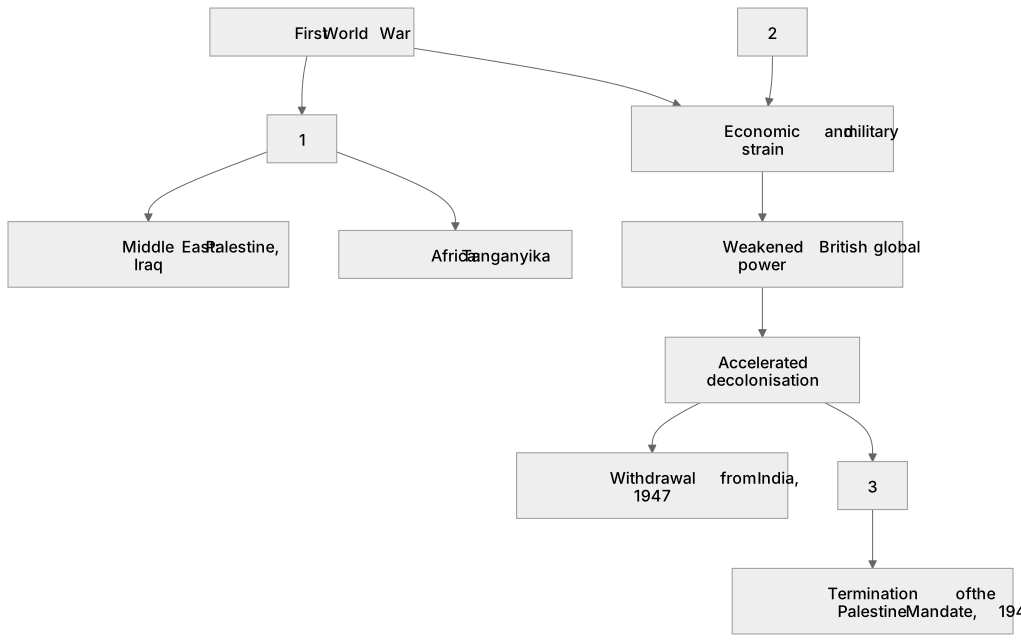
1Box 1
2Box 2
3Box 3
There is more to this lesson
The full lesson goes on to check your understanding and help you earn the marks. Create a free account to carry on, with your progress saved.
A week of Premium from your first lesson · Then the free plan continues · No card, no charge
Test your understanding of 1J The British Empire, c1857–1967 – Imperialism challenged, 1914–1947 (A-level only): Expansion and contraction of empire: the impact of the First and Second World Wars; the Mandates; withdrawal from India and the Middle East
Active recall beats re-reading. Take an instant quiz now to test what you’ve learned and lock it into long-term memory.
A week of Premium from your first lesson · Then the free plan continues · No card, no charge