AQA · A-Level · History
Course version: 7042 · Version from Sept 2017
Relations with indigenous peoples; protest and conflict; colonial…
Full specification wording
1J The British Empire, c1857–1967 – Imperialism challenged, 1914–1947 (A-level only): Relations with indigenous peoples; protest and conflict; colonial identity; the development of nationalist movements
Between 1914 and 1947, relations with indigenous peoples were increasingly strained, leading to significant protest and conflict.
Checked against the AQA 7042 specification (opens in a new tab) on .
- Point 6 of 6
- 4 key terms
Study notes
From the checked teaching notes for this specification point.
The idea
Between 1914 and 1947, relations with indigenous peoples were increasingly strained, leading to significant protest and conflict. The 1919 Amritsar Massacre fundamentally damaged British moral authority in India, while the 1936–1939 Arab Revolt in Palestine highlighted the volatility of mandate administration. Colonial identity evolved as participation in two World Wars fostered a growing sense of national consciousness among colonial populations. This period saw the crucial development of nationalist movements. In India, the Indian National Congress, led by Gandhi, launched mass campaigns like Non-Cooperation and Quit India, while the Muslim League demanded a separate state. In Africa, early nationalism emerged through figures like Nnamdi Azikiwe and the 1945 Pan-African Congress, challenging imperial rule and demanding self-determination.
What earns the marks
- Analyse the deterioration of relations with indigenous peoples, using examples like the 1919 Amritsar Massacre and its impact on British authority.
- Evaluate the causes and consequences of protest and conflict, such as Gandhi's civil disobedience campaigns or the Arab Revolt in Palestine.
- Assess how colonial identity was transformed by participation in the World Wars, leading to increased demands for self-determination.
- Trace the development of nationalist movements, focusing on the Indian National Congress, the Muslim League, and emerging African nationalism.
Common mistakes and how to put them right
Treating the development of nationalist movements as solely an Indian phenomenon.
Put it right: Include the emergence of African nationalism, such as the 1945 Pan-African Congress and leaders like Kwame Nkrumah.
Assuming colonial identity remained subservient.
Put it right: Acknowledge how service in WWI and WWII fostered distinct national identities and expectations of post-war concessions.
Viewing protest and conflict as isolated incidents.
Put it right: Connect events like the Amritsar Massacre to the broader radicalisation of nationalist movements like the INC.
Exam tips
- Use the 1919 Amritsar Massacre as a pivotal turning point in Anglo-Indian relations and the development of Indian nationalism.
- Contrast the methods of protest, such as Gandhi's non-violent civil disobedience, with armed conflicts like the Arab Revolt in Palestine.
- Highlight the impact of the Second World War as a catalyst for the rapid development of nationalist movements across the Empire.
Try the lesson
The start of the 1J The British Empire, c1857–1967 – Imperialism challenged, 1914–1947 (A-level only): Relations with indigenous peoples; protest and conflict; colonial identity; the development of nationalist movements lesson, made from checked teaching notes for this specification point.
Have a go first
How did the Amritsar Massacre of 1919 affect the development of the Indian nationalist movement?
Listen
Between 1914 and 1947, relations with indigenous peoples were increasingly strained, leading to significant protest and conflict. The 1919 Amritsar Massacre fundamentally damaged British moral authority in India, while the 1936–1939 Arab Revolt in Palestine highlighted the volatility of mandate administration. Colonial identity evolved as participation in two World Wars fostered a growing sense of national consciousness among colonial populations. This period saw the crucial development of nationalist movements. In India, the Indian National Congress, led by Gandhi, launched mass campaigns like Non-Cooperation and Quit India, while the Muslim League demanded a separate state. In Africa, early nationalism emerged through figures like Nnamdi Azikiwe and the 1945 Pan-African Congress, challenging imperial rule and demanding self-determination. A strong answer earns marks for these points. Analyse the deterioration of relations with indigenous peoples, using examples like the 1919 Amritsar Massacre and its impact on British authority. Evaluate the causes and consequences of protest and conflict, such as Gandhi's civil disobedience campaigns or the Arab Revolt in Palestine. Assess how colonial identity was transformed by participation in the World Wars, leading to increased demands for self-determination. Trace the development of nationalist movements, focusing on the Indian National Congress, the Muslim League, and emerging African nationalism. A common slip: Treating the development of nationalist movements as solely an Indian phenomenon. Instead, Include the emergence of African nationalism, such as the 1945 Pan-African Congress and leaders like Kwame Nkrumah. Exam tip: Use the 1919 Amritsar Massacre as a pivotal turning point in Anglo-Indian relations and the development of Indian nationalism.
See it
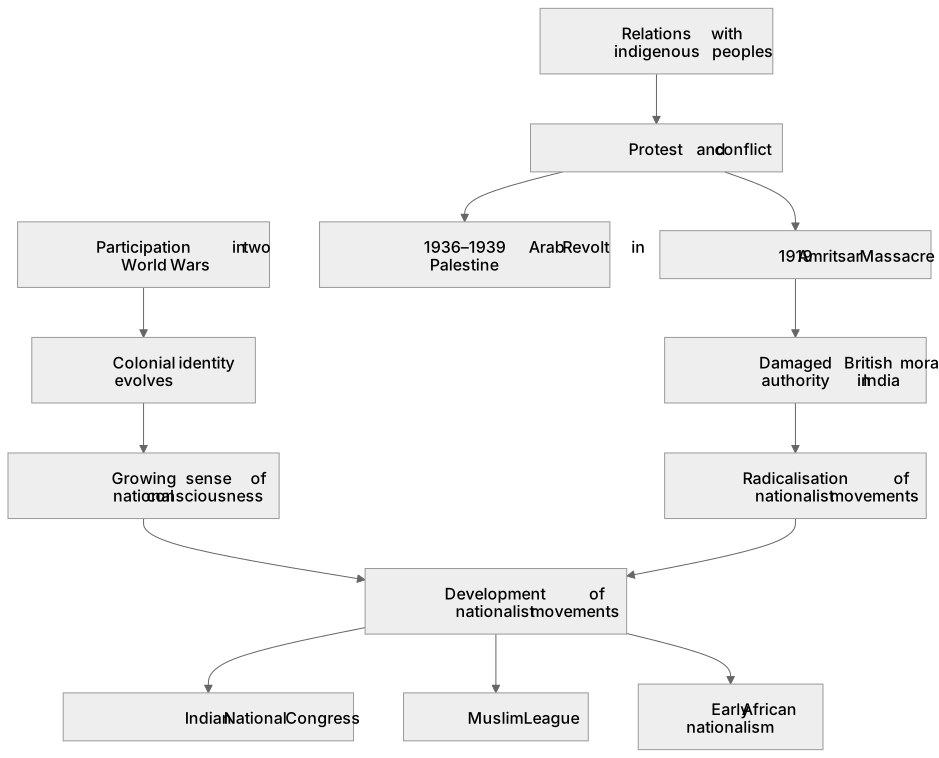
Put the events in order
Put these events in the order they happened, earliest first.
- 1. Amritsar Massacre damaged British moral authority in India
- 2. Pan-African Congress challenged imperial rule and demanded self-determination
- 3. Arab Revolt in Palestine highlighted volatility of mandate administration
Key words
Say what each word means before you turn the card.
Nationalism and self-determination
Try answering aloud or in your head before turning the card.
Protest, conflict and civil disobedience
Try answering aloud or in your head before turning the card.
The impact of the World Wars on colonial identity
Try answering aloud or in your head before turning the card.
Changing relations with indigenous peoples
Try answering aloud or in your head before turning the card.
See every definition
- Nationalism and self-determination
- The development of nationalist movements demanding self-determination challenged imperial rule across the Empire between 1914 and 1947.
- Protest, conflict and civil disobedience
- Relations with indigenous peoples were increasingly strained, leading to significant protest and conflict, including Gandhi's civil disobedience campaigns.
- The impact of the World Wars on colonial identity
- Colonial identity evolved as participation in two World Wars fostered a growing sense of national consciousness among colonial populations.
- Changing relations with indigenous peoples
- Relations with indigenous peoples were increasingly strained, leading to significant protest and conflict between 1914 and 1947.
Label the diagram
Some boxes have lost their names. Pick the right name for each number.
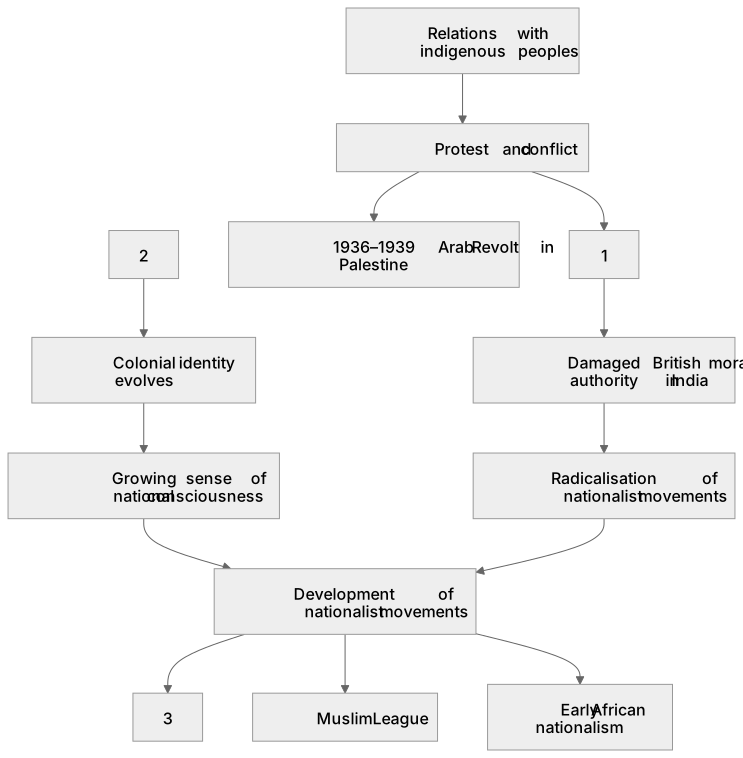
1Box 1
2Box 2
3Box 3
There is more to this lesson
The full lesson goes on to check your understanding and help you earn the marks. Create a free account to carry on, with your progress saved.
A week of Premium from your first lesson · Then the free plan continues · No card, no charge
Test your understanding of 1J The British Empire, c1857–1967 – Imperialism challenged, 1914–1947 (A-level only): Relations with indigenous peoples; protest and conflict; colonial identity; the development of nationalist movements
Active recall beats re-reading. Take an instant quiz now to test what you’ve learned and lock it into long-term memory.
A week of Premium from your first lesson · Then the free plan continues · No card, no charge