AQA · A-Level · History
Course version: 7042 · Version from Sept 2017
The expansion of the British Empire in Africa; the Suez Canal and Egypt
Full specification wording
1J The British Empire, c1857–1967 – The development of Imperialism, c1857–c1890: The expansion of the British Empire in Africa; the Suez Canal and Egypt
British expansion in Africa during the late nineteenth century was driven by strategic and economic motives.
Checked against the AQA 7042 specification (opens in a new tab) on .
- Point 1 of 6
- 3 key terms
Study notes
From the checked teaching notes for this specification point.
The idea
British expansion in Africa during the late nineteenth century was driven by strategic and economic motives. A pivotal asset was the Suez Canal, opened in 1869, which drastically shortened the sea route to India. Recognising its value, Disraeli purchased a 44% minority share in 1875. However, Egyptian financial instability and nationalist opposition led by Arabi Pasha threatened these interests. This culminated in the 1882 British bombardment of Alexandria and military occupation of Egypt. Intended as a temporary measure to protect the Canal, this occupation established a 'veiled protectorate' under Evelyn Baring. This action marked a major escalation in Britain's African expansion, catalysing further territorial grabs across the continent.
What earns the marks
- Explain the strategic importance of the Suez Canal as the primary route to India and its role in shifting British geopolitical focus towards North Africa.
- Analyse the causes of the 1882 occupation of Egypt, including the financial collapse of the Khedivate and the nationalist uprising led by Arabi Pasha.
- Evaluate the concept of the 'veiled protectorate' established by Evelyn Baring (Lord Cromer) and how British administrative control functioned in practice.
- Assess how the occupation of Egypt acted as a catalyst for broader British expansion into other parts of Africa, such as the subsequent involvement in the Sudan.
Common mistakes and how to put them right
Claiming Britain built the Suez Canal.
Put it right: State it was constructed by a French-led company and Britain only purchased a stake later in 1875.
Stating Egypt became a formal British colony in 1882.
Put it right: Explain it remained nominally part of the Ottoman Empire but operated as a 'veiled protectorate' under British control.
Assuming the 1882 occupation was planned long in advance.
Put it right: Highlight the reactive nature of Gladstone's intervention to protect immediate financial and strategic interests.
Stating Disraeli purchased a controlling share in the Suez Canal.
Put it right: Specify he acquired the Khedive's 44% minority holding, not majority control of the company.
Exam tips
- Link the acquisition of the Suez Canal directly to the broader strategic imperative of defending the route to India.
- Use the term 'veiled protectorate' when discussing post-1882 Egypt to demonstrate a precise understanding of its unique administrative status.
- Contrast the differing approaches of Disraeli's share purchase and Gladstone's military occupation to highlight shifts in imperial policy.
Try the lesson
The start of the 1J The British Empire, c1857–1967 – The development of Imperialism, c1857–c1890: The expansion of the British Empire in Africa; the Suez Canal and Egypt lesson, made from checked teaching notes for this specification point.
Have a go first
In 1875, Prime Minister Benjamin Disraeli arranged for the British government to purchase the Khedive of Egypt's shares in the Suez Canal. Which of the following best describes the primary strategic motivation for this acquisition?
Listen
British expansion in Africa during the late nineteenth century was driven by strategic and economic motives. A pivotal asset was the Suez Canal, opened in 1869, which drastically shortened the sea route to India. Recognising its value, Disraeli purchased a 44% minority share in 1875. However, Egyptian financial instability and nationalist opposition led by Arabi Pasha threatened these interests. This culminated in the 1882 British bombardment of Alexandria and military occupation of Egypt. Intended as a temporary measure to protect the Canal, this occupation established a 'veiled protectorate' under Evelyn Baring. This action marked a major escalation in Britain's African expansion, catalysing further territorial grabs across the continent. A strong answer earns marks for these points. Explain the strategic importance of the Suez Canal as the primary route to India and its role in shifting British geopolitical focus towards North Africa. Analyse the causes of the 1882 occupation of Egypt, including the financial collapse of the Khedivate and the nationalist uprising led by Arabi Pasha. Evaluate the concept of the 'veiled protectorate' established by Evelyn Baring (Lord Cromer) and how British administrative control functioned in practice. Assess how the occupation of Egypt acted as a catalyst for broader British expansion into other parts of Africa, such as the subsequent involvement in the Sudan. A common slip: Claiming Britain built the Suez Canal. Instead, State it was constructed by a French-led company and Britain only purchased a stake later in 1875. Exam tip: Link the acquisition of the Suez Canal directly to the broader strategic imperative of defending the route to India.
See it
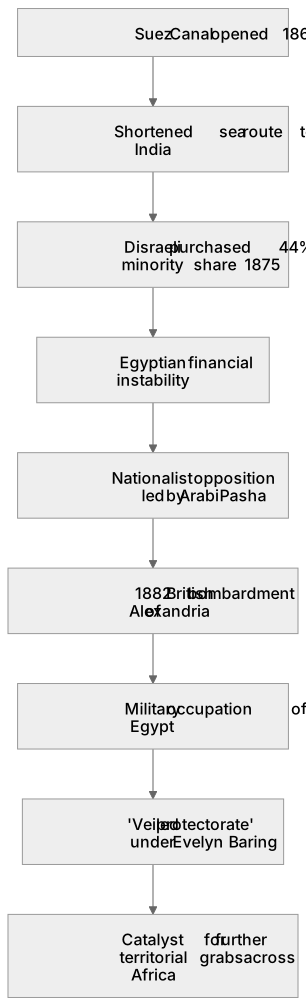
Put the events in order
Put these events in the order they happened, earliest first.
- 1. The Suez Canal opened, shortening the sea route to India
- 2. British bombardment of Alexandria and military occupation of Egypt
- 3. Disraeli purchased a minority share in the Suez Canal
Key words
Say what each word means before you turn the card.
Strategic imperatives
Try answering aloud or in your head before turning the card.
Economic imperialism
Try answering aloud or in your head before turning the card.
Nationalist resistance
Try answering aloud or in your head before turning the card.
See every definition
- Strategic imperatives
- Motives driving British expansion in Africa that centred on protecting the route to India and the value of the Suez Canal.
- Economic imperialism
- British expansion in Africa driven by economic motives, including financial interests threatened by Egyptian financial instability.
- Nationalist resistance
- Opposition in Egypt led by Arabi Pasha which threatened British interests and contributed to the 1882 occupation.
Label the diagram
Some boxes have lost their names. Pick the right name for each number.
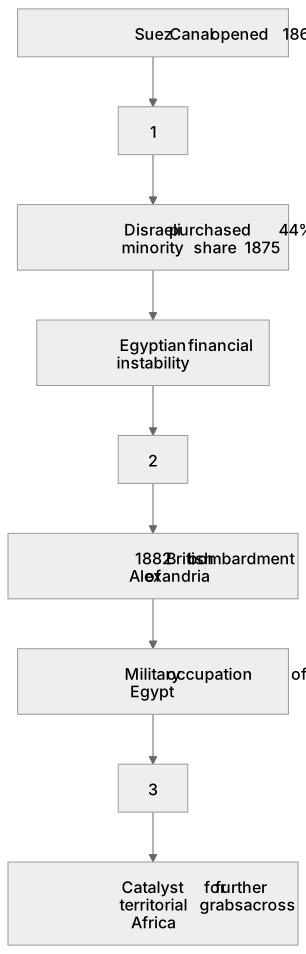
1Box 1
2Box 2
3Box 3
There is more to this lesson
The full lesson goes on to check your understanding and help you earn the marks. Create a free account to carry on, with your progress saved.
A week of Premium from your first lesson · Then the free plan continues · No card, no charge
Test your understanding of 1J The British Empire, c1857–1967 – The development of Imperialism, c1857–c1890: The expansion of the British Empire in Africa; the Suez Canal and Egypt
Active recall beats re-reading. Take an instant quiz now to test what you’ve learned and lock it into long-term memory.
A week of Premium from your first lesson · Then the free plan continues · No card, no charge