AQA · A-Level · History
Course version: 7042 · Version from Sept 2017
Decolonisation in Africa and Asia
Full specification wording
1J The British Empire, c1857–1967 – The winds of change, 1947–1967 (A-level only): Decolonisation in Africa and Asia
Between 1947 and 1967, the British Empire was rapidly dismantled across Asia and Africa.
Checked against the AQA 7042 specification (opens in a new tab) on .
- Point 1 of 6
- 4 key terms
Study notes
From the checked teaching notes for this specification point.
The idea
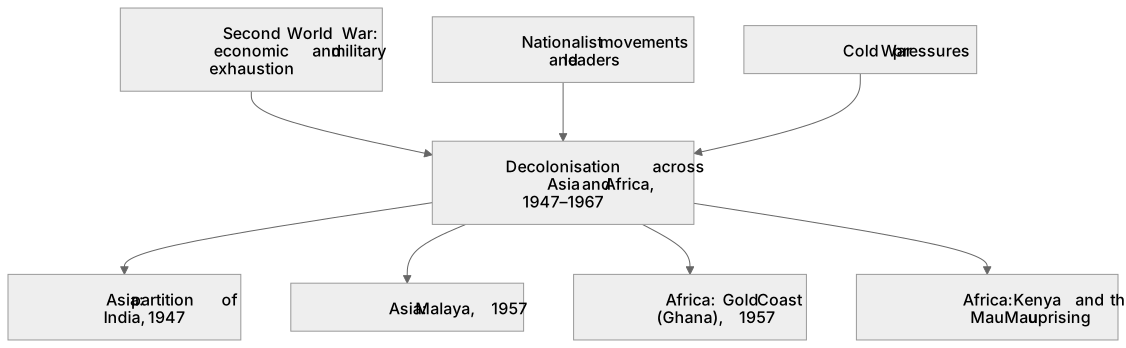
Between 1947 and 1967, the British Empire was rapidly dismantled across Asia and Africa. In Asia, the process began with the hasty partition of India in 1947 and extended to Malaya (1957), where Britain fought a protracted counter-insurgency to secure economic interests before granting independence. In Africa, Macmillan’s 1960 'Wind of Change' speech acknowledged the unstoppable force of African nationalism. Decolonisation varied from relatively peaceful transitions, such as in the Gold Coast (Ghana, 1957), to violent conflicts in colonies with white settler populations, notably the Mau Mau uprising in Kenya.
What earns the marks
- Assess the impact of the Second World War on Britain's economic and military capacity to maintain its Asian and African colonies.
- Evaluate the role of nationalist leaders, such as Kwame Nkrumah in Ghana and Gandhi or Nehru in India, in accelerating the pace of decolonisation.
- Compare the differing British approaches to colonies with significant white settler populations, such as Kenya, versus those without, such as the Gold Coast.
- Analyse the strategic and economic motivations behind the Malayan Emergency and how it influenced the timeline of Asian decolonisation.
Common mistakes and how to put them right
Treating decolonisation as a uniform process across the Empire.
Put it right: Emphasise the distinct regional differences, contrasting the hasty withdrawal from India with the managed transitions in West Africa.
Attributing decolonisation solely to British benevolence or planned policy.
Put it right: Highlight the reactive nature of British policy, driven by economic weakness, nationalist pressure, and international dynamics.
Ignoring the violence involved in the end of empire.
Put it right: Include specific examples of conflict, such as the Malayan Emergency or the Mau Mau rebellion in Kenya, to show that withdrawal was often contested.
Exam tips
- Use Macmillan's 'Wind of Change' speech as a turning point to structure arguments about the shifting pace of African decolonisation.
- When discussing Asia, ensure you link the partition of India to broader shifts in British imperial strategy East of Suez.
- Contrast the experiences of at least one African and one Asian colony to demonstrate a comprehensive understanding of the period.
Try the lesson
The start of the 1J The British Empire, c1857–1967 – The winds of change, 1947–1967 (A-level only): Decolonisation in Africa and Asia lesson, made from checked teaching notes for this specification point.
Have a go first
Which British colony became the first in sub-Saharan Africa to achieve independence in 1957, marking a significant milestone in the decolonisation process?
Listen
Between 1947 and 1967, the British Empire was rapidly dismantled across Asia and Africa. In Asia, the process began with the hasty partition of India in 1947 and extended to Malaya (1957), where Britain fought a protracted counter-insurgency to secure economic interests before granting independence. In Africa, Macmillan’s 1960 'Wind of Change' speech acknowledged the unstoppable force of African nationalism. Decolonisation varied from relatively peaceful transitions, such as in the Gold Coast (Ghana, 1957), to violent conflicts in colonies with white settler populations, notably the Mau Mau uprising in Kenya. A strong answer earns marks for these points. Assess the impact of the Second World War on Britain's economic and military capacity to maintain its Asian and African colonies. Evaluate the role of nationalist leaders, such as Kwame Nkrumah in Ghana and Gandhi or Nehru in India, in accelerating the pace of decolonisation. Compare the differing British approaches to colonies with significant white settler populations, such as Kenya, versus those without, such as the Gold Coast. Analyse the strategic and economic motivations behind the Malayan Emergency and how it influenced the timeline of Asian decolonisation. A common slip: Treating decolonisation as a uniform process across the Empire. Instead, Emphasise the distinct regional differences, contrasting the hasty withdrawal from India with the managed transitions in West Africa. Exam tip: Use Macmillan's 'Wind of Change' speech as a turning point to structure arguments about the shifting pace of African decolonisation.
See it
Put the events in order
Put these events in the order they happened, earliest first.
- 1. Hasty partition of India
- 2. Macmillan's 'Wind of Change' speech
- 3. Independence granted to Malaya
Key words
Say what each word means before you turn the card.
Nationalism and anti-colonial resistance
Try answering aloud or in your head before turning the card.
Economic decline and imperial overstretch
Try answering aloud or in your head before turning the card.
The impact of the Cold War on imperial policy
Try answering aloud or in your head before turning the card.
Violence and counter-insurgency
Try answering aloud or in your head before turning the card.
See every definition
- Nationalism and anti-colonial resistance
- The unstoppable force of African nationalism, acknowledged in Macmillan's 1960 'Wind of Change' speech, and nationalist movements that helped drive the global retreat.
- Economic decline and imperial overstretch
- Economic exhaustion and economic weakness that, together with nationalist pressure and international dynamics, drove British withdrawal and made policy reactive.
- The impact of the Cold War on imperial policy
- Cold War pressures that, alongside economic exhaustion and nationalist movements, drove the global retreat from the Empire.
- Violence and counter-insurgency
- Contested withdrawal, including a protracted counter-insurgency in Malaya to secure economic interests and the Mau Mau uprising in Kenya.
Label the diagram
Some boxes have lost their names. Pick the right name for each number.
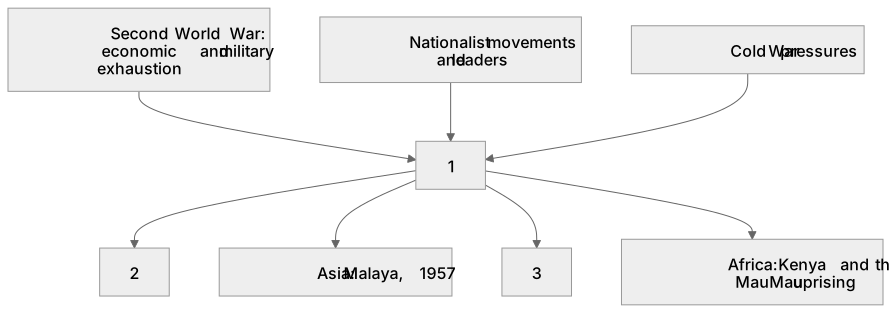
1Box 1
2Box 2
3Box 3
There is more to this lesson
The full lesson goes on to check your understanding and help you earn the marks. Create a free account to carry on, with your progress saved.
A week of Premium from your first lesson · Then the free plan continues · No card, no charge
Test your understanding of 1J The British Empire, c1857–1967 – The winds of change, 1947–1967 (A-level only): Decolonisation in Africa and Asia
Active recall beats re-reading. Take an instant quiz now to test what you’ve learned and lock it into long-term memory.
A week of Premium from your first lesson · Then the free plan continues · No card, no charge