AQA · A-Level · History
Course version: 7042 · Version from Sept 2017
USA, 1865–1975 – The Era of Reconstruction and the Gilded Age, 1865–1890:…
Full specification wording
1K The making of a Superpower: USA, 1865–1975 – The Era of Reconstruction and the Gilded Age, 1865–1890: Economic growth and the rise of corporations: railways; oil; developments in agriculture; urbanisation
The period 1865–1890 witnessed unprecedented US economic growth, driven by the rise of powerful corporations and monopolies.
Checked against the AQA 7042 specification (opens in a new tab) on .
- Point 4 of 6
- 3 key terms
Study notes
From the checked teaching notes for this specification point.
The idea
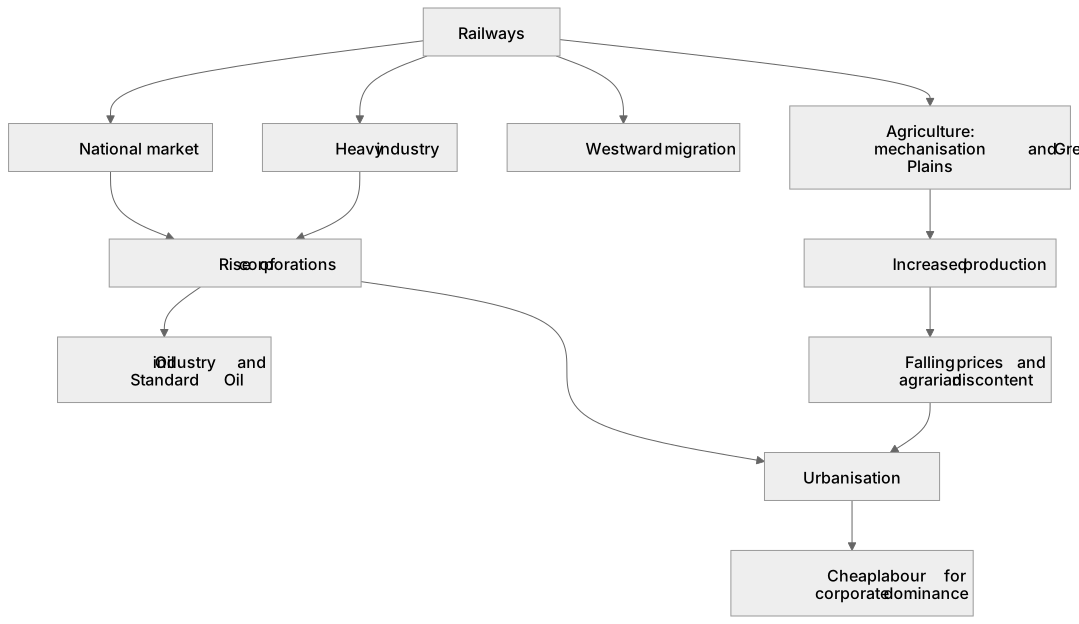
The period 1865–1890 witnessed unprecedented US economic growth, driven by the rise of powerful corporations and monopolies. Railways were the engine of this expansion, creating a national market, stimulating heavy industry, and enabling westward migration. The oil industry, dominated by figures like John D. Rockefeller and his Standard Oil corporation, pioneered horizontal integration and trust-building. Concurrently, developments in agriculture, such as mechanisation and the opening of the Great Plains, vastly increased production but led to falling prices and agrarian discontent. This industrial and agricultural boom fuelled rapid urbanisation, as millions of immigrants and rural Americans flocked to expanding cities to provide the cheap labour necessary for corporate dominance.
What earns the marks
- Explain the role of railways in driving economic growth by creating national markets and stimulating demand for coal and steel.
- Analyse the rise of corporations and trusts, using the oil industry and Standard Oil as a primary example of monopolistic practices.
- Evaluate developments in agriculture, noting how mechanisation increased yields but caused overproduction and economic hardship for small farmers.
- Assess the causes and impacts of urbanisation, linking industrial expansion to the rapid growth of city populations and changing labour demographics.
Common mistakes and how to put them right
Viewing agricultural developments as purely positive.
Put it right: Recognise that while overall production increased, mechanisation and overproduction led to falling prices and severe debt for many farmers.
Treating the rise of corporations in isolation.
Put it right: Explicitly link corporate growth to the expansion of the railway network, which provided both the infrastructure and the business model for large-scale enterprises.
Assuming urbanisation was solely driven by immigration.
Put it right: Include the significant internal migration of rural Americans moving to cities in search of industrial employment.
Exam tips
- Use specific business strategies, such as horizontal and vertical integration, to explain how corporations in the oil and railway sectors achieved dominance.
- Link developments in agriculture directly to the railways, as farmers became entirely dependent on train networks to transport their goods to urban markets.
- When evaluating economic growth, contrast the immense wealth generated by corporations with the challenging living conditions created by rapid, unregulated urbanisation.
Try the lesson
The start of the 1K The making of a Superpower: USA, 1865–1975 – The Era of Reconstruction and the Gilded Age, 1865–1890: Economic growth and the rise of corporations: railways; oil; developments in agriculture; urbanisation lesson, made from checked teaching notes for this specification point.
Have a go first
What was the primary economic impact of the expansion of the railway network in the United States between 1865 and 1890?
Listen
The period 1865–1890 witnessed unprecedented US economic growth, driven by the rise of powerful corporations and monopolies. Railways were the engine of this expansion, creating a national market, stimulating heavy industry, and enabling westward migration. The oil industry, dominated by figures like John D. Rockefeller and his Standard Oil corporation, pioneered horizontal integration and trust-building. Concurrently, developments in agriculture, such as mechanisation and the opening of the Great Plains, vastly increased production but led to falling prices and agrarian discontent. This industrial and agricultural boom fuelled rapid urbanisation, as millions of immigrants and rural Americans flocked to expanding cities to provide the cheap labour necessary for corporate dominance. A strong answer earns marks for these points. Explain the role of railways in driving economic growth by creating national markets and stimulating demand for coal and steel. Analyse the rise of corporations and trusts, using the oil industry and Standard Oil as a primary example of monopolistic practices. Evaluate developments in agriculture, noting how mechanisation increased yields but caused overproduction and economic hardship for small farmers. Assess the causes and impacts of urbanisation, linking industrial expansion to the rapid growth of city populations and changing labour demographics. A common slip: Viewing agricultural developments as purely positive. Instead, recognise that while overall production increased, mechanisation and overproduction led to falling prices and severe debt for many farmers. Exam tip: Use specific business strategies, such as horizontal and vertical integration, to explain how corporations in the oil and railway sectors achieved dominance.
See it
Key words
Say what each word means before you turn the card.
Urbanisation and Demographic Change
Try answering aloud or in your head before turning the card.
Agrarian Discontent
Try answering aloud or in your head before turning the card.
Industrialisation and Corporate Capitalism
Try answering aloud or in your head before turning the card.
See every definition
- Urbanisation and Demographic Change
- Rapid growth of city populations as millions of immigrants and rural Americans flocked to expanding cities to provide cheap labour for corporate dominance.
- Agrarian Discontent
- Hardship for small farmers caused by mechanisation and overproduction, which increased production but led to falling prices and severe debt.
- Industrialisation and Corporate Capitalism
- Economic growth driven by powerful corporations and monopolies, with railways as the engine of expansion and oil pioneering horizontal integration and trust-building.
Label the diagram
Some boxes have lost their names. Pick the right name for each number.
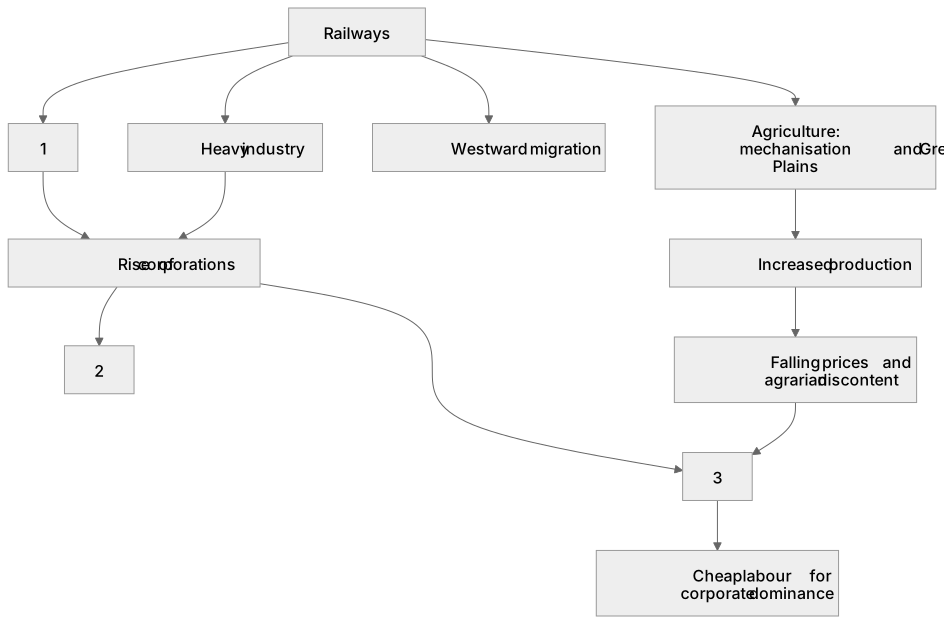
1Box 1
2Box 2
3Box 3
There is more to this lesson
The full lesson goes on to check your understanding and help you earn the marks. Create a free account to carry on, with your progress saved.
A week of Premium from your first lesson · Then the free plan continues · No card, no charge
Test your understanding of 1K The making of a Superpower: USA, 1865–1975 – The Era of Reconstruction and the Gilded Age, 1865–1890: Economic growth and the rise of corporations: railways; oil; developments in agriculture; urbanisation
Active recall beats re-reading. Take an instant quiz now to test what you’ve learned and lock it into long-term memory.
A week of Premium from your first lesson · Then the free plan continues · No card, no charge