AQA · A-Level · History
Course version: 7042 · Version from Sept 2017
USA, 1865–1975 – The Era of Reconstruction and the Gilded Age, 1865–1890:…
Full specification wording
1K The making of a Superpower: USA, 1865–1975 – The Era of Reconstruction and the Gilded Age, 1865–1890: The limits of foreign engagement and continuation of isolationism: the continuation of the Monroe Doctrine; territorial consolidation (Alaska) and tensions over Canada
Post-Civil War US foreign policy featured strict limits on foreign engagement and a continuation of isolationism, avoiding European conflicts.
Checked against the AQA 7042 specification (opens in a new tab) on .
- Point 6 of 6
- 4 key terms
Study notes
From the checked teaching notes for this specification point.
The idea
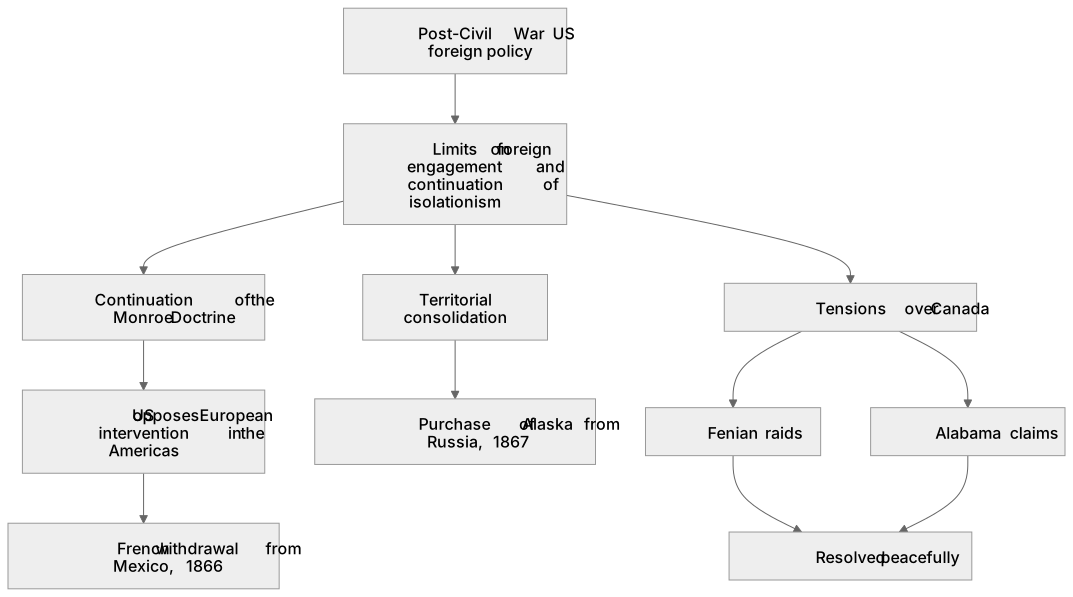
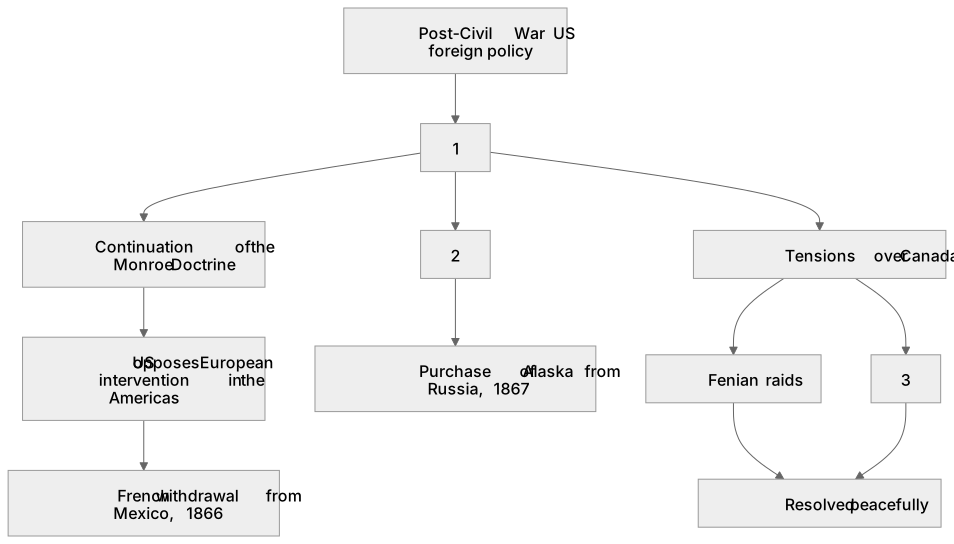
Post-Civil War US foreign policy featured strict limits on foreign engagement and a continuation of isolationism, avoiding European conflicts. However, this stance was nuanced. The continuation of the Monroe Doctrine meant the US actively opposed European intervention in the Americas, notably forcing French withdrawal from Mexico in 1866. Territorial consolidation also progressed, exemplified by Seward's 1867 purchase of Alaska from Russia, securing northern dominance. Concurrently, tensions over Canada tested diplomatic limits; Fenian raids and disputes over the Alabama claims highlighted friction with Britain. These were ultimately resolved peacefully, reinforcing US regional hegemony without breaking isolationist principles.
What earns the marks
- Explain the nature of US isolationism post-1865, focusing on the deliberate avoidance of European political and military alliances.
- Analyse how the continuation of the Monroe Doctrine was applied in practice, such as the US response to French intervention in Mexico.
- Evaluate the motivations behind the 1867 purchase of Alaska, including economic interests, territorial consolidation, and the desire to reduce Russian influence.
- Assess the causes and resolution of tensions over Canada, including the Fenian Brotherhood raids and the settlement of the Alabama claims via the Treaty of Washington (1871).
- Discuss the apparent contradiction between isolationist rhetoric and the active consolidation of North American territory.
Common mistakes and how to put them right
Equating isolationism with total withdrawal from world affairs.
Put it right: The US remained highly active in trade and regional diplomacy in the Americas.
Assuming the purchase of Alaska was universally popular.
Put it right: It was widely mocked as 'Seward's Folly' before its strategic and resource value was realised.
Treating tensions over Canada as a prelude to war.
Put it right: While friction existed, both the US and Britain actively sought diplomatic resolutions like the 1871 Treaty of Washington.
Exam tips
- Use the French intervention in Mexico as a primary example to demonstrate the practical enforcement of the Monroe Doctrine.
- Contrast the policy of isolationism towards Europe with the active policy of territorial consolidation in North America to show a nuanced understanding.
- Reference the Treaty of Washington (1871) to illustrate how tensions over Canada and British Civil War actions were resolved diplomatically.
Try the lesson
The start of the 1K The making of a Superpower: USA, 1865–1975 – The Era of Reconstruction and the Gilded Age, 1865–1890: The limits of foreign engagement and continuation of isolationism: the continuation of the Monroe Doctrine; territorial consolidation (Alaska) and tensions over Canada lesson, made from checked teaching notes for this specification point.
Have a go first
What was the primary motivation behind the United States' purchase of Alaska from the Russian Empire in 1867?
Listen
Post-Civil War US foreign policy featured strict limits on foreign engagement and a continuation of isolationism, avoiding European conflicts. However, this stance was nuanced. The continuation of the Monroe Doctrine meant the US actively opposed European intervention in the Americas, notably forcing French withdrawal from Mexico in 1866. Territorial consolidation also progressed, exemplified by Seward's 1867 purchase of Alaska from Russia, securing northern dominance. Concurrently, tensions over Canada tested diplomatic limits; Fenian raids and disputes over the Alabama claims highlighted friction with Britain. These were ultimately resolved peacefully, reinforcing US regional hegemony without breaking isolationist principles. A strong answer earns marks for these points. Explain the nature of US isolationism post-1865, focusing on the deliberate avoidance of European political and military alliances. Analyse how the continuation of the Monroe Doctrine was applied in practice, such as the US response to French intervention in Mexico. Evaluate the motivations behind the 1867 purchase of Alaska, including economic interests, territorial consolidation, and the desire to reduce Russian influence. Assess the causes and resolution of tensions over Canada, including the Fenian Brotherhood raids and the settlement of the Alabama claims via the Treaty of Washington (1871). Exam tip: Use the French intervention in Mexico as a primary example to demonstrate the practical enforcement of the Monroe Doctrine.
See it
Key words
Say what each word means before you turn the card.
Isolationism
Try answering aloud or in your head before turning the card.
Monroe Doctrine
Try answering aloud or in your head before turning the card.
Territorial consolidation
Try answering aloud or in your head before turning the card.
Regional hegemony
Try answering aloud or in your head before turning the card.
See every definition
- Isolationism
- A stance of strict limits on foreign engagement, avoiding European conflicts and political and military alliances.
- Monroe Doctrine
- A doctrine whose continuation meant the US actively opposed European intervention in the Americas.
- Territorial consolidation
- A process that progressed through the purchase of Alaska from Russia, securing northern dominance.
- Regional hegemony
- A position reinforced as tensions over Canada were ultimately resolved peacefully without breaking isolationist principles.
Label the diagram
Some boxes have lost their names. Pick the right name for each number.
1Box 1
2Box 2
3Box 3
There is more to this lesson
The full lesson goes on to check your understanding and help you earn the marks. Create a free account to carry on, with your progress saved.
A week of Premium from your first lesson · Then the free plan continues · No card, no charge
Test your understanding of 1K The making of a Superpower: USA, 1865–1975 – The Era of Reconstruction and the Gilded Age, 1865–1890: The limits of foreign engagement and continuation of isolationism: the continuation of the Monroe Doctrine; territorial consolidation (Alaska) and tensions over Canada
Active recall beats re-reading. Take an instant quiz now to test what you’ve learned and lock it into long-term memory.
A week of Premium from your first lesson · Then the free plan continues · No card, no charge