AQA · A-Level · History
Course version: 7042 · Version from Sept 2017
Germany, 1871–1991 – consequence in this period through the following key…
Full specification wording
1L The quest for political stability: Germany, 1871–1991 – consequence in this period through the following key questions:: How was Germany governed and how did political authority change and develop?
This theme requires tracing the evolution of German governance and political authority from the creation of the Kaiserreich in 1871 to the reunification of Germany in 1990-1991.
Checked against the AQA 7042 specification (opens in a new tab) on .
- Point 1 of 6
- 4 key terms
Study notes
From the checked teaching notes for this specification point.
The idea
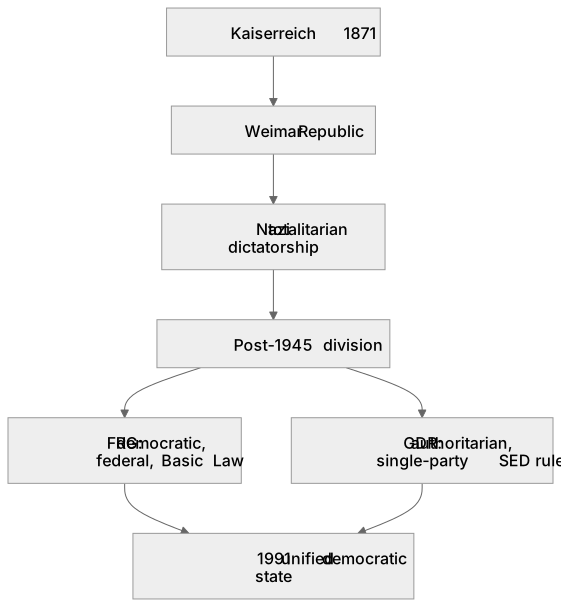
This theme requires tracing the evolution of German governance and political authority from the creation of the Kaiserreich in 1871 to the reunification of Germany in 1990-1991. You must analyse the shift from Bismarck's semi-authoritarian constitutional monarchy, where the Kaiser and Chancellor held dominant executive power, to the democratic experiment of the Weimar Republic with its proportional representation and Article 48. Evaluate the total collapse of democratic authority under the Nazi totalitarian dictatorship, where power was centralised in the Führer. Finally, contrast the post-1945 division, comparing the democratic, federal structure of the FRG (Basic Law) with the authoritarian, single-party SED rule in the GDR, culminating in the 1991 unified democratic state.
What earns the marks
- Identify the constitutional structures of the Kaiserreich, Weimar Republic, Nazi Germany, FRG, and GDR.
- Analyse the location of executive power in each regime, contrasting the Kaiser and Chancellor with the Weimar President, the Führer, and the post-war Chancellors.
- Evaluate the reasons for transitions between different forms of government, such as military defeat, economic crisis, or foreign intervention.
- Compare the extent of democratic participation, federalism, and civil liberties across the different political systems from 1871 to 1991.
Common mistakes and how to put them right
Assuming the Kaiserreich was an absolute monarchy.
Put it right: It was a constitutional monarchy with a federal structure and universal male suffrage for the Reichstag, albeit with limited parliamentary power.
Treating the Weimar Republic's constitution as entirely flawed from the start.
Put it right: Acknowledge that it was highly democratic for its time, and its failure was due to a complex mix of structural, economic, and political factors.
Equating the governance of the FRG and GDR post-1949.
Put it right: Clearly distinguish the democratic, capitalist federal system of the West (FRG) from the Soviet-backed, centralised socialist dictatorship of the East (GDR).
Exam tips
- Use specific constitutional features, such as Article 48 in Weimar or the Basic Law in the FRG, to support arguments about political authority.
- When discussing change, explicitly evaluate the pace and extent of the transition, noting periods of rapid upheaval versus gradual evolution.
- Structure comparative essays thematically, focusing on concepts like the role of the executive or democratic representation, rather than writing a chronological narrative of each regime.
Try the lesson
The start of the 1L The quest for political stability: Germany, 1871–1991 – consequence in this period through the following key questions:: How was Germany governed and how did political authority change and develop? lesson, made from checked teaching notes for this specification point.
Have a go first
Under the 1871 Constitution of the German Empire, how was the Chancellor appointed and to whom were they primarily accountable?
Listen
This theme requires tracing the evolution of German governance and political authority from the creation of the Kaiserreich in 1871 to the reunification of Germany in 1990-1991. You must analyse the shift from Bismarck's semi-authoritarian constitutional monarchy, where the Kaiser and Chancellor held dominant executive power, to the democratic experiment of the Weimar Republic with its proportional representation and Article 48. Evaluate the total collapse of democratic authority under the Nazi totalitarian dictatorship, where power was centralised in the Führer. Finally, contrast the post-1945 division, comparing the democratic, federal structure of the FRG (Basic Law) with the authoritarian, single-party SED rule in the GDR, culminating in the 1991 unified democratic state. A strong answer earns marks for these points. Identify the constitutional structures of the Kaiserreich, Weimar Republic, Nazi Germany, FRG, and GDR. Analyse the location of executive power in each regime, contrasting the Kaiser and Chancellor with the Weimar President, the Führer, and the post-war Chancellors. Evaluate the reasons for transitions between different forms of government, such as military defeat, economic crisis, or foreign intervention. Compare the extent of democratic participation, federalism, and civil liberties across the different political systems from 1871 to 1991. A common slip: Assuming the Kaiserreich was an absolute monarchy. Instead, it was a constitutional monarchy with a federal structure and universal male suffrage for the Reichstag, albeit with limited parliamentary power. Exam tip: Use specific constitutional features, such as Article 48 in Weimar or the Basic Law in the FRG, to support arguments about political authority.
See it
Key words
Say what each word means before you turn the card.
Authoritarianism vs. Democracy
Try answering aloud or in your head before turning the card.
Constitutional change
Try answering aloud or in your head before turning the card.
Centralisation vs. Federalism
Try answering aloud or in your head before turning the card.
The role of the executive
Try answering aloud or in your head before turning the card.
See every definition
- Authoritarianism vs. Democracy
- The shift from Bismarck's semi-authoritarian constitutional monarchy to the democratic experiment of the Weimar Republic, and later the contrast between the democratic FRG and the authoritarian GDR.
- Constitutional change
- The move from the Kaiserreich's constitutional monarchy to the Weimar Republic's proportional representation and Article 48, and the FRG's Basic Law.
- Centralisation vs. Federalism
- Power centralised in the Führer under the Nazi totalitarian dictatorship, contrasted with the democratic, federal structure of the FRG.
- The role of the executive
- Executive power held by the Kaiser and Chancellor, the Weimar President, the Führer, and the post-war Chancellors.
Label the diagram
Some boxes have lost their names. Pick the right name for each number.
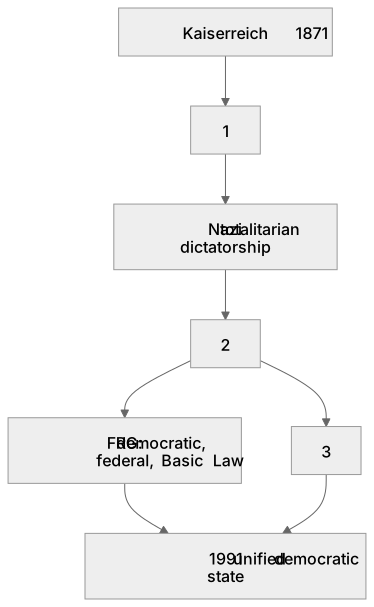
1Box 1
2Box 2
3Box 3
There is more to this lesson
The full lesson goes on to check your understanding and help you earn the marks. Create a free account to carry on, with your progress saved.
A week of Premium from your first lesson · Then the free plan continues · No card, no charge
Test your understanding of 1L The quest for political stability: Germany, 1871–1991 – consequence in this period through the following key questions:: How was Germany governed and how did political authority change and develop?
Active recall beats re-reading. Take an instant quiz now to test what you’ve learned and lock it into long-term memory.
A week of Premium from your first lesson · Then the free plan continues · No card, no charge