AQA · A-Level · History
Course version: 7042 · Version from Sept 2017
Germany, 1871–1991 – Division to unity: the Federal Republic of Germany,…
Full specification wording
1L The quest for political stability: Germany, 1871–1991 – Division to unity: the Federal Republic of Germany, 1949–1991 (A-level only): The political, economic and social condition of reunified Germany by 1991: Kohl and the drive to reunification; strengths and problems of reunification
By 1991, reunified Germany faced a complex political, economic, and social landscape.
Checked against the AQA 7042 specification (opens in a new tab) on .
- Point 6 of 6
- 4 key terms
Study notes
From the checked teaching notes for this specification point.
The idea
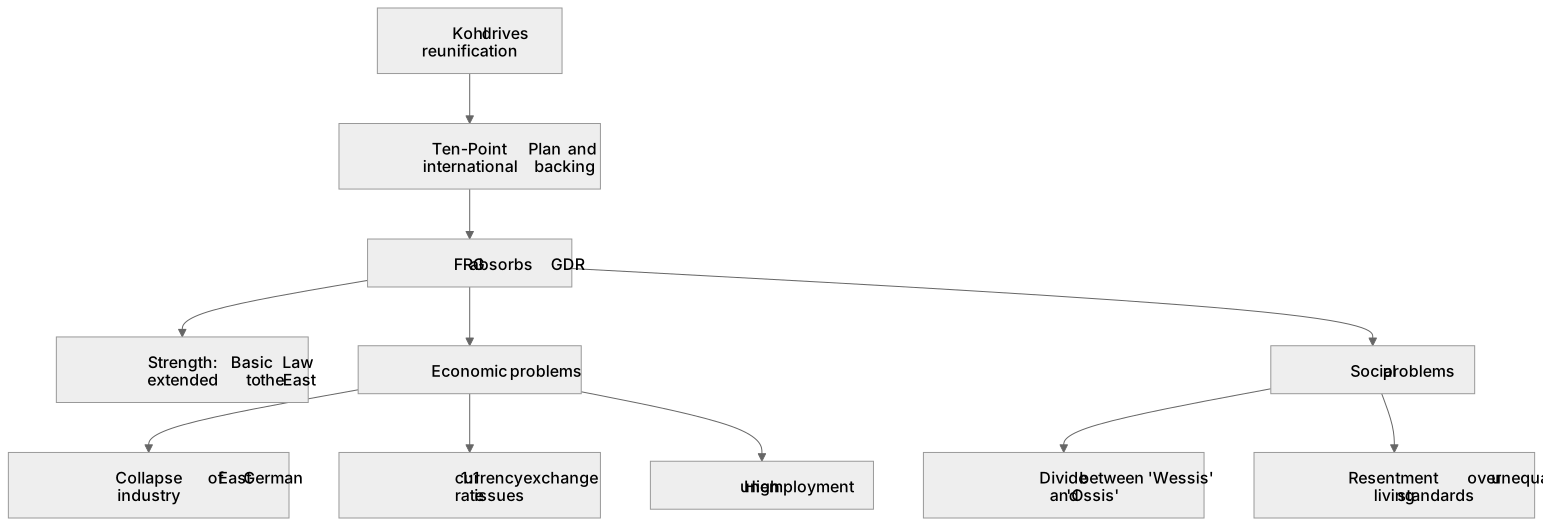
By 1991, reunified Germany faced a complex political, economic, and social landscape. Chancellor Helmut Kohl drove the rapid reunification process, capitalising on the Berlin Wall's fall with his Ten-Point Plan and securing international backing. Politically, the FRG absorbed the GDR, showing the strength of West German democracy. However, severe problems emerged. Economically, the transition to a market economy devastated the East, causing mass unemployment and requiring costly privatisation. Socially, a deep divide persisted between 'Wessis' and 'Ossis', fuelled by resentment over unequal living standards and the psychological trauma of adapting to a new capitalist reality, highlighting the mixed condition of the newly unified state.
What earns the marks
- Assess Helmut Kohl's political opportunism and diplomatic skill in driving reunification, particularly his Ten-Point Plan and negotiations with Gorbachev.
- Evaluate the political condition of Germany by 1991, noting the successful extension of the Basic Law to the East as a major strength of the reunification process.
- Analyse the economic problems of reunification, focusing on the collapse of East German industry, the 1:1 currency exchange rate issues, and the resulting high unemployment.
- Examine the social condition of reunified Germany, highlighting the cultural alienation and lingering resentment between East ('Ossis') and West ('Wessis') Germans.
- Weigh the long-term strengths of a unified, democratic Germany against the immediate, severe economic and social costs incurred by 1991.
Common mistakes and how to put them right
Claiming that reunification was a merger of two equal states.
Put it right: Emphasise that reunification was effectively an absorption (Beitritt) of the GDR into the FRG under Article 23 of the Basic Law.
Assuming the East German economy seamlessly integrated into the West.
Put it right: Detail the severe economic shock, deindustrialisation, and mass unemployment the East suffered during the transition to a market economy.
Overlooking the international dimension of Kohl's drive to reunification.
Put it right: Acknowledge that Kohl had to secure the agreement of the four occupying powers, particularly the Soviet Union, to achieve reunification.
Exam tips
- Use the terms 'Ossi' and 'Wessi' to effectively illustrate the social and psychological divisions that persisted after formal political reunification.
- When evaluating Kohl's role, balance his decisive leadership in 1989-1990 against his underestimation of the economic costs of integrating the GDR.
- Structure essays on this topic thematically, separating the political strengths of reunification from the severe economic and social problems evident by 1991.
Try the lesson
The start of the 1L The quest for political stability: Germany, 1871–1991 – Division to unity: the Federal Republic of Germany, 1949–1991 (A-level only): The political, economic and social condition of reunified Germany by 1991: Kohl and the drive to reunification; strengths and problems of reunification lesson, made from checked teaching notes for this specification point.
Have a go first
What was the primary mechanism proposed by Chancellor Helmut Kohl in November 1989 to guide the process of German reunification?
Listen
By 1991, reunified Germany faced a complex political, economic, and social landscape. Chancellor Helmut Kohl drove the rapid reunification process, capitalising on the Berlin Wall's fall with his Ten-Point Plan and securing international backing. Politically, the FRG absorbed the GDR, showing the strength of West German democracy. However, severe problems emerged. Economically, the transition to a market economy devastated the East, causing mass unemployment and requiring costly privatisation. Socially, a deep divide persisted between 'Wessis' and 'Ossis', fuelled by resentment over unequal living standards and the psychological trauma of adapting to a new capitalist reality, highlighting the mixed condition of the newly unified state. A strong answer earns marks for these points. Assess Helmut Kohl's political opportunism and diplomatic skill in driving reunification, particularly his Ten-Point Plan and negotiations with Gorbachev. Evaluate the political condition of Germany by 1991, noting the successful extension of the Basic Law to the East as a major strength of the reunification process. Analyse the economic problems of reunification, focusing on the collapse of East German industry, the 1:1 currency exchange rate issues, and the resulting high unemployment. Examine the social condition of reunified Germany, highlighting the cultural alienation and lingering resentment between East ('Ossis') and West ('Wessis') Germans. A common slip: Claiming that reunification was a merger of two equal states. Instead, Emphasise that reunification was effectively an absorption (Beitritt) of the GDR into the FRG under Article 23 of the Basic Law. Exam tip: Use the terms 'Ossi' and 'Wessi' to effectively illustrate the social and psychological divisions that persisted after formal political reunification.
See it
Key words
Say what each word means before you turn the card.
Political integration and absorption
Try answering aloud or in your head before turning the card.
Economic transition and disparity
Try answering aloud or in your head before turning the card.
Social division and identity
Try answering aloud or in your head before turning the card.
Diplomacy and statecraft
Try answering aloud or in your head before turning the card.
See every definition
- Political integration and absorption
- The process by which the FRG absorbed the GDR, showing the strength of West German democracy.
- Economic transition and disparity
- The transition to a market economy devastated the East, causing mass unemployment and requiring costly privatisation.
- Social division and identity
- A deep divide persisted between 'Wessis' and 'Ossis', fuelled by resentment over unequal living standards and the psychological trauma of adapting to a new capitalist reality.
- Diplomacy and statecraft
- Kohl capitalised on the Berlin Wall's fall with his Ten-Point Plan and secured international backing.
Label the diagram
Some boxes have lost their names. Pick the right name for each number.
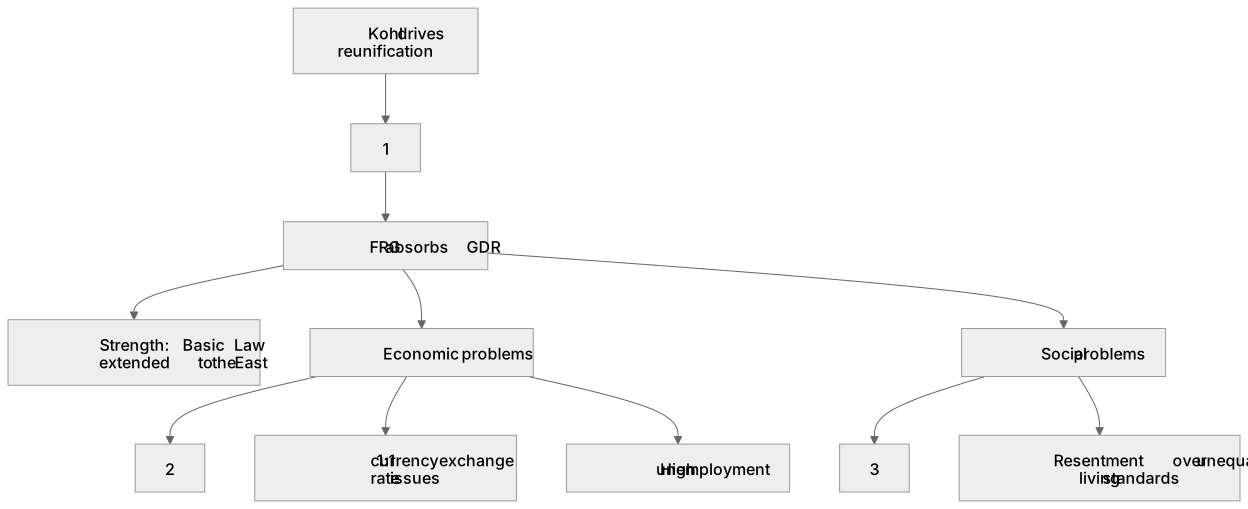
1Box 1
2Box 2
3Box 3
There is more to this lesson
The full lesson goes on to check your understanding and help you earn the marks. Create a free account to carry on, with your progress saved.
A week of Premium from your first lesson · Then the free plan continues · No card, no charge
Test your understanding of 1L The quest for political stability: Germany, 1871–1991 – Division to unity: the Federal Republic of Germany, 1949–1991 (A-level only): The political, economic and social condition of reunified Germany by 1991: Kohl and the drive to reunification; strengths and problems of reunification
Active recall beats re-reading. Take an instant quiz now to test what you’ve learned and lock it into long-term memory.
A week of Premium from your first lesson · Then the free plan continues · No card, no charge