AQA · A-Level · History
Course version: 7042 · Version from Sept 2017
Germany, 1871–1991 – Empire to democracy, 1914–1929: Government and…
Full specification wording
1L The quest for political stability: Germany, 1871–1991 – Empire to democracy, 1914–1929: Government and opposition to 1924: post-war political problems; attempted coups and the opposition of left and right; the occupation of the Ruhr; the working of Weimar government; its strengths and weaknesses
Between 1919 and 1924, the Weimar government faced severe post-war political problems, including the stigma of the Versailles Treaty and intense opposition from both extremes.
Checked against the AQA 7042 specification (opens in a new tab) on .
- Point 2 of 6
- 4 key terms
Study notes
From the checked teaching notes for this specification point.
The idea
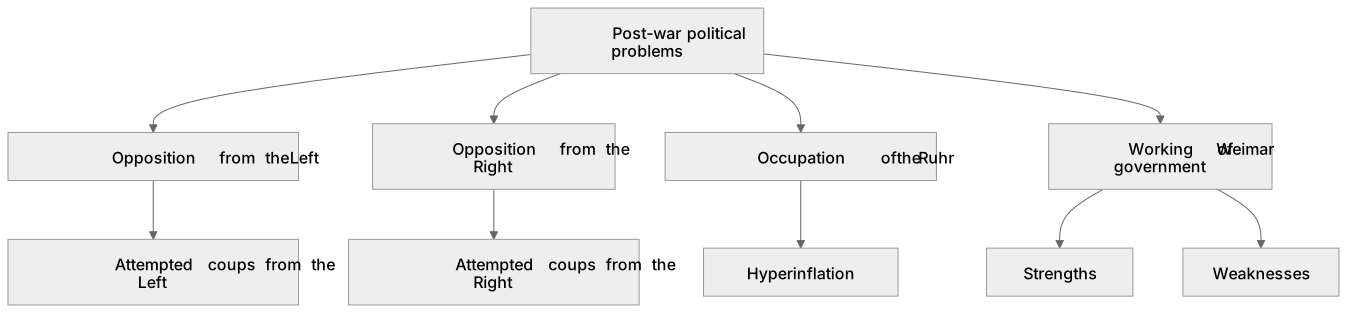
Between 1919 and 1924, the Weimar government faced severe post-war political problems, including the stigma of the Versailles Treaty and intense opposition from both extremes. The Left launched attempted coups like the Spartacist Uprising (1919), while the Right orchestrated the Kapp Putsch (1920) and Munich Putsch (1923). In 1923, French and Belgian forces initiated the occupation of the Ruhr to extract unpaid reparations, triggering hyperinflation and exposing the government's economic vulnerability. Despite these crises, the working of the Weimar government demonstrated notable strengths, such as Ebert's decisive use of Article 48 and Stresemann's leadership, which allowed the Republic to survive its inherent constitutional weaknesses and extreme political polarisation.
What earns the marks
- Identify key post-war political problems, particularly the 'stab in the back' myth (Dolchstoßlegende) and the burden of the Treaty of Versailles.
- Compare the attempted coups from the Left (e.g., Spartacist Uprising, Ruhr Uprising) and the Right (e.g., Kapp Putsch, Munich Putsch), noting the differing responses of the judiciary and the Reichswehr.
- Explain the causes and consequences of the occupation of the Ruhr, linking passive resistance directly to the hyperinflation crisis of 1923.
- Evaluate the working of the Weimar government, contrasting its weaknesses (coalition instability) with its strengths (effective use of emergency powers by Ebert to suppress rebellions).
Common mistakes and how to put them right
Stating that hyperinflation was caused solely by the occupation of the Ruhr.
Put it right: Explain that while the Ruhr crisis triggered hyperinflation through passive resistance, the underlying inflation began during the First World War.
Claiming the army supported the government equally against all threats.
Put it right: Note that the Reichswehr ruthlessly suppressed left-wing revolts but often refused to fire on right-wing nationalists, as seen in the Kapp Putsch.
Assuming the Weimar government was entirely dysfunctional before 1924.
Put it right: Highlight its strengths, such as surviving multiple existential crises and Stresemann's successful currency reform with the Rentenmark.
Exam tips
- Use specific examples of attempted coups, such as the Kapp Putsch and the Spartacist Uprising, to illustrate the distinct threats posed by the extreme right and extreme left.
- When evaluating the working of the Weimar government, balance the structural weaknesses of coalition politics with the resilience shown by leaders like Ebert and Stresemann.
- Connect the occupation of the Ruhr to both economic disaster (hyperinflation) and political extremism (the Munich Putsch) to show synoptic understanding.
Try the lesson
The start of the 1L The quest for political stability: Germany, 1871–1991 – Empire to democracy, 1914–1929: Government and opposition to 1924: post-war political problems; attempted coups and the opposition of left and right; the occupation of the Ruhr; the working of Weimar government; its strengths and weaknesses lesson, made from checked teaching notes for this specification point.
Have a go first
Which of the following was a right-wing attempt to overthrow the Weimar government in 1920?
Listen
Between 1919 and 1924, the Weimar government faced severe post-war political problems, including the stigma of the Versailles Treaty and intense opposition from both extremes. The Left launched attempted coups like the Spartacist Uprising (1919), while the Right orchestrated the Kapp Putsch (1920) and Munich Putsch (1923). In 1923, French and Belgian forces initiated the occupation of the Ruhr to extract unpaid reparations, triggering hyperinflation and exposing the government's economic vulnerability. Despite these crises, the working of the Weimar government demonstrated notable strengths, such as Ebert's decisive use of Article 48 and Stresemann's leadership, which allowed the Republic to survive its inherent constitutional weaknesses and extreme political polarisation. A strong answer earns marks for these points. Identify key post-war political problems, particularly the 'stab in the back' myth (Dolchstoßlegende) and the burden of the Treaty of Versailles. Compare the attempted coups from the Left (e.g., Spartacist Uprising, Ruhr Uprising) and the Right (e.g., Kapp Putsch, Munich Putsch), noting the differing responses of the judiciary and the Reichswehr. Explain the causes and consequences of the occupation of the Ruhr, linking passive resistance directly to the hyperinflation crisis of 1923. Evaluate the working of the Weimar government, contrasting its weaknesses (coalition instability) with its strengths (effective use of emergency powers by Ebert to suppress rebellions). A common slip: Stating that hyperinflation was caused solely by the occupation of the Ruhr. Instead, explain that while the Ruhr crisis triggered hyperinflation through passive resistance, the underlying inflation began during the First World War. Exam tip: Use specific examples of attempted coups, such as the Kapp Putsch and the Spartacist Uprising, to illustrate the distinct threats posed by the extreme right and extreme left.
See it
Put the events in order
Put these events in the order they happened, earliest first.
- 1. The Left launched the Spartacist Uprising
- 2. The Right orchestrated the Munich Putsch
- 3. The Right orchestrated the Kapp Putsch
Key words
Say what each word means before you turn the card.
Political extremism and opposition
Try answering aloud or in your head before turning the card.
Economic crisis and government response
Try answering aloud or in your head before turning the card.
The legacy of the Treaty of Versailles
Try answering aloud or in your head before turning the card.
Constitutional strengths and vulnerabilities
Try answering aloud or in your head before turning the card.
See every definition
- Political extremism and opposition
- Intense opposition from both extremes, with the Left launching attempted coups and the Right orchestrating putsches against the Weimar government.
- Economic crisis and government response
- The occupation of the Ruhr to extract unpaid reparations triggered hyperinflation and exposed the government's economic vulnerability.
- The legacy of the Treaty of Versailles
- The stigma of the Versailles Treaty was among the severe post-war political problems faced by the Weimar government.
- Constitutional strengths and vulnerabilities
- The working of Weimar government showed strengths such as Ebert's decisive use of Article 48, yet also inherent constitutional weaknesses and extreme political polarisation.
Label the diagram
Some boxes have lost their names. Pick the right name for each number.
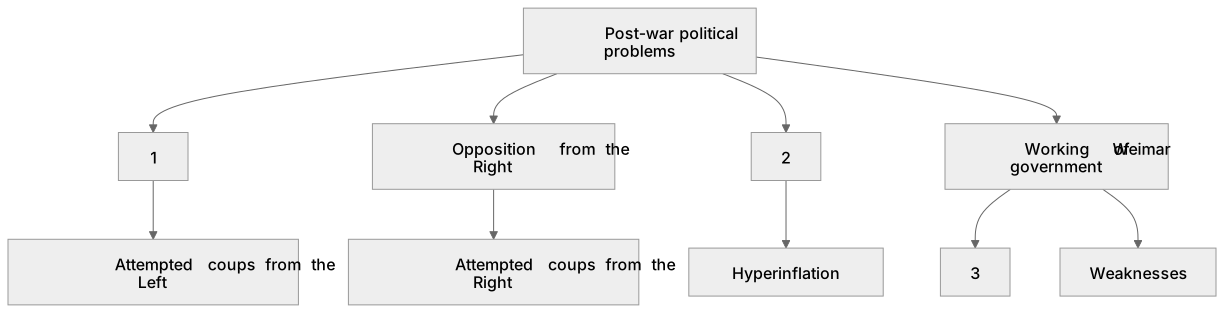
1Box 1
2Box 2
3Box 3
There is more to this lesson
The full lesson goes on to check your understanding and help you earn the marks. Create a free account to carry on, with your progress saved.
A week of Premium from your first lesson · Then the free plan continues · No card, no charge
Test your understanding of 1L The quest for political stability: Germany, 1871–1991 – Empire to democracy, 1914–1929: Government and opposition to 1924: post-war political problems; attempted coups and the opposition of left and right; the occupation of the Ruhr; the working of Weimar government; its strengths and weaknesses
Active recall beats re-reading. Take an instant quiz now to test what you’ve learned and lock it into long-term memory.
A week of Premium from your first lesson · Then the free plan continues · No card, no charge