AQA · A-Level · History
Course version: 7042 · Version from Sept 2017
Germany, 1871–1991 – only) The Nazi experiment, 1929–1949 (A-level only):…
Full specification wording
1L The quest for political stability: Germany, 1871–1991 – only) The Nazi experiment, 1929–1949 (A-level only): Political authority 1929–1945: the collapse of Weimar democracy and the establishment of the one-party authoritarian Nazi State; the roles of Hindenburg and Hitler
The period 1929–1945 witnessed the fatal collapse of Weimar democracy and its replacement by a one-party authoritarian Nazi State.
Checked against the AQA 7042 specification (opens in a new tab) on .
- Point 1 of 6
- 4 key terms
Study notes
From the checked teaching notes for this specification point.
The idea
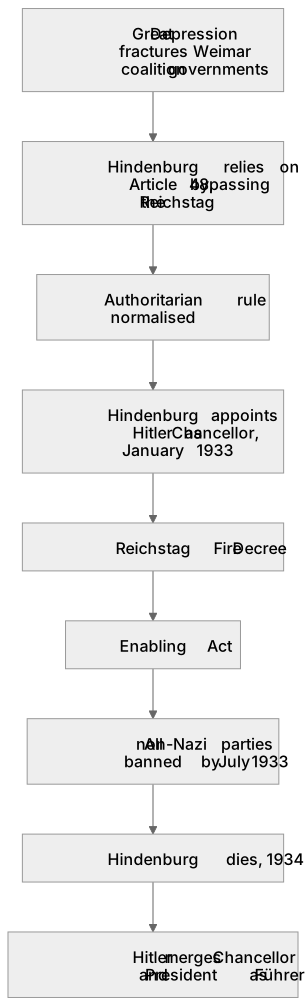
The period 1929–1945 witnessed the fatal collapse of Weimar democracy and its replacement by a one-party authoritarian Nazi State. The Great Depression fractured Weimar's coalition governments, leading President Hindenburg to increasingly rely on Article 48, bypassing the Reichstag and normalising authoritarian rule. Hindenburg’s underestimation of the Nazis culminated in his disastrous appointment of Hitler as Chancellor in January 1933. Hitler rapidly dismantled democratic institutions through pseudo-legal means, such as the Reichstag Fire Decree and the Enabling Act, which neutralised political opposition. By July 1933, all non-Nazi parties were banned, cementing the one-party state. Following Hindenburg's death in 1934, Hitler merged the offices of Chancellor and President, securing absolute political authority as Führer.
What earns the marks
- Explain the impact of the Wall Street Crash on the collapse of the Grand Coalition and the rise of presidential government under Hindenburg.
- Analyse Hindenburg's role in appointing Hitler, driven by conservative elites like von Papen who mistakenly believed they could control him.
- Detail the legislative steps Hitler took to establish the one-party state, specifically the Reichstag Fire Decree and the Enabling Act of 1933.
- Evaluate the process of Gleichschaltung (co-ordination), including the banning of trade unions and opposition parties by July 1933.
- Assess the significance of the Night of the Long Knives and Hindenburg's death in 1934 in consolidating Hitler's absolute authority.
Common mistakes and how to put them right
Claiming Hitler seized power by force in 1933.
Put it right by explaining he was legally appointed Chancellor by Hindenburg under the Weimar Constitution.
Stating the Enabling Act immediately made Germany a one-party state.
Put it right by noting it gave Hitler dictatorial powers, but the formal banning of other parties occurred progressively until July 1933.
Ignoring Hindenburg's agency; correct by emphasising that Hindenburg's use of Article 48 from 1930 fundamentally undermined Weimar democracy before Hitler's appointment.
Exam tips
- When evaluating the collapse of Weimar, weigh long-term structural weaknesses against short-term triggers like the Depression and political intrigue.
- Use specific constitutional terms, such as Article 48 and proportional representation, to demonstrate precise knowledge of Weimar's vulnerabilities.
- Contrast the roles of Hindenburg as a facilitator of authoritarianism and Hitler as the architect of the totalitarian state when discussing the transition of power.
Try the lesson
The start of the 1L The quest for political stability: Germany, 1871–1991 – only) The Nazi experiment, 1929–1949 (A-level only): Political authority 1929–1945: the collapse of Weimar democracy and the establishment of the one-party authoritarian Nazi State; the roles of Hindenburg and Hitler lesson, made from checked teaching notes for this specification point.
Have a go first
Which constitutional power did President Hindenburg use extensively between 1930 and 1933, contributing significantly to the collapse of Weimar democracy?
Listen
The period 1929–1945 witnessed the fatal collapse of Weimar democracy and its replacement by a one-party authoritarian Nazi State. The Great Depression fractured Weimar's coalition governments, leading President Hindenburg to increasingly rely on Article 48, bypassing the Reichstag and normalising authoritarian rule. Hindenburg’s underestimation of the Nazis culminated in his disastrous appointment of Hitler as Chancellor in January 1933. Hitler rapidly dismantled democratic institutions through pseudo-legal means, such as the Reichstag Fire Decree and the Enabling Act, which neutralised political opposition. By July 1933, all non-Nazi parties were banned, cementing the one-party state. Following Hindenburg's death in 1934, Hitler merged the offices of Chancellor and President, securing absolute political authority as Führer. A strong answer earns marks for these points. Explain the impact of the Wall Street Crash on the collapse of the Grand Coalition and the rise of presidential government under Hindenburg. Analyse Hindenburg's role in appointing Hitler, driven by conservative elites like von Papen who mistakenly believed they could control him. Detail the legislative steps Hitler took to establish the one-party state, specifically the Reichstag Fire Decree and the Enabling Act of 1933. Evaluate the process of Gleichschaltung (co-ordination), including the banning of trade unions and opposition parties by July 1933. A common slip: Claiming Hitler seized power by force in 1933. Instead, explaining he was legally appointed Chancellor by Hindenburg under the Weimar Constitution. Exam tip: When evaluating the collapse of Weimar, weigh long-term structural weaknesses against short-term triggers like the Depression and political intrigue.
See it
Key words
Say what each word means before you turn the card.
Authoritarianism
Try answering aloud or in your head before turning the card.
Constitutional collapse
Try answering aloud or in your head before turning the card.
Political intrigue
Try answering aloud or in your head before turning the card.
Consolidation of power
Try answering aloud or in your head before turning the card.
See every definition
- Authoritarianism
- Rule normalised when Hindenburg increasingly relied on Article 48, bypassing the Reichstag, before the one-party Nazi State was established.
- Constitutional collapse
- The fatal collapse of Weimar democracy, as coalition governments fractured and presidential government bypassed the Reichstag through Article 48.
- Political intrigue
- The manoeuvring of conservative elites such as von Papen, who mistakenly believed they could control Hitler, culminating in his appointment as Chancellor.
- Consolidation of power
- Hitler's dismantling of democratic institutions through pseudo-legal means, banning all non-Nazi parties by July 1933 and merging the offices of Chancellor and President in 1934.
Label the diagram
Some boxes have lost their names. Pick the right name for each number.
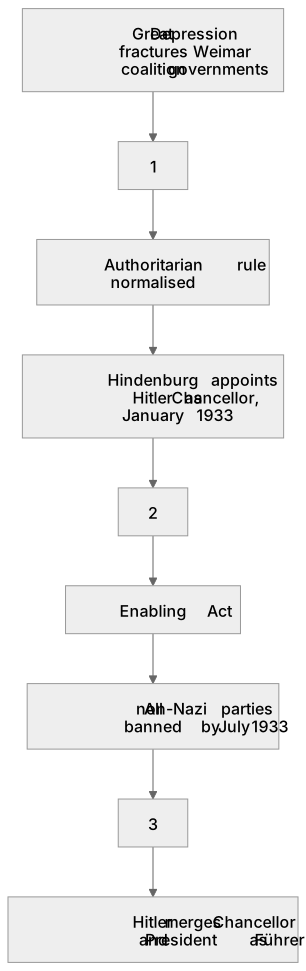
1Box 1
2Box 2
3Box 3
There is more to this lesson
The full lesson goes on to check your understanding and help you earn the marks. Create a free account to carry on, with your progress saved.
A week of Premium from your first lesson · Then the free plan continues · No card, no charge
Test your understanding of 1L The quest for political stability: Germany, 1871–1991 – only) The Nazi experiment, 1929–1949 (A-level only): Political authority 1929–1945: the collapse of Weimar democracy and the establishment of the one-party authoritarian Nazi State; the roles of Hindenburg and Hitler
Active recall beats re-reading. Take an instant quiz now to test what you’ve learned and lock it into long-term memory.
A week of Premium from your first lesson · Then the free plan continues · No card, no charge