AQA · A-Level · History
Course version: 7042 · Version from Sept 2017
The place of religion in society: the political role of the Church;…
Full specification wording
2A Royal Authority and the Angevin Kings, 1154–1216 – The Restoration of Royal Authority, 1154–1166: The place of religion in society: the political role of the Church; ecclesiastical courts; the importance of the Church in finance and the economy
In twelfth-century England, religion permeated daily life, with the Catholic Church acting as a central pillar of society.
Checked against the AQA 7042 specification (opens in a new tab) on .
- Point 3 of 4
Study notes
From the checked teaching notes for this specification point.
The idea
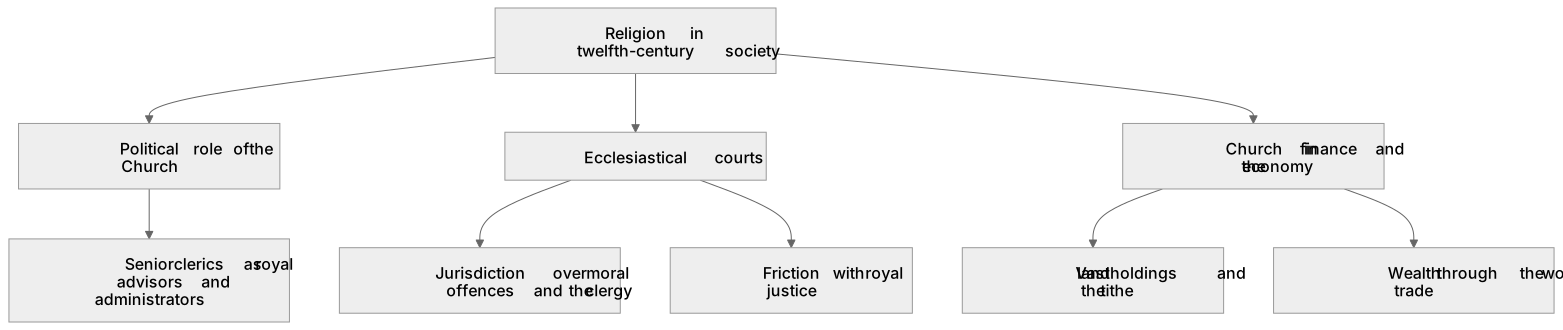
In twelfth-century England, religion permeated daily life, with the Catholic Church acting as a central pillar of society. Politically, senior clerics like Archbishop Theobald of Bec served as vital royal advisors and administrators, bridging the gap between secular governance and divine authority. The Church operated its own parallel legal system through ecclesiastical courts, claiming jurisdiction over moral offences and the clergy, which increasingly caused friction with Henry II's centralising royal justice. Economically, the Church was a financial powerhouse; it held vast swathes of land, collected the tithe, and generated immense wealth through the wool trade, particularly via Cistercian monasteries, making it indispensable to the Crown.
What earns the marks
- Explain the dual role of bishops and abbots as both spiritual leaders and major feudal tenants-in-chief who owed knight service to the Crown.
- Analyse the function of ecclesiastical courts in handling cases involving wills, marriages, and clerical crimes, noting how this challenged royal jurisdictional supremacy.
- Evaluate the economic impact of monastic orders, particularly the Cistercians, in developing the wool trade and agricultural innovations.
- Assess the political influence of key churchmen in royal administration, such as Thomas Becket's early role as Chancellor before becoming Archbishop.
Common mistakes and how to put them right
Assuming the Church and Crown were always in conflict.
Put it right: In reality, they were highly interdependent in administration and finance during the early years of Henry II's reign.
Confusing ecclesiastical courts with royal courts.
Put it right: Ecclesiastical courts used canon law and could not impose the death penalty, unlike secular royal courts.
Underestimating the Church's economic power; students often focus solely on its spiritual role, ignoring its status as the largest landowner and a major source of taxation.
Exam tips
- Use specific examples of Church wealth, such as the Cistercian wool trade, to support arguments about its economic importance.
- When discussing political roles, highlight how Henry II relied on literate clerics to staff his chancery and exchequer.
- Link the jurisdiction of ecclesiastical courts directly to the emerging tensions that culminated in the Constitutions of Clarendon.
Try the lesson
The start of the 2A Royal Authority and the Angevin Kings, 1154–1216 – The Restoration of Royal Authority, 1154–1166: The place of religion in society: the political role of the Church; ecclesiastical courts; the importance of the Church in finance and the economy lesson, made from checked teaching notes for this specification point.
Have a go first
What was a primary source of regular financial income for the Church in England during the mid-twelfth century?
Listen
In twelfth-century England, religion permeated daily life, with the Catholic Church acting as a central pillar of society. Politically, senior clerics like Archbishop Theobald of Bec served as vital royal advisors and administrators, bridging the gap between secular governance and divine authority. The Church operated its own parallel legal system through ecclesiastical courts, claiming jurisdiction over moral offences and the clergy, which increasingly caused friction with Henry II's centralising royal justice. Economically, the Church was a financial powerhouse; it held vast swathes of land, collected the tithe, and generated immense wealth through the wool trade, particularly via Cistercian monasteries, making it indispensable to the Crown. A strong answer earns marks for these points. Explain the dual role of bishops and abbots as both spiritual leaders and major feudal tenants-in-chief who owed knight service to the Crown. Analyse the function of ecclesiastical courts in handling cases involving wills, marriages, and clerical crimes, noting how this challenged royal jurisdictional supremacy. Evaluate the economic impact of monastic orders, particularly the Cistercians, in developing the wool trade and agricultural innovations. Assess the political influence of key churchmen in royal administration, such as Thomas Becket's early role as Chancellor before becoming Archbishop. Exam tip: Use specific examples of Church wealth, such as the Cistercian wool trade, to support arguments about its economic importance.
See it
Label the diagram
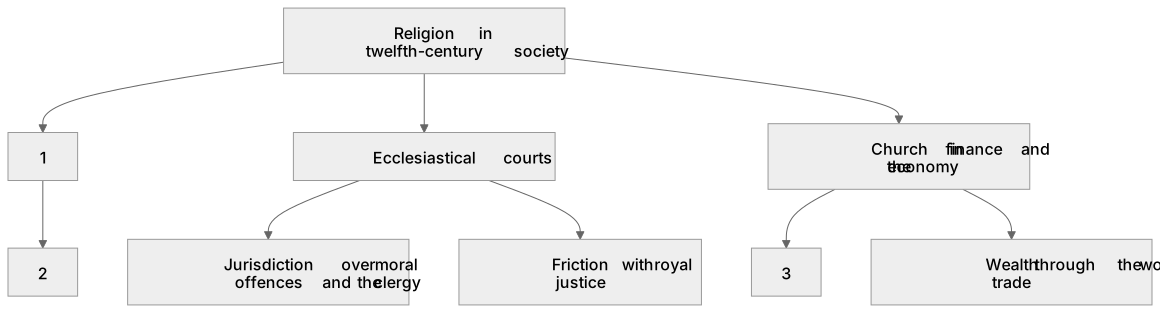
Some boxes have lost their names. Pick the right name for each number.
1Box 1
2Box 2
3Box 3
There is more to this lesson
The full lesson goes on to check your understanding and help you earn the marks. Create a free account to carry on, with your progress saved.
A week of Premium from your first lesson · Then the free plan continues · No card, no charge
Test your understanding of 2A Royal Authority and the Angevin Kings, 1154–1216 – The Restoration of Royal Authority, 1154–1166: The place of religion in society: the political role of the Church; ecclesiastical courts; the importance of the Church in finance and the economy
Active recall beats re-reading. Take an instant quiz now to test what you’ve learned and lock it into long-term memory.
A week of Premium from your first lesson · Then the free plan continues · No card, no charge