AQA · A-Level · History
Course version: 7042 · Version from Sept 2017
The uneasy peace: the influence of Margaret of Anjou; factional rivalries…
Full specification wording
2B The Wars of the Roses, 1450–1499 – The origins of conflict, 1450–1459: The uneasy peace: the influence of Margaret of Anjou; factional rivalries and their impact on English society
Following St Albans, England entered an 'uneasy peace' (1455–1459) characterised by deep factional rivalries and the growing influence of Queen Margaret of Anjou.
Checked against the AQA 7042 specification (opens in a new tab) on .
- Point 4 of 4
- 3 key terms
Study notes
From the checked teaching notes for this specification point.
The idea
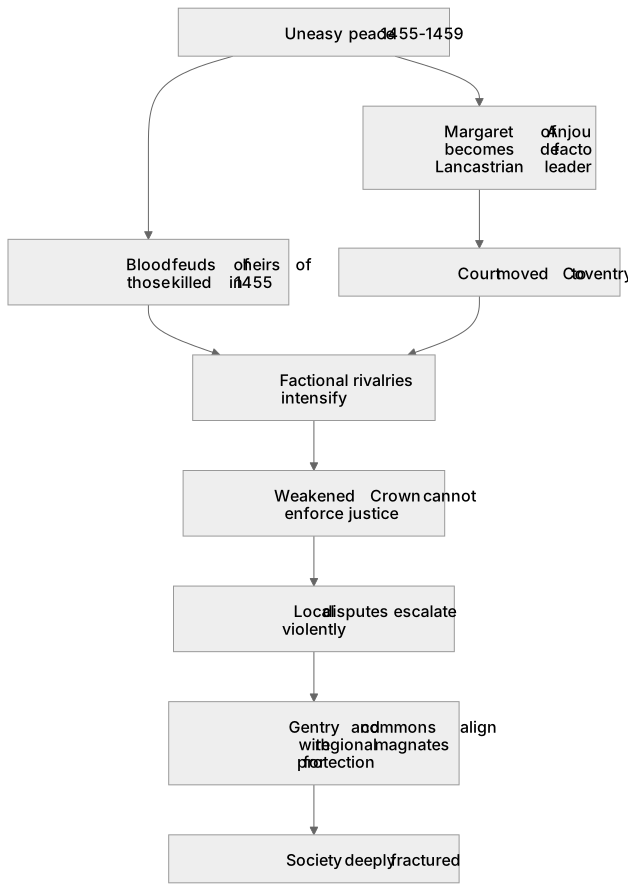
Following St Albans, England entered an 'uneasy peace' (1455–1459) characterised by deep factional rivalries and the growing influence of Queen Margaret of Anjou. Factional rivalries intensified, driven by blood feuds of the heirs of those killed in 1455. The impact on English society was profound; local disputes, like the Courtenay-Bonville feud, escalated violently because the weakened Crown could not enforce justice. This breakdown of law and order forced the gentry and commons to align with regional magnates for protection, deeply fracturing society.
What earns the marks
- Analyse Margaret of Anjou's shift from a traditional queen consort to a partisan political leader defending Prince Edward's rights.
- Evaluate the significance of the court's relocation to Coventry in polarising national politics and alienating London.
- Assess how the blood feuds generated by the First Battle of St Albans fuelled ongoing factional rivalries during the 'uneasy peace'.
- Explain the impact of these rivalries on English society, using examples of local disorder such as the Courtenay-Bonville or Percy-Neville disputes.
Common mistakes and how to put them right
Stating that Margaret of Anjou was the sole cause of the conflict.
Put it right by acknowledging the role of Henry VI's incapacity and pre-existing noble feuds.
Assuming the 'uneasy peace' was completely bloodless.
Put it right by referencing the violent local skirmishes and breakdowns in law and order that affected society.
Claiming society was entirely consumed by national war.
Put it right: Clarify that the impact was often felt through the escalation of localised gentry and noble disputes rather than continuous national battles.
Exam tips
- Use the 'Loveday' of 1458 as a key piece of evidence to demonstrate both the attempt to maintain peace and the underlying reality of entrenched factionalism.
- When discussing Margaret of Anjou, focus on her specific actions, such as controlling royal appointments and building a Midlands affinity, rather than just her reputation.
- Connect national factional rivalries to their societal impact by explaining how the lack of a strong king allowed local magnates to abuse the justice system.
Try the lesson
The start of the 2B The Wars of the Roses, 1450–1499 – The origins of conflict, 1450–1459: The uneasy peace: the influence of Margaret of Anjou; factional rivalries and their impact on English society lesson, made from checked teaching notes for this specification point.
Have a go first
During the 'uneasy peace' following the First Battle of St Albans, how did Margaret of Anjou primarily exert her political influence?
Listen
Following St Albans, England entered an 'uneasy peace' (1455–1459) characterised by deep factional rivalries and the growing influence of Queen Margaret of Anjou. Factional rivalries intensified, driven by blood feuds of the heirs of those killed in 1455. The impact on English society was profound; local disputes, like the Courtenay-Bonville feud, escalated violently because the weakened Crown could not enforce justice. This breakdown of law and order forced the gentry and commons to align with regional magnates for protection, deeply fracturing society. A strong answer earns marks for these points. Analyse Margaret of Anjou's shift from a traditional queen consort to a partisan political leader defending Prince Edward's rights. Evaluate the significance of the court's relocation to Coventry in polarising national politics and alienating London. Assess how the blood feuds generated by the First Battle of St Albans fuelled ongoing factional rivalries during the 'uneasy peace'. Explain the impact of these rivalries on English society, using examples of local disorder such as the Courtenay-Bonville or Percy-Neville disputes. A common slip: Stating that Margaret of Anjou was the sole cause of the conflict. Instead, acknowledging the role of Henry VI's incapacity and pre-existing noble feuds. Exam tip: Use the 'Loveday' of 1458 as a key piece of evidence to demonstrate both the attempt to maintain peace and the underlying reality of entrenched factionalism.
See it
Watch it explained
How useful is the Loveday of 1458 as evidence about the uneasy peace?
Read the described scene instead
After the First Battle of St Albans in 1455, England did not settle into stable peace. Instead, the years to 1459 are often called an uneasy peace. They were marked by deep factional rivalries and the growing influence of Queen Margaret of Anjou. This lesson examines how national politics and local society were pulled apart. Margaret of Anjou moved from a traditional queen consort to a partisan political leader. She defended Prince Edward's rights and became the de facto leader of the Lancastrian cause. The court moved to Coventry, helping her consolidate power in the Midlands and protect her son's inheritance from York. This also polarised national politics and alienated London. The First Battle of St Albans generated blood feuds among the heirs of those killed. These feuds fuelled ongoing factional rivalries during the uneasy peace. Noble affinities and regional disputes became harder to contain. The weakened Crown could not enforce justice consistently, so local conflicts escalated. Local disputes, such as the Courtenay-Bonville feud, escalated violently when the Crown could not enforce justice. Gentry and commons then sought protection from regional magnates. That alignment deepened factionalism and fractured society. The Percy-Neville dispute shows the same pattern of magnate rivalry and local disorder. Consider this question: how useful is the Loveday of 1458 as evidence about the uneasy peace? Pause briefly to think. The Loveday shows an attempt to maintain peace and reconcile factions. But it also reveals entrenched factionalism beneath the ceremony. It is useful because it captures both the hope of peace and the underlying rivalry. Do not claim Margaret of Anjou was the sole cause of conflict. Henry VI's incapacity and pre-existing noble feuds also mattered. Do not assume the uneasy peace was bloodless; violent local skirmishes and breakdowns in law and order continued. And do not say society was entirely consumed by national war, because impact often came through localised gentry and noble disputes. The uneasy peace was shaped by Margaret's partisan leadership, the Coventry court, and blood feuds from St Albans. A weakened Crown allowed local disputes to escalate. As law and order broke down, gentry and commons aligned with regional magnates. National factionalism and local disorder therefore reinforced each other.
Key words
Say what each word means before you turn the card.
Queenship and female power
Try answering aloud or in your head before turning the card.
Law and order
Try answering aloud or in your head before turning the card.
Factionalism and affinity
Try answering aloud or in your head before turning the card.
See every definition
- Queenship and female power
- Margaret of Anjou shifted from a traditional queen consort to a partisan political leader defending Prince Edward's rights.
- Law and order
- The weakened Crown could not enforce justice, so local disputes escalated violently and the gentry and commons aligned with regional magnates for protection.
- Factionalism and affinity
- Deep factional rivalries were driven by blood feuds of the heirs of those killed in 1455, while Margaret built a Midlands affinity and moved the court to Coventry.
Label the diagram
Some boxes have lost their names. Pick the right name for each number.
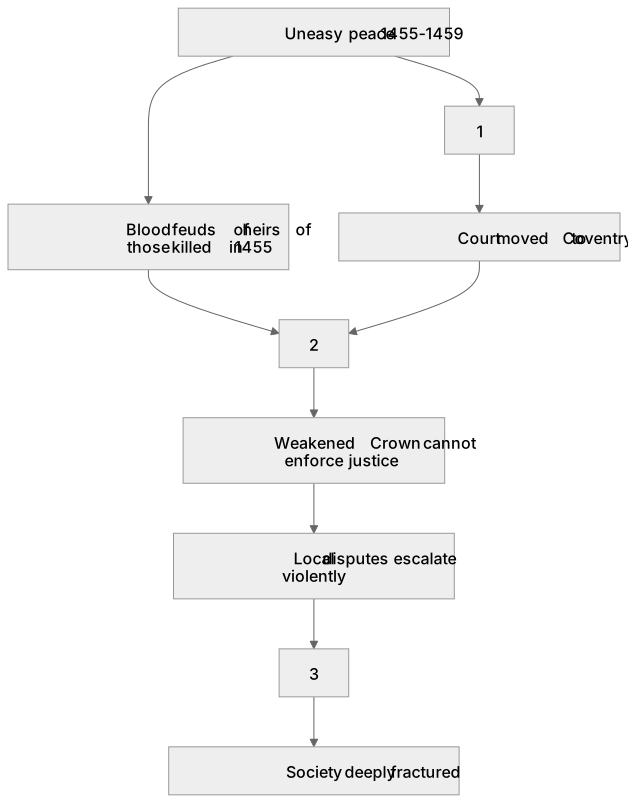
1Box 1
2Box 2
3Box 3
There is more to this lesson
The full lesson goes on to check your understanding and help you earn the marks. Create a free account to carry on, with your progress saved.
A week of Premium from your first lesson · Then the free plan continues · No card, no charge
Test your understanding of 2B The Wars of the Roses, 1450–1499 – The origins of conflict, 1450–1459: The uneasy peace: the influence of Margaret of Anjou; factional rivalries and their impact on English society
Active recall beats re-reading. Take an instant quiz now to test what you’ve learned and lock it into long-term memory.
A week of Premium from your first lesson · Then the free plan continues · No card, no charge