AQA · A-Level · History
Course version: 7042 · Version from Sept 2017
The Holy Roman Empire, its government, condition and social composition:…
Full specification wording
2C The Reformation in Europe, c1500–1564 (A-level only) – The challenge of Luther, 1517–1521: The Holy Roman Empire, its government, condition and social composition: emperor, princes, knights, towns and electors; urban workers and peasants
The Holy Roman Empire in 1500 was a decentralised political entity comprising over 300 semi-autonomous states.
Checked against the AQA 7042 specification (opens in a new tab) on .
- Point 1 of 4
- 4 key terms
Study notes
From the checked teaching notes for this specification point.
The idea
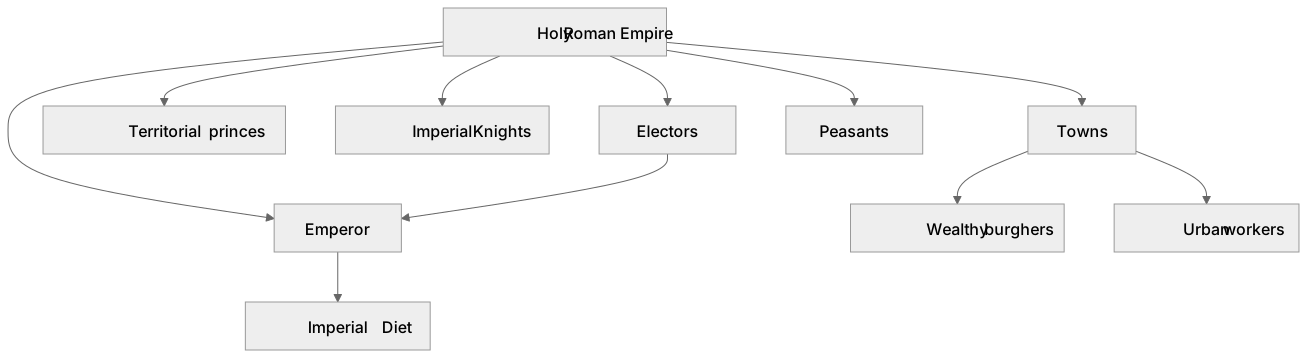
The Holy Roman Empire in 1500 was a decentralised political entity comprising over 300 semi-autonomous states. Its government relied on a delicate balance of power. The Emperor, chosen by seven powerful Electors, held limited central authority and relied on the Imperial Diet. Below the Electors were territorial princes wielding significant local power, and Imperial Knights whose status was declining. The Empire's condition was prosperous but politically fractured. Socially, free imperial towns thrived on trade, creating a wealthy burgher class alongside poorer urban workers. Meanwhile, the vast majority were peasants, whose grievances over feudal dues and economic pressures were mounting, creating a volatile social composition ripe for upheaval.
What earns the marks
- Explain the decentralised nature of the Holy Roman Empire and the limitations on the Emperor's central power.
- Identify the role of the seven Electors in choosing the Emperor and their significant influence over imperial policy.
- Analyse the declining military and economic status of the Imperial Knights compared to the rising power of territorial princes.
- Evaluate the social tensions between wealthy burghers and urban workers in the towns, alongside the growing economic grievances of the peasantry.
Common mistakes and how to put them right
Assuming the Emperor had absolute power over the entire Empire.
Put it right by explaining that power was highly decentralised and shared with princes and Electors.
Confusing the roles of Electors and ordinary princes.
Put it right by noting that only the seven Electors had the constitutional right to choose the Emperor.
Treating the peasantry and urban workers as a single homogenous poor class.
Put it right by distinguishing between rural feudal grievances and urban economic tensions.
Exam tips
- Use the fragmented nature of the Empire to explain why it was difficult for the Emperor to suppress early religious dissent.
- Highlight the specific grievances of the peasants and urban workers to provide context for the later Peasants' War.
- Mention specific Electors, such as Frederick the Wise of Saxony, to demonstrate precise knowledge of the political structure.
Try the lesson
The start of the 2C The Reformation in Europe, c1500–1564 (A-level only) – The challenge of Luther, 1517–1521: The Holy Roman Empire, its government, condition and social composition: emperor, princes, knights, towns and electors; urban workers and peasants lesson, made from checked teaching notes for this specification point.
Have a go first
Which of the following best describes the primary constitutional role of the seven Prince-Electors within the Holy Roman Empire in the early sixteenth century?
Listen
The Holy Roman Empire in 1500 was a decentralised political entity comprising over 300 semi-autonomous states. Its government relied on a delicate balance of power. The Emperor, chosen by seven powerful Electors, held limited central authority and relied on the Imperial Diet. Below the Electors were territorial princes wielding significant local power, and Imperial Knights whose status was declining. The Empire's condition was prosperous but politically fractured. Socially, free imperial towns thrived on trade, creating a wealthy burgher class alongside poorer urban workers. Meanwhile, the vast majority were peasants, whose grievances over feudal dues and economic pressures were mounting, creating a volatile social composition ripe for upheaval. A strong answer earns marks for these points. Explain the decentralised nature of the Holy Roman Empire and the limitations on the Emperor's central power. Identify the role of the seven Electors in choosing the Emperor and their significant influence over imperial policy. Analyse the declining military and economic status of the Imperial Knights compared to the rising power of territorial princes. Evaluate the social tensions between wealthy burghers and urban workers in the towns, alongside the growing economic grievances of the peasantry. A common slip: Assuming the Emperor had absolute power over the entire Empire. Instead, explaining that power was highly decentralised and shared with princes and Electors. Exam tip: Use the fragmented nature of the Empire to explain why it was difficult for the Emperor to suppress early religious dissent.
See it
Key words
Say what each word means before you turn the card.
Political fragmentation and decentralisation
Try answering aloud or in your head before turning the card.
The limits of imperial authority
Try answering aloud or in your head before turning the card.
Social inequality and class tension
Try answering aloud or in your head before turning the card.
Economic change and urbanisation
Try answering aloud or in your head before turning the card.
See every definition
- Political fragmentation and decentralisation
- The Empire was a decentralised political entity of over 300 semi-autonomous states, whose government relied on a delicate balance of power.
- The limits of imperial authority
- The Emperor, chosen by seven powerful Electors, held limited central authority and relied on the Imperial Diet.
- Social inequality and class tension
- A wealthy burgher class in the free imperial towns stood alongside poorer urban workers, while peasants' grievances over feudal dues and economic pressures were mounting.
- Economic change and urbanisation
- Free imperial towns thrived on trade, creating a wealthy burgher class alongside poorer urban workers.
Label the diagram
Some boxes have lost their names. Pick the right name for each number.
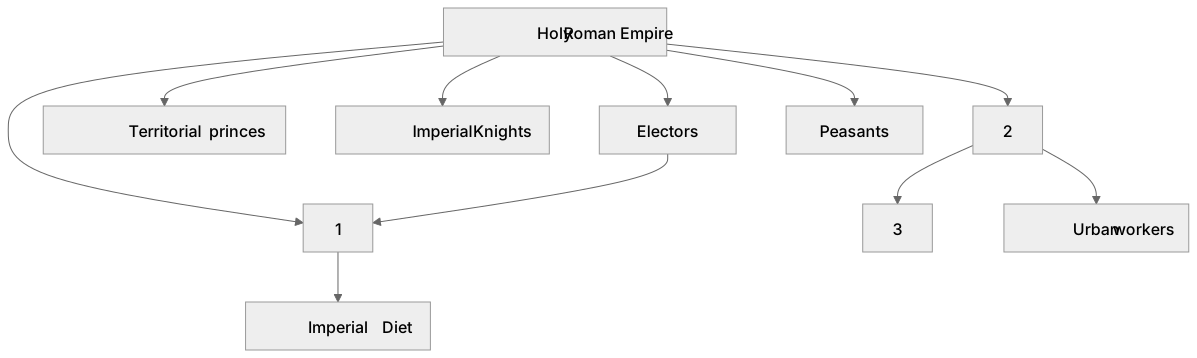
1Box 1
2Box 2
3Box 3
There is more to this lesson
The full lesson goes on to check your understanding and help you earn the marks. Create a free account to carry on, with your progress saved.
A week of Premium from your first lesson · Then the free plan continues · No card, no charge
Test your understanding of 2C The Reformation in Europe, c1500–1564 (A-level only) – The challenge of Luther, 1517–1521: The Holy Roman Empire, its government, condition and social composition: emperor, princes, knights, towns and electors; urban workers and peasants
Active recall beats re-reading. Take an instant quiz now to test what you’ve learned and lock it into long-term memory.
A week of Premium from your first lesson · Then the free plan continues · No card, no charge