AQA · A-Level · History
Course version: 7042 · Version from Sept 2017
The Diet of Regensburg and state of the Church by 1541
Full specification wording
2C The Reformation in Europe, c1500–1564 (A-level only) – The expansion of the Reformation, 1531–1541: The Diet of Regensburg and state of the Church by 1541
The 1541 Diet of Regensburg represents the final major attempt to achieve theological reconciliation between Catholics and Protestants.
Checked against the AQA 7042 specification (opens in a new tab) on .
- Point 4 of 4
- 4 key terms
Study notes
From the checked teaching notes for this specification point.
The idea
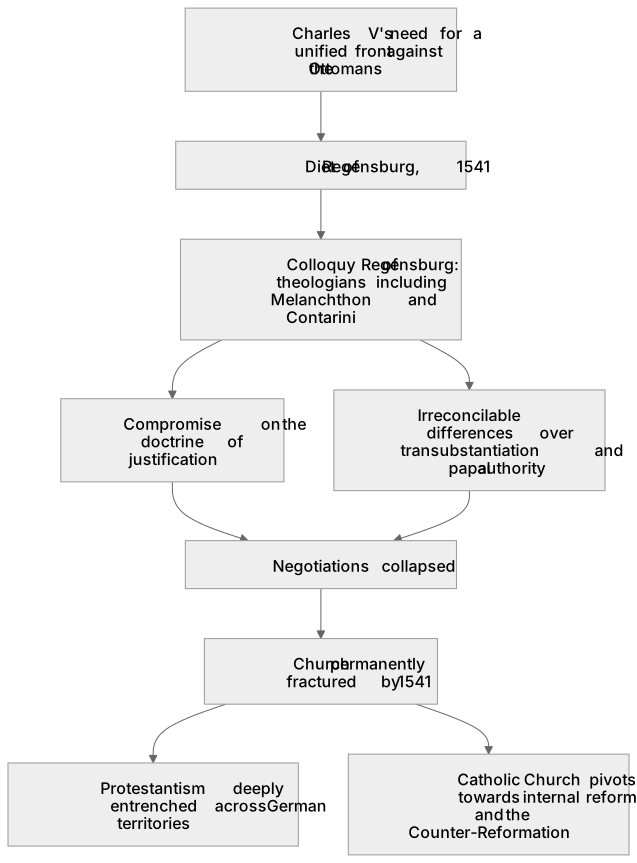
The 1541 Diet of Regensburg represents the final major attempt to achieve theological reconciliation between Catholics and Protestants. Driven by Emperor Charles V's need for a unified front against the Ottomans, theologians including Melanchthon and Contarini engaged in the Colloquy of Regensburg. Although they achieved a compromise on the doctrine of justification, negotiations collapsed over irreconcilable differences regarding transubstantiation and papal authority. This failure starkly illuminated the state of the Church by 1541: it was permanently fractured. Protestantism was now deeply entrenched across German territories, while the Catholic Church was forced to pivot towards internal reform and the Counter-Reformation rather than reunification.
What earns the marks
- Explain Charles V's political motivations for calling the Diet of Regensburg, specifically the Ottoman threat.
- Detail the theological compromises attempted at the Colloquy of Regensburg, particularly the agreement on double justification.
- Identify the reasons for the failure of the Diet, focusing on disagreements over the Eucharist and papal supremacy.
- Assess the state of the Church by 1541, noting the permanent entrenchment of Protestantism and the end of hopes for a unified Western Christendom.
Common mistakes and how to put them right
Stating that no theological agreements were reached at Regensburg.
Put it right: Highlight that a significant, albeit temporary, compromise was reached on the doctrine of justification before talks broke down.
Blaming only the Protestants for the failure of the Diet.
Put it right: Acknowledge that both Luther and the Pope ultimately rejected the compromises proposed by their respective negotiators.
Assuming the Catholic Church was completely passive by 1541.
Put it right: Recognise that by 1541, the Catholic Church was actively beginning its own internal reforms, spurred partly by the failure of reconciliation.
Exam tips
- Use the Diet of Regensburg as a turning point in essays to demonstrate when the religious division in Europe became irreversible.
- Contrast the conciliatory approach of figures like Contarini with the more hardline stances of Luther and the Papacy to show the complexity of the negotiations.
- Link the state of the Church in 1541 directly to the political survival of the Schmalkaldic League, showing how theology and politics intertwined.
Try the lesson
The start of the 2C The Reformation in Europe, c1500–1564 (A-level only) – The expansion of the Reformation, 1531–1541: The Diet of Regensburg and state of the Church by 1541 lesson, made from checked teaching notes for this specification point.
Have a go first
What was the primary objective of the colloquy at the Diet of Regensburg in 1541?
Listen
The 1541 Diet of Regensburg represents the final major attempt to achieve theological reconciliation between Catholics and Protestants. Driven by Emperor Charles V's need for a unified front against the Ottomans, theologians including Melanchthon and Contarini engaged in the Colloquy of Regensburg. Although they achieved a compromise on the doctrine of justification, negotiations collapsed over irreconcilable differences regarding transubstantiation and papal authority. This failure starkly illuminated the state of the Church by 1541: it was permanently fractured. Protestantism was now deeply entrenched across German territories, while the Catholic Church was forced to pivot towards internal reform and the Counter-Reformation rather than reunification. A strong answer earns marks for these points. Explain Charles V's political motivations for calling the Diet of Regensburg, specifically the Ottoman threat. Detail the theological compromises attempted at the Colloquy of Regensburg, particularly the agreement on double justification. Identify the reasons for the failure of the Diet, focusing on disagreements over the Eucharist and papal supremacy. Assess the state of the Church by 1541, noting the permanent entrenchment of Protestantism and the end of hopes for a unified Western Christendom. A common slip: Stating that no theological agreements were reached at Regensburg. Instead, Highlight that a significant, albeit temporary, compromise was reached on the doctrine of justification before talks broke down. Exam tip: Use the Diet of Regensburg as a turning point in essays to demonstrate when the religious division in Europe became irreversible.
See it
Key words
Say what each word means before you turn the card.
Theological compromise
Try answering aloud or in your head before turning the card.
Imperial politics
Try answering aloud or in your head before turning the card.
Irreversible schism
Try answering aloud or in your head before turning the card.
Catholic reform
Try answering aloud or in your head before turning the card.
See every definition
- Theological compromise
- An agreement on the doctrine of justification was reached at the Colloquy of Regensburg, although negotiations later collapsed over transubstantiation and papal authority.
- Imperial politics
- Emperor Charles V's need for a unified front against the Ottomans drove the final major attempt at theological reconciliation between Catholics and Protestants.
- Irreversible schism
- By 1541 the Church was permanently fractured, with Protestantism deeply entrenched across German territories and hopes for a unified Western Christendom ended.
- Catholic reform
- Rather than reunification, the Catholic Church was forced to pivot towards internal reform and the Counter-Reformation.
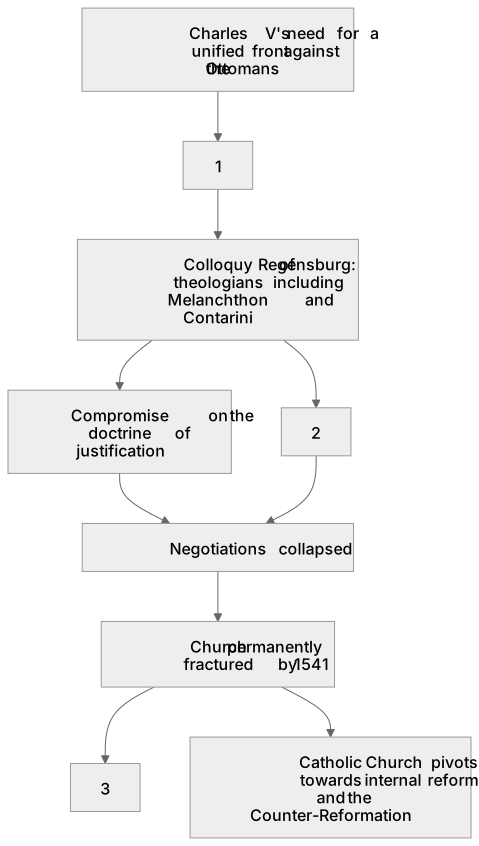
Label the diagram
Some boxes have lost their names. Pick the right name for each number.
1Box 1
2Box 2
3Box 3
There is more to this lesson
The full lesson goes on to check your understanding and help you earn the marks. Create a free account to carry on, with your progress saved.
A week of Premium from your first lesson · Then the free plan continues · No card, no charge
Test your understanding of 2C The Reformation in Europe, c1500–1564 (A-level only) – The expansion of the Reformation, 1531–1541: The Diet of Regensburg and state of the Church by 1541
Active recall beats re-reading. Take an instant quiz now to test what you’ve learned and lock it into long-term memory.
A week of Premium from your first lesson · Then the free plan continues · No card, no charge